
The Barcelona Sagrada Família towers highest among all Christian temples
 |
The newly placed cross at the top of the central tower is made of glass and glazed white ceramics. It was produced in Germany and assembled directly in the temple. Built-in lighting allows it to shine after dark – from the highest point of the basilica, it becomes a glowing landmark visible throughout Barcelona. The cross is not a compact mass. It has a delicate, almost crystal-like geometry with glass facets that capture sunlight during the day and disperse it across the light stone of the tower.
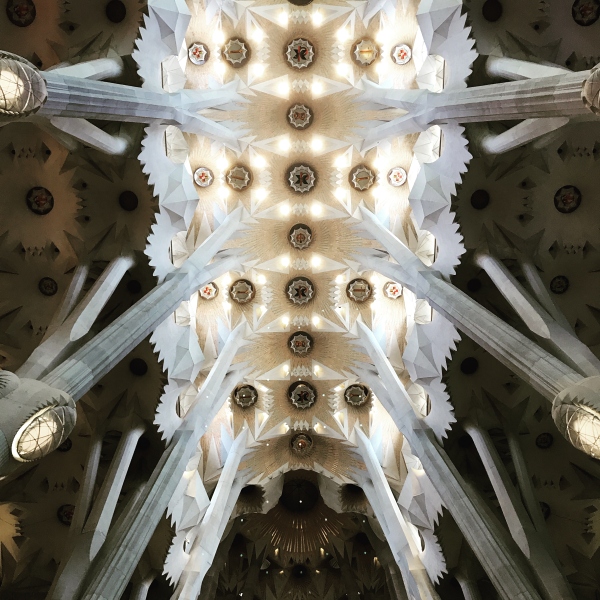
The Barcelona temple is unique also in its connection between stunning architecture, nature, and music. Gaudí designed extensive choirs to accommodate more than 1500 singers. Singing was a key component of the mass for him. Thanks to the arches and the placement of the choirs 15 to 20 meters above the ground, the ceiling acts as a giant resonator, harmoniously carrying the voices of the singers throughout the basilica. Inspired by nature, Gaudí adorned the temple with 160 statues of various species of plants and animals – he believed that nature is a perfect work of God.
Of the three monumental facades of the Sagrada Família, the Nativity Facade, oriented east, was largely completed during Gaudí's lifetime. Hundreds of details from Catalan nature, including plants, animals, and insects, have been carved into the stone. The entrance to the temple is guarded by two chameleons, and the columns stand on the sculptures of sea and land turtles. The western facade, the Passion Facade, began construction only after Gaudí's death. It is supported by six inclined columns resembling the trunks of sequoias. The third, the Glory Facade, is the largest and most significant entrance facade of the temple and remains unfinished for now.
The long completion of Gaudí's work is accompanied by constant negotiations between the original vision and modern materials. The result is an architecture that expresses faith in the language of the 21st century: "The fundamental reason why the Sagrada Família was not completed during Gaudí's lifetime was a lack of funds," explains historian Michael Eaude, author of a recent book on Gaudí's life and work.
However, the idea of the famous temple did not originate directly in Gaudí's mind. Its cornerstone was laid on March 19, 1882. Construction began according to the design of architect Francisco de Paula del Villar, but at the end of 1883, the work was taken over by Gaudí, who transformed it in his exuberant style. After his death in 1926, work continued according to his designs. During the Civil War (1936-1939), part of the construction was burned, destroying Gaudí's plans and models, which were later restored by architect Francesc de Paula Quintana, a former collaborator of Gaudí.
Gaudí regarded the construction of the temple as "a mission entrusted to him by God, and with this awareness, he transformed the original neo-Gothic project into something else and original", wrote Vatican News at the time of the consecration of the building. The five-nave basilica with three aisles and twelve bell towers was to reflect the hierarchy of the Christian universe. The central tower of Jesus Christ deliberately does not exceed the height of the Barcelona hill Montjuïc: Gaudí wanted to express that human work will never surpass God's creation.
In the following decades, work on the temple alternately stopped and resumed – led by a diverse group of artists and architects who attempted to harmonize Gaudí's unique style with elements of contemporary aesthetics. The temple was consecrated on November 7, 2010, by Pope Benedict XVI, who also granted it the title basilica minor, even though it was only one-fifth finished at that time. The Pope praised Gaudí's genius, who "inspired by the fervor of his Christian faith, managed to transform this church into a stone praise of God."
The main tower and central structural element were completed this year, but the complete finishing of the basilica, including the Glory Facade, may extend into the mid-2030s. When historian Eaude was asked about the effort to declare the basilica complete, he recalled one of Gaudí's most famous quotes: "My client," the architect once stated, referring to God himself, "is not in a hurry."
While the initial stages of construction were stalled due to a lack of funds, today's construction activity is fueled by abundant finances. Ticket sales annually bring in hundreds of millions of euros; before the COVID-19 pandemic, the number of visitors exceeded 4.5 million annually, and in 2024, the basilica was visited by 4.8 million people.
Catalan architect, urban planner, and visionary Antoni Gaudí y Cornet (1852-1926) was a representative of a unique style and a pioneer of Art Nouveau in Spain. He dedicated the last 16 years of his life exclusively to the construction of the Barcelona cathedral. During that time, he also stopped caring about his appearance, so when he was hit by a tram in early June 1926, he was initially mistaken for a beggar.
Other works by Gaudí include fairy-tale houses, such as Barcelona's Casa Milá (nicknamed La Pedrera), which resembles sand dunes in its façade and colors, or the colorful Casa Batlló, as well as Park Güell in Barcelona, an unfinished grand project of a garden city. Seven of Gaudí's buildings are on the UNESCO list, including the Nativity Facade and the crypt where Gaudí is buried.
The English translation is powered by AI tool. Switch to Czech to view the original text source.
0 comments
add comment
Related articles
0
11.06.2026 | The Pope blessed the new tower of the Sagrada Familia temple in Barcelona
0
20.02.2026 | <Sagrada Familia> has reached its highest point, the tower rises to a height of 172.5 meters.</Sagrada Familia>
0
10.02.2026 | The neighbors of the Barcelona temple Sagrada Familia are fighting against its completion
0
31.10.2025 | The Barcelona Sagrada Família has the tallest church tower in the world
0
14.02.2025 | The construction of the Sagrada Família temple will enter its final phase this year, builders said
0
09.12.2021 | In Barcelona, the tallest tower of the Sagrada Família basilica was ceremoniously unveiled
0
18.09.2020 | The construction of the Sagrada Família basilica was slowed down by the coronavirus
0
19.10.2018 | Sagrada Familia will receive a building permit after more than 130 years
0
09.06.2016 | 90 years ago, the famous Spanish architect Antonio Gaudí passed away
0
23.09.2011 | Gaudí's Sagrada Familia will be completed by 2028 at the latest
0
19.04.2011 | The Sagrada Familia Cathedral in Barcelona was evacuated due to a fire
0
06.11.2010 | La Sagrada Familia will be consecrated on Sunday by the Pope himself