
The Bauer Villa in Brno, according to Loos's design, will have a new roof for 12 million
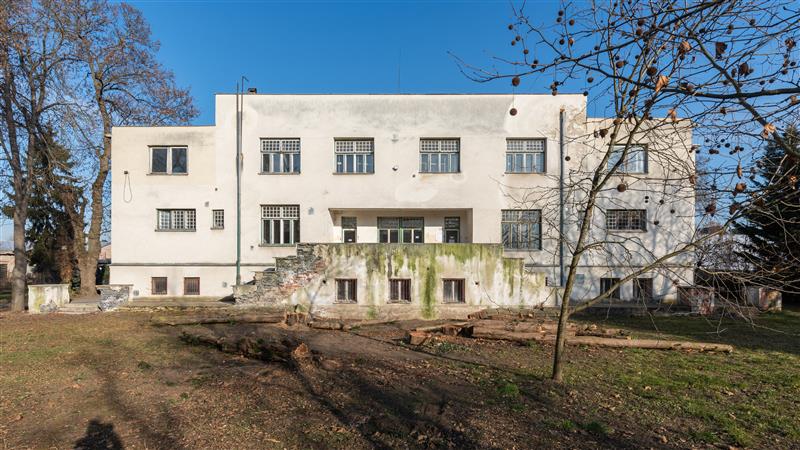 |
Hrušovany u Brna – The villa of industrialist Viktor Bauer in Hrušovany near Brno, built according to the design of architect Adolf Loos, will receive a new roof for 12 million crowns. Dušan Knoflíček, the deputy mayor of Hrušovany (Young Change with the support of STAN), told ČTK. The villa has been owned by the city since 2020, and it plans a complete restoration for approximately 100 million crowns. An archaeological survey in the garden has already finished, mapping the original network of paths. The Archaia Brno company, which conducted the survey, reported this on its website.
Work on the villa's roof will begin in the second week of June. This is the first major construction step toward the villa's restoration. "We are also negotiating about the pilot restoration of two selected original windows. Unfortunately, many of them are in a deplorable state, and only a few have survived. We need to find a way to restore them in collaboration with a restorer," Knoflíček stated.
The city has a ten-year plan for the villa's restoration, which could ultimately cost up to 100 million crowns. It seeks to obtain grants for the repairs either from a cross-border cooperation program or from Norwegian funds. The villa is already registered in the architectural heritage rescue program.
In recent weeks, the archaeological survey in the garden has concluded. Its goal was to determine the extent and appearance of the network of paths, as well as the potential existence of already vanished buildings or technological elements in the garden. The survey was preceded by a geophysical survey, which uses non-destructive methods to map the composition of the geological subsoil. Archaia Brno collaborated on this with Masaryk University.
The geophysical survey helped to partially map the distribution of paths. Based on this, archaeologists proceeded with their probes below the surface. They found that the paths formed regular shapes centered on the central axis in front of the villa's western façade. In the northern part of the garden, they discovered an irregular network of paths with varying widths.
"The walkable surface was likely covered with fine ochre to yellow sand, which has been blended with the surrounding terrain. Among the original elements, we found a remnant of a brick shaft with an outlet, likely for a garden fountain or a semicircular base for a gazebo or bench," described the findings Ondřej Navrátil from Archaia Brno.
In addition to expected finds from the 20th century, such as fragments of garden pottery, metal technological elements, or bathroom tiles, experts also discovered a significant amount of prehistoric pottery, specifically from the Bronze to Iron Age, as well as ceramics from the late middle ages to the early Renaissance. This material likely comes from fill that occurred in the second half of the last century when the garden underwent terrain modifications.
The villa was intended to serve as the apartment for the director of the neighboring sugar factory and the headquarters of the company. Viktor Bauer commissioned architect Adolf Loos, and the villa was completed in 1914. After 1948, the communists nationalized the family property. The national enterprise Svit operated in the sugar factory, and the villa partially served as medical offices and apartments. Since the 1990s, the villa, like the surrounding land, has been deteriorating; since 2020, it has been owned by the city. The villa is the oldest flat-roof building in the territory of the Czech Republic.
The English translation is powered by AI tool. Switch to Czech to view the original text source.
0 comments
add comment