
The industrial area after ČKD in Vysočany is gradually being replaced by thousands of apartments
 |
The first workshop in Vysočany, which was a wooden building for 25 employees, was gradually replaced by a huge complex manufacturing electric motors, water turbines, locomotives, and equipment for power plants. After 1989, the complex gradually lost its purpose, and a few years ago, its transformation into a residential quarter began.
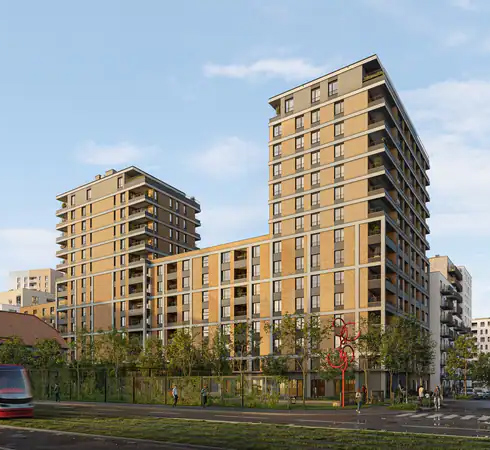
The most advanced projects are by the companies AFI, Vivus, and Skanska Residential. The latter is building the Emil Kolben quarter on the southern side of Kolbenova Street. "By 2026, a significant part of the quarter will already be completed and inhabited. Further stages of the project are at various stages of construction and preparation, with the currently sold stage expected to be completed by the end of 2029," said Iva Stejskalová from Skanska Residential. The developer names individual buildings after members of the Kolben family, such as his brothers Alfred and Jindřich, as well as his children Hanuš and Lilly.
Near the UN Square, the project called Kolbenova Park is being built by CPI Property Group. "In several stages, a harmoniously organized complex of six apartment buildings is being created, set in its own green park without vehicle traffic, which is the dominant element of the entire project," described Jakub Velen, spokesperson for CPI Property Group. The company will build about 1000 apartments, with the first stage of 245 apartments completed in 2024. The second stage with 272 apartments is currently under construction and is expected to be finished in the second quarter of next year. The completion of the third stage is planned for the end of 2028.
According to the Institute of Planning and Development of the Capital City of Prague website, a project called Lofty Kolbenova with 215 apartments ranging from 1+kk to 6+kk is being developed on the northern side of Kolbenova Street by the company MP Kolbenka, and the Kolben Gate project, a joint venture of Kolben Gate and Cronesta, is under construction. Three apartment buildings will contain 290 apartments.
The Prague 9 City Hall is preparing for several thousand new residents. "In connection with the construction, we have built the Elektra I primary school, which has become the first new school in the numbered city districts (Prague 1 – 22, note of the editor) in 30 years. We are expecting to obtain a building permit for the Elektra II primary school soon," stated the mayor of Prague 9, Tomáš Portlík (ODS). He added that the city hall is preparing an expansion of the Zahrádky park between Kolbenova and Poděbradská streets and has also created a relaxation zone along the Rokytka river.
Kolben was born on November 1, 1862, in Strančice near Prague to a poorer Jewish family. He had nine siblings and had to take care of himself from the age of 15. He began studying at a higher real school in Prague and continued studying mechanical engineering and electrical engineering at the Czech Technical University in Prague. In 1887, he went abroad, where he collaborated with Thomas Edison and later with Nikola Tesla.
He returned to Prague in 1896 and founded the company Kolben & Co. The wooden workshop was gradually replaced by a modern steel hall. In the 1920s, mergers followed – first in 1921, Kolben’s factory merged with the Czech-Moravian Engineering and, six years later, this company created the joint-stock company Czech-Moravian-Kolben-Daňek (ČKD) with the engineering firm Breitfeld-Daněk.
The Jewish origin was fatal for the famous industrialist. In June 1943, he was deported to the Theresienstadt ghetto, where he died a few weeks later at the age of 81. After nationalization, many companies from across the republic were incorporated into ČKD, which operated in more than 40 manufacturing sectors. After 1989, the company lost its largest market. The company was unsuccessfully privatized, and the holding broke down into several companies.
The English translation is powered by AI tool. Switch to Czech to view the original text source.
0 comments
add comment