
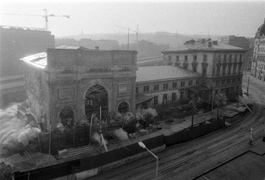
25 years ago, the station at Prague's Těšnov was demolished
 |
The Těšnov station (Northwest, Denisovo) was built on the border of New Town and Karlín from 1872 to 1875. Its creation was the work of the Austrian Northwest Railway (ÖNWB), a company that began constructing a new long-distance connection between Vienna and Berlin in the early 1870s. The last day the station still belonged to trains and passengers was July 1, 1972. After that, the building was closed and its gradual decline followed.
The demolition of Těšnov station sparked a storm of indignation 25 years ago
The demolition of the railway station at Těšnov in Prague became a kind of memento and symbol of the insensitive approach of the authorities towards monuments. The neo-Renaissance building, which was one of the most beautiful stations in Central Europe, definitively disappeared in clouds of dust 25 years ago, on March 16, 1985. Alongside 400 kilograms of explosives, a political decision was also involved, despite protests from both experts and the lay public. The site where Těšnov station once stood is now crossed by a north-south highway. In the memories of many Praguers, the building, which was constructed on the border of New Town and Karlín from 1872 to 1875, is well known by the affectionate name "Deniska". The birth of the station was the work of the Austrian Northwest Railway (ÖNWB) - a company that began building a new long-distance connection between Vienna and Berlin in the early 1870s. However, the new route bypassed Prague by about 30 kilometers to the north. To somewhat alleviate the domestic discontent over the neglect of the capital, ÖNWB decided to build a branch line into the city.
When the station was ceremoniously put into operation on October 15, 1875, it was clear that the railway company had spared no expense on its final appearance. ÖNWB commissioned the project from its court architect, Karel Schlimp, a native of Velenice near Žatec. Schlimp was not just anyone in the world of architecture - at the time of the construction of the Prague station, he was a professor at the Vienna University of Technology. He embodied his ideas in a truly generous manner, designing a complex of buildings that were far from the often mundane railway architecture.
Schlimp gave the building a neo-Renaissance character. He left the side wings without external decorations, but made the central building more magnificent: a monumentally imposing Roman triumphal arch with Corinthian columns, crowned with an allegorical group of statues representing Austria - the protector of agriculture and industry. The spacious departure hall was adorned with the emblems of the cities through which the railway passed. The wing extensions served operational needs of the railway, and Schlimp also included representative spaces, salons, waiting rooms, and a restaurant in them.
For more than 40 years, the station carried its original name Northwest, after the company that built it. After 1919, it took the name after the then-still-living Ernest Denis, a French historian and Slavophile. However, his name was unacceptable to the Nazis, who in 1940 assigned a new name: Moldau Bahnhof or Vltavské nádraží. The post-war period briefly returned to Denis, but the 1950s were not kind to such traditions, and the station was named Těšnov. However, it did not bear the name for long, as the urban planners of the 1960s began to find it an obstacle.
The last day the station still belonged to trains and passengers was July 1, 1972. After that, the building was closed and its decline followed. The northern wing was demolished, and a purpose for the remains of Schlimp's neo-Renaissance was long sought. A deposit building for the Museum of the Capital City was planned. It was also considered that the building, which was listed in the State Register of Heritage Buildings in 1978, should become a university cafeteria or a shopping center. However, none of the options were realized. The idea of running a highway through the city was stronger.
The fate of Těšnov was sealed when on March 15, 1985, a brief report appeared in the newspapers stating that "on Saturday, March 16, at eight o'clock, the building of the former Těšnov station in Prague will be demolished by explosives. For the safety of operations, a closure has been authorized in Prague 1 and Prague 8. Transport will be suspended for about 10 to 20 minutes...". Such was the official obituary of building number 562 in Prague 8 - Karlín.
The English translation is powered by AI tool. Switch to Czech to view the original text source.
27 comments
add comment
Subject
Author
Date
Placek Normalizace
takyarchitekt
15.03.10 11:09
jeste dodatek
takyarchitekt
15.03.10 11:28
..plácek Normalizace
Kaker
17.03.10 01:05
veze antinormalizace
Jan Sommer
17.03.10 07:58
jaká tragédie nastala, když domu přistavěli věže
Petr
17.03.10 09:57
show all comments