
The book commemorates the extinct Prague train stations
 |
The publishing house has focused on industrial buildings and city elements in individual Prague districts, which have long been overlooked by experts and informed members of the public. Their rapid disappearance in the last decade has generated a social need to engage with their value, documentation, and conversion possibilities. This edition should contribute to fulfilling this need, states the publisher.
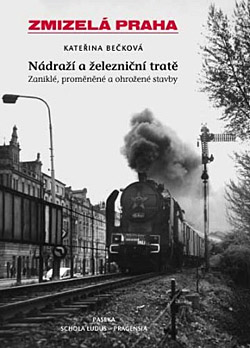
The title by Kateřina Bečková Stations and Railway Lines begins a new thematic series of the edition, whose further volumes will take readers into the world of vanished industrial sites, markets, baths, and other places. The first volume addresses the generally popular theme of railways. Indeed, this sector in Prague is currently undergoing such a dynamic transformation that during the preparation of the book, it was necessary to reclassify some buildings or elements from the category of existing to the category of vanished.
Although modern monuments have their place alongside century-old ones, including examples of industrial architecture, Prague's railway stations are among the buildings that have bad luck. The demolition of the Těšnov station in the 1980s stands as a deterrent example of monument care, often blamed on the period of oppression when even monument preservation served the ruling ideology. Even today, several Prague stations are on the brink of destruction, and their condition can also be attributed to state monument care in combination with the city's attitude.
A prime example of long-term deterioration of a building with historical value is the Vyšehrad station, which was sold by the railways, just like part of the freight station in Žižkov. Monument protection does not help these buildings - for instance, in the case of the structures in the Bubny station area, the Ministry of Culture revoked the already granted monument protection after four years, likely under pressure from developers.
Czech developers, unlike some foreign ones, have yet to find the charm and potential for creating interesting commercial and residential properties in old industrial buildings. However, the current economic crisis does not favor developers, and thus paradoxically, the situation in the real estate market could help old buildings, as to some extent it "succeeded" during the decades of socialist management when reconstruction was minimal. Unless monuments meet the fate of the aforementioned Těšnov or other structures that fell victim to megalomaniacal new constructions.
The unique project of the Paseka publishing house began in 2002 when reprints of five volumes of the Lost Prague series, originating from the late 1940s, were published. With the help of period photographs, historians recalled significant monuments that were lost during demolitions. Bečková continued this work with three volumes of Supplement, which focused on interventions after 1945. The author manages a collection of old photographs at the Museum of the Capital City of Prague and has been the chairwoman of the Club for Old Prague since 2000. She is the author of several publications about old Prague.
The English translation is powered by AI tool. Switch to Czech to view the original text source.

0 comments
add comment