
Gardens in Winter
Publisher
Jan Kratochvíl
25.01.2010 13:00
Jan Kratochvíl
25.01.2010 13:00
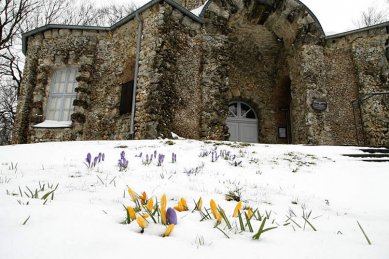
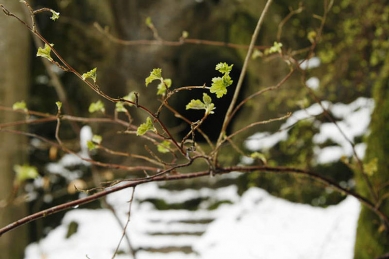
Gardens in winter have a limited palette of colors. In the modest graphic color scheme, without foliage and floral ornaments, the basic structure and geometry of the garden are clearly visible. Against the background of this skeleton, the colors and shapes of the first heralds of spring stand out – early bulbs, frost-resistant shoots, and early-flowering shrubs.
One of the main characteristics of a garden is transience and changeability. The passage of the seasons measures the duration of aesthetic enjoyment derived from plants. Some withdraw into their roots for winter, completely disappearing above ground, while others leave only "bones" and basic silhouettes. Persephone, the daughter of the goddess of fertility Demeter, departs to the realm of the dead in autumn, and her grieving mother ceases to grant nature the power of reproduction until spring, when her child returns from the underworld to the earth.
Apart from the fact that during this period of vegetative dormancy the gardens lack their basic component, a winter visit to the gardens is limited by short days, light conditions, and low temperatures. Vegetation sleeps, the senses are not distracted by colors, fragrances, or the sounds of fountains and flowing water; nature compresses its diversity into roots and dry seeds, blooming, flowering, and harvesting remain only memories of the past or visions of the future. On the other hand, however, in this starkness, the creator's intent for the garden may stand out more prominently, naturally receding into the background during times of vegetative abundance: there are emphasized lines, dominant features, vistas, and shapes of permanent elements.
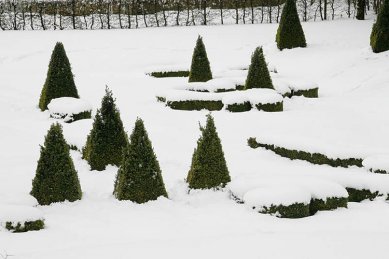
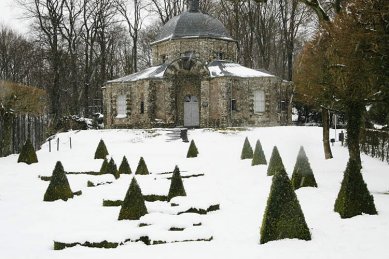
While the other seasons favor colors, shades, and values, winter is a period of contrast. Deep shadows create chiaroscuro and, especially in baroque gardens with sculptural decor, contribute to the overall dramatic atmosphere. The play of light and shadow also aligns with the spirit of romantic constructions in landscape parks. The confectioner's snowy dusting is the only distinctive embellishment throughout the year on the evergreen and unchanging boxwood embroideries of formal gardens.
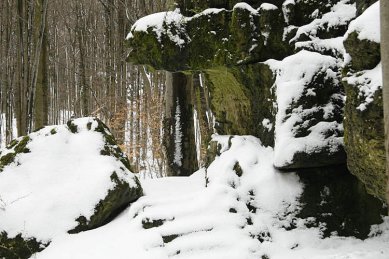
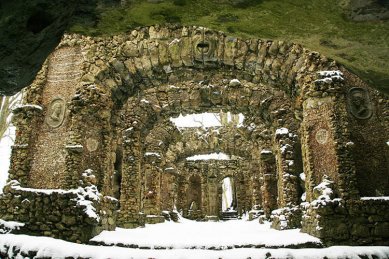
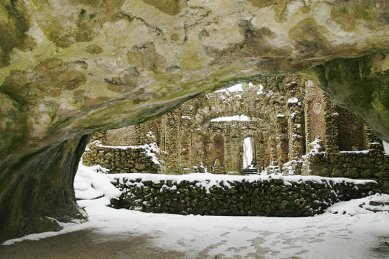
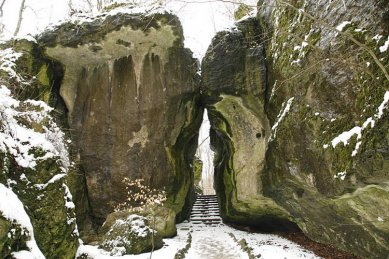
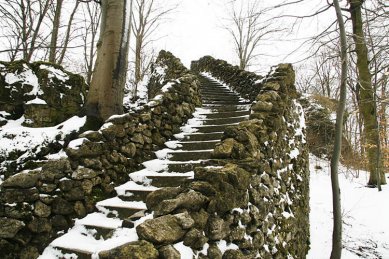
A winter visit to parks and gardens with a minimalist range of plants and striking symbolic elements, such as Sanspareil near the castle of Zwernitz not far from Bayreuth in Bavaria, is particularly impressive. The name of the place is said to have been inspired by an admiring exclamation from one of the court ladies: "Ah, c'est sans pareil!" (It is unparalleled!) This truly unique garden-landscape formation is primarily a work of nature. In the 1740s, the Margravine Wilhelmina of Bayreuth (Wilhelmine von Bayreuth), sister of Frederick II the Great, elevated it with her idea of a natural garden. The landscape, with its natural caves, gorges, rock overhangs, and massive boulders, was transformed into scenes from the then-popular book "The Adventures of Telemachus," written by Francois de Salignac de la Mothe-Fénelon, with minimal human intervention.
The hero of the book is Odysseus's son Telemachus, who sets out to search for his father and wrecks on the same island of Ogygia with the nymph Calypso, who falls in love with him just as she did with his father. Throughout the tale, Telemachus is accompanied by the figure of Mentor – in reality, the goddess Pallas Athena in disguise. Calypso desperately tries to keep Telemachus on the island until he finally has no choice but to jump off a cliff with Mentor and swim to a ship anchored offshore. Various garden elements illustrate this story. According to some sources, Wilhelmina was also inspired by other contemporary authors and directly by Homer's "Odyssey." Thus, the visitor, on his journey, alternates between gorges, descends into the caves of Calypso, the Sibyl, or Vulcan, and ascends to Aeolus's temple, until he reaches the stone amphitheater with massive stone arches, where the archetypal and universally valid story of descents and ascents is symbolically replayed in one location. Significantly, this place is nature itself, which repeatedly narrates the story of Demeter and Persephone.
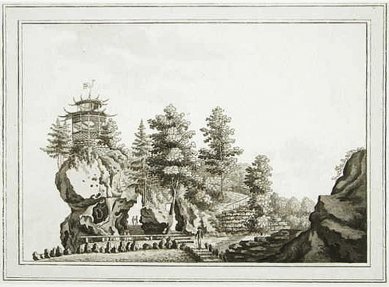
Today, it is difficult to definitively say whether Wilhelmina was inspired by Braun's forest Bethlehem at Kuks, which was created twenty years earlier, or the sculptural Mannerist garden in Bomarzo near Viterbo, or perhaps the contemporary English trends reflecting philosophical and artistic changes in garden and landscape designs. Unlike all these models, Sanspareil features a high degree of abstraction, partly intentional because minimal human intervention was made in the rock formations during the garden's creation (as Wilhelmina wrote to her brother Frederick: "Nature herself was the architect."), and partly due to the passage of time – the original illusionistic paintings on the rocks have not survived, some contemporary structures have collapsed over time, such as hermitages or the temple of the god of winds Aeolus, built on a crag in chinoiserie style according to contemporary tastes. (From depictions, this pagoda-like structure on the windy hill appears quite fragile, and it is no wonder it did not last long). The original intention of contrast to the regular Rococo garden with a flower parterre, which is located in front of the oriental pavilion, remains fulfilled; however, without contemporary embellishments or literary and mythological guidance, Sanspareil could, at first glance, merely appear as a grove with many rocks and boulders or some kind of giant rock formation.
The Margravine Wilhelmina, however, is said to have created Sanspareil with a clear intention during a time of personal and family difficulties, to serve as a didactic tool for her future son-in-law, Duke Karl Eugen of Württemberg, who grew up without good family role models, and Wilhelmina could be for him, as for Telemachus, the disguised guiding Athena (Minerva), to become a good husband to her daughter and a wise ruler. The garden was also intended to be an allegorical reminder of Wilhelmina-Penelope to her unfaithful husband, who was infatuated with his Calypso, a role played by Wilhelmina's court lady Dorothea von der Marwitz, later prompted by Wilhelmina to marry the Austrian Count Burghaus.
The story of Telemachus and Odysseus as an individuating journey, as well as the passing down of life tasks and psychological constellations from generation to generation, is universally valid. Reading gardens as books has the advantage that everyone can not only find their own story in them but also walk through and live it.
gardenpanorama.cz is a place for everyone who perceives the garden as a changing space where nature meets human activity and culture, where botany intertwines with architecture, history, mythology, philosophy, art, and entertainment
gardenpanorama.cz is a guide to the traces left by both significant and less significant personalities in gardens, and to the traces that gardens have left in their lives and works
gardenpanorama.cz is a place for everyone who considers Czech gardens to be part of European and world cultural heritage
gardenpanorama.cz is a guide for all who enjoy traveling not only to well-known monuments but also to less visited places
gardenpanorama.cz is a guide for wanderings through gardens that have inspired artistic works
gardenpanorama.cz is a small project by several people who love gardens
gardenpanorama.cz is a garden on the web, a place for rest and inspiration
gardenpanorama.cz is a place for garden lovers
Apart from the fact that during this period of vegetative dormancy the gardens lack their basic component, a winter visit to the gardens is limited by short days, light conditions, and low temperatures. Vegetation sleeps, the senses are not distracted by colors, fragrances, or the sounds of fountains and flowing water; nature compresses its diversity into roots and dry seeds, blooming, flowering, and harvesting remain only memories of the past or visions of the future. On the other hand, however, in this starkness, the creator's intent for the garden may stand out more prominently, naturally receding into the background during times of vegetative abundance: there are emphasized lines, dominant features, vistas, and shapes of permanent elements.
While the other seasons favor colors, shades, and values, winter is a period of contrast. Deep shadows create chiaroscuro and, especially in baroque gardens with sculptural decor, contribute to the overall dramatic atmosphere. The play of light and shadow also aligns with the spirit of romantic constructions in landscape parks. The confectioner's snowy dusting is the only distinctive embellishment throughout the year on the evergreen and unchanging boxwood embroideries of formal gardens.
A winter visit to parks and gardens with a minimalist range of plants and striking symbolic elements, such as Sanspareil near the castle of Zwernitz not far from Bayreuth in Bavaria, is particularly impressive. The name of the place is said to have been inspired by an admiring exclamation from one of the court ladies: "Ah, c'est sans pareil!" (It is unparalleled!) This truly unique garden-landscape formation is primarily a work of nature. In the 1740s, the Margravine Wilhelmina of Bayreuth (Wilhelmine von Bayreuth), sister of Frederick II the Great, elevated it with her idea of a natural garden. The landscape, with its natural caves, gorges, rock overhangs, and massive boulders, was transformed into scenes from the then-popular book "The Adventures of Telemachus," written by Francois de Salignac de la Mothe-Fénelon, with minimal human intervention.
The hero of the book is Odysseus's son Telemachus, who sets out to search for his father and wrecks on the same island of Ogygia with the nymph Calypso, who falls in love with him just as she did with his father. Throughout the tale, Telemachus is accompanied by the figure of Mentor – in reality, the goddess Pallas Athena in disguise. Calypso desperately tries to keep Telemachus on the island until he finally has no choice but to jump off a cliff with Mentor and swim to a ship anchored offshore. Various garden elements illustrate this story. According to some sources, Wilhelmina was also inspired by other contemporary authors and directly by Homer's "Odyssey." Thus, the visitor, on his journey, alternates between gorges, descends into the caves of Calypso, the Sibyl, or Vulcan, and ascends to Aeolus's temple, until he reaches the stone amphitheater with massive stone arches, where the archetypal and universally valid story of descents and ascents is symbolically replayed in one location. Significantly, this place is nature itself, which repeatedly narrates the story of Demeter and Persephone.
Today, it is difficult to definitively say whether Wilhelmina was inspired by Braun's forest Bethlehem at Kuks, which was created twenty years earlier, or the sculptural Mannerist garden in Bomarzo near Viterbo, or perhaps the contemporary English trends reflecting philosophical and artistic changes in garden and landscape designs. Unlike all these models, Sanspareil features a high degree of abstraction, partly intentional because minimal human intervention was made in the rock formations during the garden's creation (as Wilhelmina wrote to her brother Frederick: "Nature herself was the architect."), and partly due to the passage of time – the original illusionistic paintings on the rocks have not survived, some contemporary structures have collapsed over time, such as hermitages or the temple of the god of winds Aeolus, built on a crag in chinoiserie style according to contemporary tastes. (From depictions, this pagoda-like structure on the windy hill appears quite fragile, and it is no wonder it did not last long). The original intention of contrast to the regular Rococo garden with a flower parterre, which is located in front of the oriental pavilion, remains fulfilled; however, without contemporary embellishments or literary and mythological guidance, Sanspareil could, at first glance, merely appear as a grove with many rocks and boulders or some kind of giant rock formation.
The Margravine Wilhelmina, however, is said to have created Sanspareil with a clear intention during a time of personal and family difficulties, to serve as a didactic tool for her future son-in-law, Duke Karl Eugen of Württemberg, who grew up without good family role models, and Wilhelmina could be for him, as for Telemachus, the disguised guiding Athena (Minerva), to become a good husband to her daughter and a wise ruler. The garden was also intended to be an allegorical reminder of Wilhelmina-Penelope to her unfaithful husband, who was infatuated with his Calypso, a role played by Wilhelmina's court lady Dorothea von der Marwitz, later prompted by Wilhelmina to marry the Austrian Count Burghaus.
The story of Telemachus and Odysseus as an individuating journey, as well as the passing down of life tasks and psychological constellations from generation to generation, is universally valid. Reading gardens as books has the advantage that everyone can not only find their own story in them but also walk through and live it.

gardenpanorama.cz is a place for everyone who perceives the garden as a changing space where nature meets human activity and culture, where botany intertwines with architecture, history, mythology, philosophy, art, and entertainment
gardenpanorama.cz is a guide to the traces left by both significant and less significant personalities in gardens, and to the traces that gardens have left in their lives and works
gardenpanorama.cz is a place for everyone who considers Czech gardens to be part of European and world cultural heritage
gardenpanorama.cz is a guide for all who enjoy traveling not only to well-known monuments but also to less visited places
gardenpanorama.cz is a guide for wanderings through gardens that have inspired artistic works
gardenpanorama.cz is a small project by several people who love gardens
gardenpanorama.cz is a garden on the web, a place for rest and inspiration
gardenpanorama.cz is a place for garden lovers
The English translation is powered by AI tool. Switch to Czech to view the original text source.
0 comments
add comment