
Wandering Green

Publisher
Jan Kratochvíl
29.04.2010 09:00
Jan Kratochvíl
29.04.2010 09:00
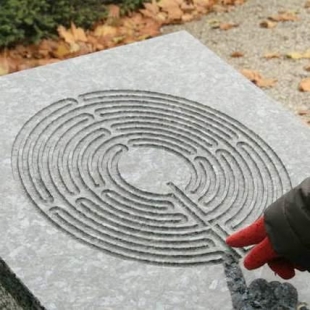
Labyrinth and maze. These words are often interchangeable, but strictly speaking, their meanings differ. A labyrinth is one-way; you cannot get lost in it. One path approaches the center and then moves away from it, but ultimately leads you to it. A maze has many false turns and dead ends, and it may happen that you never reach the center. Or you may reach it, but cannot get out.
The labyrinth is one of the oldest motifs, and its depiction has been preserved from all ancient cultures. The most famous ancient labyrinth was located in Knossos on Crete. King Minos had the Minotaur imprisoned within it, a monster born from the queen's infidelity with a sacred bull. As Ovid states in Metamorphoses: “Daidalus, the famous builder and inventive artist, established the whole construction and confused all traces within it with a multitude of winding paths, whose twists deceived the eyes.” The Minotaur was killed only by the hero Theseus with the help of Ariadne and her ball of thread. This myth and its characters are the subject of many psychological interpretations and literary adaptations. The figure of the Minotaur as an unwanted child, as a repressed inner aspect projected onto the outer world, as the embodiment of the horror of self-discovery hidden in the tangle of human emotions, as a key to one's uniqueness amid the complexity of human existence, is a powerful symbol of the human psyche.
The Minotaur is one of the main motifs in the work of Swiss writer Friedrich Dürrenmatt. In one of his late works, Labyrinth (1985), he places a solitary Minotaur, who has never seen anyone, into a mirrored labyrinth where only his face is constantly reflected. His encounter with a living other being, the disguised Theseus, ends tragically for him. The notorious mirrored maze on Petřín was created solely for the amusement of visitors to a jubilee exhibition, yet among the mirrored corridors and the hall of laughter with distorting mirrors, there is no cheerful scene depicted, but a war scene of the Swedish attack on Prague. It’s as if the idea of who the spectators really see in the mirror was inadvertently imposed on them during the interlude between the two acts of the comedy.
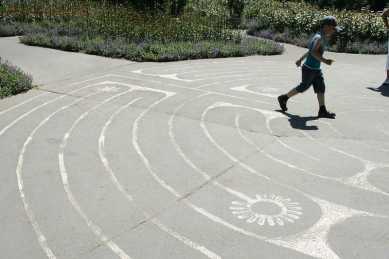
To find oneself and one's center through contemplation and penance led believers to labyrinths on the floors of Gothic cathedrals in Chartres, Amiens, St Omer, Reims, and other places. In the Rose Garden on Petřín, there is a now somewhat faded copy of the labyrinth from Chartres drawn on the asphalt surface. Children run or ride their scooters in it and repeatedly reach the center, then distance themselves from it again, while parents impatiently stand at the edge and look at their watches.
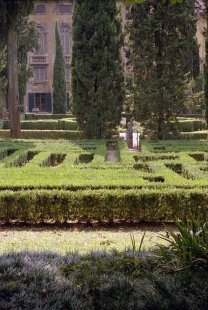
The most famous but also the most treacherous garden maze is probably at Hampton Court in England. It dates back to 1690, when it was created for King William III of Orange. Although it is not one of the longest, one can easily get lost in it, even with a map, as Jerome K. Jerome confirms in the famous scene from Three Men in a Boat: “Then they simply could not get anywhere. No matter which way they turned, they always ended up back in the center. It happened so regularly that some people stayed there waiting for the others to go around the maze and return to them. Harris pulled out the map again, but looking at the map only infuriated the crowd. They advised Harris to make hair curlers out of it. Harris allegedly could not shake the impression that he had become somewhat unpopular.”
A similar situation befell Canadian writer Carol Shields at Hampton Court, who provides a guaranteed correct description of the route through this maze in her novel Larry's Party (1997), whose main character Larry is engaged in creating labyrinths and mazes. However, the writer similarly failed to reach the center of the maze, even in the presence of a full film crew documenting her.
While Larry in Carol Shields' work is presented as an "ordinary" hero despite his unusual profession, the life and work of the most famous contemporary labyrinth creator Adrian Fisher is certainly extraordinary. Fisher designs magnificent green, stone, mirrored, rope, and even light labyrinths and mazes all over the world. Czech Castle Loučeň boasts a unique labyrinth complex built with the considerable efforts of Czech designers and gardeners.
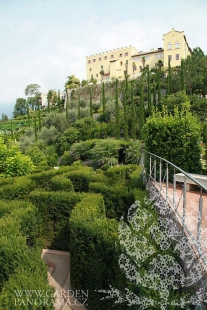
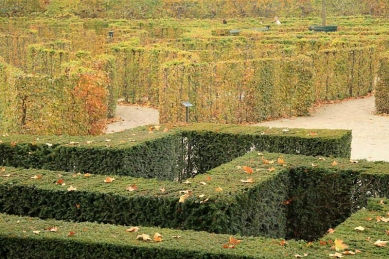
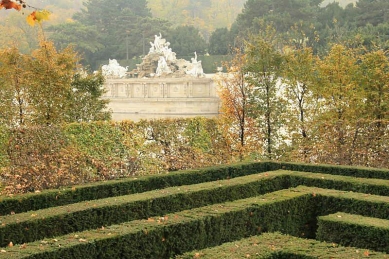
Similar labyrinth complexes can be found in other places in Europe, such as in Hauterives, France, or at Schönbrunn in Vienna. The main element of the Schönbrunn complex is the restored section of a yew maze (originally established in 1720 and abolished in 1892 for moral reasons). In the center of the maze is an elevated platform from which the entire maze can be seen, an old plane tree, and two stones in its shade, activated by a feng shui master and symbolizing cosmic harmony. In the dead ends of the maze are markers of the individual zodiac signs, which make finding one’s way a bit easier and hint that the path leads from Aries to Pisces... Near the maze are several different labyrinths and the children's playground Labyrinthikon.
Wandering through labyrinths and mazes naturally delights children, who enjoy the game and the present moment, and curiosity about where they will end up is secondary. Therefore, unlike most adults, they love the longest garden maze in the world (from 16,000 yew trees, with a total path length of 2,700 meters). It was created in 1975 at the Wiltshire estate of Longleat, where it is one of many attractions alongside carousels, rocket simulators, fairy-tale castles, and slides. Away from the carnival hustle and the interests of entertainment-seeking visitors, close to the estate itself, there are several green labyrinths – the labyrinth of love and the solar and lunar labyrinth. A visit to Longleat is a bizarre experience of modern times: on one hand, a splendid Elizabethan estate surrounded by vast gardens and a landscape park created by the most famous creators of several centuries, and on the other hand, the most garish attributes of the entertainment industry.
There are opinions that the garden labyrinths and mazes created from the 17th to the 19th century were primarily intended for distraction and entertainment, and that their alleged symbolic or spiritual purposes are a product of later interpretations, provoked by the revival of interest in old rituals sparked by James Frazer’s book The Golden Bough (1890). It is hard to assess, but given that garden architecture has always largely reflected contemporary ideas and prevailing worldviews, it might be more accurate to say that over time, some originally substantial elements have only remained in form, which this revival has once again filled with content.
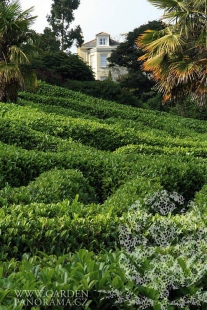
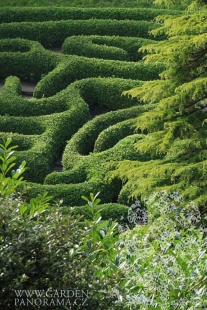
By the end of the 19th century, a number of labyrinths and mazes had indeed become primarily an ornamental motif selected from a catalog of garden patterns, while at other times, their symbolic meanings are speculated on, as in the case of the maze in Glendurgan, Cornwall. In 1833, Alfred Fox had it planted with cherry laurel (Prunus laurocerasus) based on the design of a then-existing maze (now long gone) in Sydney Gardens in Bath. The Victorian reaction to a century of landscape park alterations consisted of often superficial and soulless restorations of ornamental garden elements; however, Fox came from a Quaker background, and the entire layout of the Glendurgan gardens reflects a spiritual symbolism, where the maze, located in a valley beneath a sacred mound with biblical plants, could symbolize earthly human existence striving towards a higher spiritual dimension.
A remarkable maze, which certainly was not created solely for amusement, is located in the “garden kingdom” of Wörlitz near Dessau, constructed by Prince Leopold III Friedrich von Anhalt-Dessau in collaboration with his friend, architect Friedrich Wilhelm von Erdmannsdorf, between 1765 and 1817 during travels to England, France, and Italy. They were inspired by English landscape parks, the natural philosophy of Jean Jacques Rousseau, and Palladian architecture. The result is a unique, freely accessible landscape complex of water works, islets, and garden buildings connected by visual axes and perspectives as well as hidden meanings. On one of the islands, they built a stone maze symbolizing the arduous journey of human life. On the path of light and shadow, enhanced only by sparse vegetation, the pilgrim is accompanied by guides in the form of busts of Johann Caspar Lavater and Christian Fürchtegott Gellert and various warning signs and instructions. When the pilgrim walks through the dark corridor, they discover an inscription: Here occurs a difficult yet fundamental choice. At the end of the corridor is a white statue of Leda with a swan illuminated by daylight coming from the right through a side niche, above which is written: Turn back immediately. Those who do not obey will fall from the high wall straight into the water. There is no other option but to go left into the unknown, into a narrow underground tunnel that leads... to Elysium – to a grassy glade surrounded by lushly growing bushes and trees.
All labyrinths and mazes lead to the center – through approaching and distancing, through turning points as well as through trials and errors. Various paths lead through a labyrinth and a maze, yet the same rules apply here: The road to the goal leads around. Only from above do they make sense.
gardenpanorama.cz is a place for all those who perceive gardens as a changing space where nature meets human activity and culture, where botany intertwines with architecture, history, mythology, philosophy, art, and entertainment.
gardenpanorama.cz is a guide to the traces left by significant and less significant personalities in gardens, and to the traces that gardens have left in their lives and works.
gardenpanorama.cz is a place for all who consider Czech gardens a part of European and world cultural heritage.
gardenpanorama.cz is a guide for all those who like to travel not only to well-known monuments but also to less visited places.
gardenpanorama.cz is a guide for wandering through gardens that have inspired works of art.
gardenpanorama.cz is a small project of several people who love gardens.
gardenpanorama.cz is a garden on the web, a place for rest and inspiration.
gardenpanorama.cz is a place for garden lovers.
The Minotaur is one of the main motifs in the work of Swiss writer Friedrich Dürrenmatt. In one of his late works, Labyrinth (1985), he places a solitary Minotaur, who has never seen anyone, into a mirrored labyrinth where only his face is constantly reflected. His encounter with a living other being, the disguised Theseus, ends tragically for him. The notorious mirrored maze on Petřín was created solely for the amusement of visitors to a jubilee exhibition, yet among the mirrored corridors and the hall of laughter with distorting mirrors, there is no cheerful scene depicted, but a war scene of the Swedish attack on Prague. It’s as if the idea of who the spectators really see in the mirror was inadvertently imposed on them during the interlude between the two acts of the comedy.
To find oneself and one's center through contemplation and penance led believers to labyrinths on the floors of Gothic cathedrals in Chartres, Amiens, St Omer, Reims, and other places. In the Rose Garden on Petřín, there is a now somewhat faded copy of the labyrinth from Chartres drawn on the asphalt surface. Children run or ride their scooters in it and repeatedly reach the center, then distance themselves from it again, while parents impatiently stand at the edge and look at their watches.
The most famous but also the most treacherous garden maze is probably at Hampton Court in England. It dates back to 1690, when it was created for King William III of Orange. Although it is not one of the longest, one can easily get lost in it, even with a map, as Jerome K. Jerome confirms in the famous scene from Three Men in a Boat: “Then they simply could not get anywhere. No matter which way they turned, they always ended up back in the center. It happened so regularly that some people stayed there waiting for the others to go around the maze and return to them. Harris pulled out the map again, but looking at the map only infuriated the crowd. They advised Harris to make hair curlers out of it. Harris allegedly could not shake the impression that he had become somewhat unpopular.”
A similar situation befell Canadian writer Carol Shields at Hampton Court, who provides a guaranteed correct description of the route through this maze in her novel Larry's Party (1997), whose main character Larry is engaged in creating labyrinths and mazes. However, the writer similarly failed to reach the center of the maze, even in the presence of a full film crew documenting her.
While Larry in Carol Shields' work is presented as an "ordinary" hero despite his unusual profession, the life and work of the most famous contemporary labyrinth creator Adrian Fisher is certainly extraordinary. Fisher designs magnificent green, stone, mirrored, rope, and even light labyrinths and mazes all over the world. Czech Castle Loučeň boasts a unique labyrinth complex built with the considerable efforts of Czech designers and gardeners.
Similar labyrinth complexes can be found in other places in Europe, such as in Hauterives, France, or at Schönbrunn in Vienna. The main element of the Schönbrunn complex is the restored section of a yew maze (originally established in 1720 and abolished in 1892 for moral reasons). In the center of the maze is an elevated platform from which the entire maze can be seen, an old plane tree, and two stones in its shade, activated by a feng shui master and symbolizing cosmic harmony. In the dead ends of the maze are markers of the individual zodiac signs, which make finding one’s way a bit easier and hint that the path leads from Aries to Pisces... Near the maze are several different labyrinths and the children's playground Labyrinthikon.
Wandering through labyrinths and mazes naturally delights children, who enjoy the game and the present moment, and curiosity about where they will end up is secondary. Therefore, unlike most adults, they love the longest garden maze in the world (from 16,000 yew trees, with a total path length of 2,700 meters). It was created in 1975 at the Wiltshire estate of Longleat, where it is one of many attractions alongside carousels, rocket simulators, fairy-tale castles, and slides. Away from the carnival hustle and the interests of entertainment-seeking visitors, close to the estate itself, there are several green labyrinths – the labyrinth of love and the solar and lunar labyrinth. A visit to Longleat is a bizarre experience of modern times: on one hand, a splendid Elizabethan estate surrounded by vast gardens and a landscape park created by the most famous creators of several centuries, and on the other hand, the most garish attributes of the entertainment industry.
There are opinions that the garden labyrinths and mazes created from the 17th to the 19th century were primarily intended for distraction and entertainment, and that their alleged symbolic or spiritual purposes are a product of later interpretations, provoked by the revival of interest in old rituals sparked by James Frazer’s book The Golden Bough (1890). It is hard to assess, but given that garden architecture has always largely reflected contemporary ideas and prevailing worldviews, it might be more accurate to say that over time, some originally substantial elements have only remained in form, which this revival has once again filled with content.
By the end of the 19th century, a number of labyrinths and mazes had indeed become primarily an ornamental motif selected from a catalog of garden patterns, while at other times, their symbolic meanings are speculated on, as in the case of the maze in Glendurgan, Cornwall. In 1833, Alfred Fox had it planted with cherry laurel (Prunus laurocerasus) based on the design of a then-existing maze (now long gone) in Sydney Gardens in Bath. The Victorian reaction to a century of landscape park alterations consisted of often superficial and soulless restorations of ornamental garden elements; however, Fox came from a Quaker background, and the entire layout of the Glendurgan gardens reflects a spiritual symbolism, where the maze, located in a valley beneath a sacred mound with biblical plants, could symbolize earthly human existence striving towards a higher spiritual dimension.
A remarkable maze, which certainly was not created solely for amusement, is located in the “garden kingdom” of Wörlitz near Dessau, constructed by Prince Leopold III Friedrich von Anhalt-Dessau in collaboration with his friend, architect Friedrich Wilhelm von Erdmannsdorf, between 1765 and 1817 during travels to England, France, and Italy. They were inspired by English landscape parks, the natural philosophy of Jean Jacques Rousseau, and Palladian architecture. The result is a unique, freely accessible landscape complex of water works, islets, and garden buildings connected by visual axes and perspectives as well as hidden meanings. On one of the islands, they built a stone maze symbolizing the arduous journey of human life. On the path of light and shadow, enhanced only by sparse vegetation, the pilgrim is accompanied by guides in the form of busts of Johann Caspar Lavater and Christian Fürchtegott Gellert and various warning signs and instructions. When the pilgrim walks through the dark corridor, they discover an inscription: Here occurs a difficult yet fundamental choice. At the end of the corridor is a white statue of Leda with a swan illuminated by daylight coming from the right through a side niche, above which is written: Turn back immediately. Those who do not obey will fall from the high wall straight into the water. There is no other option but to go left into the unknown, into a narrow underground tunnel that leads... to Elysium – to a grassy glade surrounded by lushly growing bushes and trees.
All labyrinths and mazes lead to the center – through approaching and distancing, through turning points as well as through trials and errors. Various paths lead through a labyrinth and a maze, yet the same rules apply here: The road to the goal leads around. Only from above do they make sense.

gardenpanorama.cz is a place for all those who perceive gardens as a changing space where nature meets human activity and culture, where botany intertwines with architecture, history, mythology, philosophy, art, and entertainment.
gardenpanorama.cz is a guide to the traces left by significant and less significant personalities in gardens, and to the traces that gardens have left in their lives and works.
gardenpanorama.cz is a place for all who consider Czech gardens a part of European and world cultural heritage.
gardenpanorama.cz is a guide for all those who like to travel not only to well-known monuments but also to less visited places.
gardenpanorama.cz is a guide for wandering through gardens that have inspired works of art.
gardenpanorama.cz is a small project of several people who love gardens.
gardenpanorama.cz is a garden on the web, a place for rest and inspiration.
gardenpanorama.cz is a place for garden lovers.
The English translation is powered by AI tool. Switch to Czech to view the original text source.
0 comments
add comment