
Mosaic on the entrance facade of Jurkovič's villa
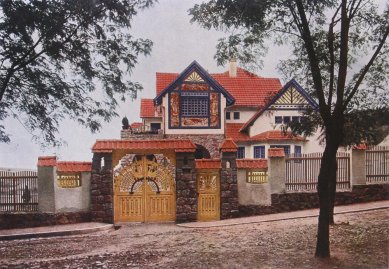
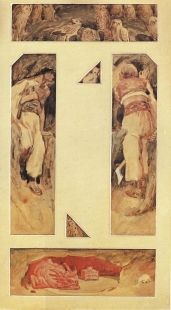
The entrance façade of the villa designed by Dušan Jurkovič was once significantly dominated by glass mosaics. The author of the mosaic design was Adolf Kašpar (1877-1934), a painter and graphic artist, known primarily for his illustrations of the novel Babička by Božena Němcová. The mosaic depicted a scene from the fairy tale Bača a šiarkan and was executed in 1906 by the Bohumil Škarda Glassworks in Brno.
Kašpar's mosaic has not survived; it was destroyed likely during World War I or in the subsequent period. By 1938, when the house was purchased by Růžena Švancarová, the mosaic was no longer present on the facade. For a certain period, it was replaced by a painting, which was likely covered over during World War II. Since there are no execution documents or detailed photographic documentation of the destroyed glass mosaic on the façade, the Moravian Gallery in Brno decided against creating a non-authentic replica and opted for a work by a contemporary artist who received the same brief as Adolf Kašpar had in 1906. The new mosaic will again return the house's lively atmosphere and add quality to contemporary artistic creation.
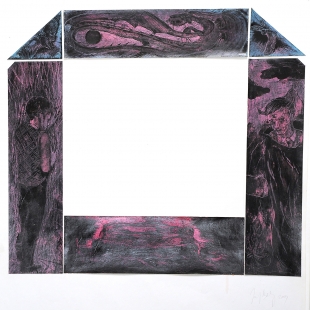
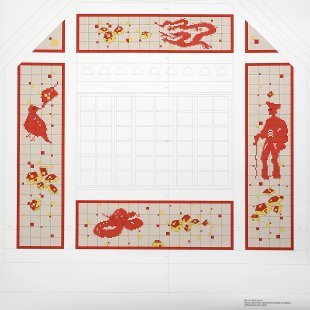
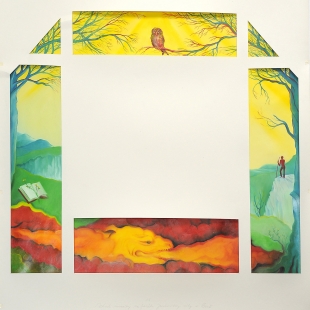
As part of the tender process, MG approached five artists. The selection criteria were twofold: figurative painting and interesting work with color. The artists contacted were Josef Bolf, Veronika Holcová, and Petr Písařík from the Czech Republic, and Juraj Gavula and Bohdan Hostinák from Slovakia. The creators were given the same brief as the original mosaic creator Adolf Kašpar in 1906: the fairy tale Bača a drak. In addition to this, they received a detailed analysis of the work in its historical context and commentary on the role of the mosaic on the façade of the house.
Three authors participated in the competition; Bohdan Hostinák and Petr Písařík submitted apologies. The author of the winning proposal was Josef Bolf, who best fulfilled the conditions set by the client, adhered to the theme of the fairy tale, and managed well with the proportions of the villa. His design was closest to Adolf Kašpar's interpretation, while also being very original and contemporary.
ABOUT THE MOSAIC
The fairy tale Bača a šiarkan was published in 1903 in the leading periodical of Czech modernists Volné směry. The editorial team decided at that time to include a special issue dedicated to fairy tales, titled Snow. Emphasis was placed on Slavic fairy tales, but "Germanic" fairy tales also appeared. Today, the fairy tale Bača a šiarkan is considered by the public to be a work of Slovak folklore. However, its genesis is more complex. Originally, two fairy tales existed in the Slovak context, which Božena Němcová recorded on her travels to Slovakia. She combined both tales into one, O bačovi a šarkanovi, and retold it under the pseudonym Š. Danieli in the almanac Perly české. This fairy tale subsequently returned to Slovak folk culture.
Why Jurkovič chose Adolf Kašpar remains a question. In the periodical Volné směry, the fairy tale was illustrated by Mikoláš Aleš, with whom Dušan Jurkovič collaborated on the decoration of Pustevny (1898) or the Spolkový dům in Skalica (1904). Perhaps Hanuš Schwaiger recommended him, who, even after moving to Prague, continued to have significant influence among the members of the Club of Friends of Art in Brno, and Kašpar was one of his students.
Dušan Jurkovič commissioned the realization of the glass mosaic to Bohumil Škarda, the owner of the glassworks, who specialized in the production of stained glass. In collaboration with Jurkovič, he created several pieces. The most notable was the mosaic on the façade of the Spolkový dům in Skalica (1904), featuring the theme of St. Stephen, king of Hungary, and also the mosaic on his own villa in Žabovřesky (1906).
The glass material was not assembled from classic square tesserae, but from glass cut similarly to stained glass and perhaps also additionally painted like stained glass. The sparkle and brilliance of the mosaic were very important for the concept of the house. The use of mosaics on building façades was among the important elements of modernism, appearing increasingly not only on public buildings but also on villa façades. The realization of the colony of houses at Matildenhöhe in Darmstadt, which was closely monitored throughout Central Europe due to its chief architect Josef Maria Olbrich, had significant importance for the development of this element in villa architecture. For Jurkovič's concept, the house of the painter, graphic artist, and decorator Hans Christiansen, who had a glass mosaic depicting Adam and Eve created for the façade of his house designed by Olbrich in 1900-1901, likely played a crucial role. Its use sparked discussion and was admired as an example of a very modern depiction of a façade.
The theme of the fairy tale Bača a šiarkan is respect for the land, nature, and traditions, while simultaneously showcasing the dazzling mysteries of fairy tales and magic, typical of Art Nouveau. Central to the story is the figure of the dragon depicted in the spirit of the fairy tale as the guardian of treasure. Kašpar's interpretation further gave up on historicism, turning primarily towards contemporaneity in the figure of the dragon, which was inspired by popular and very fashionable images of Chinese dragons. Similarly progressive was the figure of the owl, or rather owls, in the upper part of the mosaic. Here the author again looked to Olbrich, more precisely to Koloman Moser, who designed owl decorations for the façade of Olbrich's exhibition pavilion of the Secession at Karlsplatz in Vienna (1898). On the sides were two male figures. However, they do not consistently represent the main characters of the fairy tale, the shepherd and the wizard, but capture only the shepherd entering / exiting the rock (?). The use of figures in the mosaic on the façade was typical for Jurkovič's work (Pustevny, Skalica, Luhačovice…). In addition to the symbolic content, they allowed for the building's scale to be defined.
Kašpar's mosaic has not survived; it was destroyed likely during World War I or in the subsequent period. By 1938, when the house was purchased by Růžena Švancarová, the mosaic was no longer present on the facade. For a certain period, it was replaced by a painting, which was likely covered over during World War II. Since there are no execution documents or detailed photographic documentation of the destroyed glass mosaic on the façade, the Moravian Gallery in Brno decided against creating a non-authentic replica and opted for a work by a contemporary artist who received the same brief as Adolf Kašpar had in 1906. The new mosaic will again return the house's lively atmosphere and add quality to contemporary artistic creation.
As part of the tender process, MG approached five artists. The selection criteria were twofold: figurative painting and interesting work with color. The artists contacted were Josef Bolf, Veronika Holcová, and Petr Písařík from the Czech Republic, and Juraj Gavula and Bohdan Hostinák from Slovakia. The creators were given the same brief as the original mosaic creator Adolf Kašpar in 1906: the fairy tale Bača a drak. In addition to this, they received a detailed analysis of the work in its historical context and commentary on the role of the mosaic on the façade of the house.
Three authors participated in the competition; Bohdan Hostinák and Petr Písařík submitted apologies. The author of the winning proposal was Josef Bolf, who best fulfilled the conditions set by the client, adhered to the theme of the fairy tale, and managed well with the proportions of the villa. His design was closest to Adolf Kašpar's interpretation, while also being very original and contemporary.
ABOUT THE MOSAIC
The fairy tale Bača a šiarkan was published in 1903 in the leading periodical of Czech modernists Volné směry. The editorial team decided at that time to include a special issue dedicated to fairy tales, titled Snow. Emphasis was placed on Slavic fairy tales, but "Germanic" fairy tales also appeared. Today, the fairy tale Bača a šiarkan is considered by the public to be a work of Slovak folklore. However, its genesis is more complex. Originally, two fairy tales existed in the Slovak context, which Božena Němcová recorded on her travels to Slovakia. She combined both tales into one, O bačovi a šarkanovi, and retold it under the pseudonym Š. Danieli in the almanac Perly české. This fairy tale subsequently returned to Slovak folk culture.
Why Jurkovič chose Adolf Kašpar remains a question. In the periodical Volné směry, the fairy tale was illustrated by Mikoláš Aleš, with whom Dušan Jurkovič collaborated on the decoration of Pustevny (1898) or the Spolkový dům in Skalica (1904). Perhaps Hanuš Schwaiger recommended him, who, even after moving to Prague, continued to have significant influence among the members of the Club of Friends of Art in Brno, and Kašpar was one of his students.
Dušan Jurkovič commissioned the realization of the glass mosaic to Bohumil Škarda, the owner of the glassworks, who specialized in the production of stained glass. In collaboration with Jurkovič, he created several pieces. The most notable was the mosaic on the façade of the Spolkový dům in Skalica (1904), featuring the theme of St. Stephen, king of Hungary, and also the mosaic on his own villa in Žabovřesky (1906).
The glass material was not assembled from classic square tesserae, but from glass cut similarly to stained glass and perhaps also additionally painted like stained glass. The sparkle and brilliance of the mosaic were very important for the concept of the house. The use of mosaics on building façades was among the important elements of modernism, appearing increasingly not only on public buildings but also on villa façades. The realization of the colony of houses at Matildenhöhe in Darmstadt, which was closely monitored throughout Central Europe due to its chief architect Josef Maria Olbrich, had significant importance for the development of this element in villa architecture. For Jurkovič's concept, the house of the painter, graphic artist, and decorator Hans Christiansen, who had a glass mosaic depicting Adam and Eve created for the façade of his house designed by Olbrich in 1900-1901, likely played a crucial role. Its use sparked discussion and was admired as an example of a very modern depiction of a façade.
The theme of the fairy tale Bača a šiarkan is respect for the land, nature, and traditions, while simultaneously showcasing the dazzling mysteries of fairy tales and magic, typical of Art Nouveau. Central to the story is the figure of the dragon depicted in the spirit of the fairy tale as the guardian of treasure. Kašpar's interpretation further gave up on historicism, turning primarily towards contemporaneity in the figure of the dragon, which was inspired by popular and very fashionable images of Chinese dragons. Similarly progressive was the figure of the owl, or rather owls, in the upper part of the mosaic. Here the author again looked to Olbrich, more precisely to Koloman Moser, who designed owl decorations for the façade of Olbrich's exhibition pavilion of the Secession at Karlsplatz in Vienna (1898). On the sides were two male figures. However, they do not consistently represent the main characters of the fairy tale, the shepherd and the wizard, but capture only the shepherd entering / exiting the rock (?). The use of figures in the mosaic on the façade was typical for Jurkovič's work (Pustevny, Skalica, Luhačovice…). In addition to the symbolic content, they allowed for the building's scale to be defined.
The English translation is powered by AI tool. Switch to Czech to view the original text source.
5 comments
add comment
Subject
Author
Date
...
Viktor Vlach
02.04.10 02:11
TA TŘETÍ JE NEJLEPŠÍ!
de ardoise
02.04.10 04:42
Ad Moravská galerie v Brně
02.04.10 07:39
ta třetí je opravdu nejlepší
Eva Sadílková
03.04.10 02:05
Mozaika
Michal Trávníček
13.05.11 03:04
show all comments