
Heavy accumulation stoves with clay plaster as the dominant element of the log cabin

Publisher
advertorial
17.02.2026 14:30
advertorial
17.02.2026 14:30
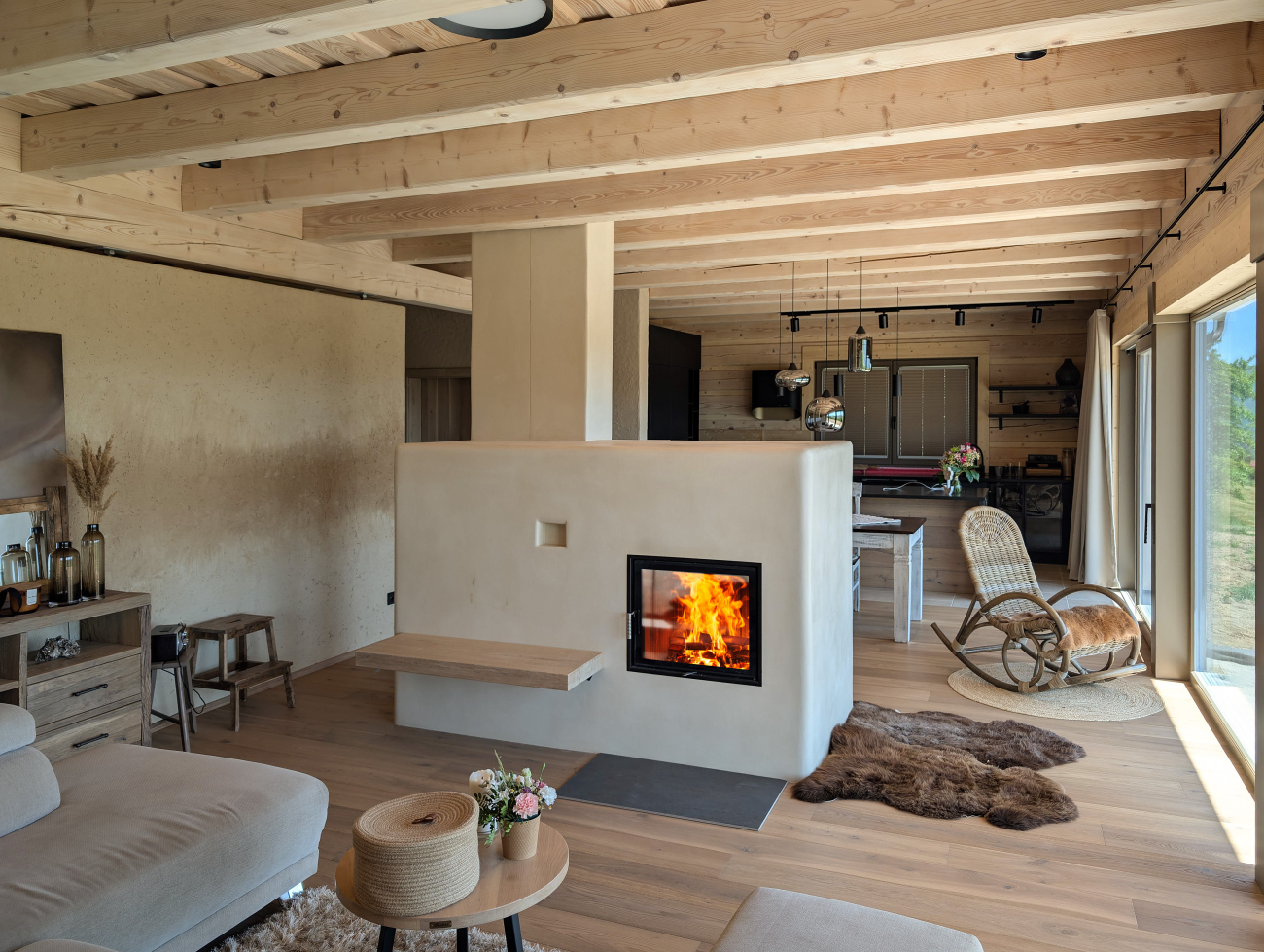 |
In the mountainous landscape of the Moravian Kopanice, at the legendary Žítková, a house has been built that is exceptional in its conception and technical solution. A pure log cabin made of solid wood, designed by architects from the studio Sercel & Svec, is the answer to the investors' desire to live in a house made of purely natural materials and to be maximally energy self-sufficient. Heavy accumulation stoves with clay plaster played a key role here – an element that connects architecture, craftsmanship, and the theme of clay as a material.
"From the beginning, it was clear that this would not be a house where the stoves are just an accessory to the interior,” explains Jan Křivonožka from the Křivonožka stove company. "The investor wanted the fire and accumulation to be the heart of the house and for most of the year the building to function practically without technologies dependent on electricity.”
Initial considerations inclined towards an electric boiler and a heat pump. Gradually, however, another idea matured – to use wood as a local, renewable source and reserve electricity only for additional heating. The result is heavy stoves that now heat almost the entire house.
"We designed the stoves to handle not only the heating of the living space but also to cooperate with the hot water system,” describes Křivonožka. "It includes a hot water absorber that heats the utility water in the boiler and helps with heating the bathroom. Everything is without complicated technology and without dependency on electric energy.”
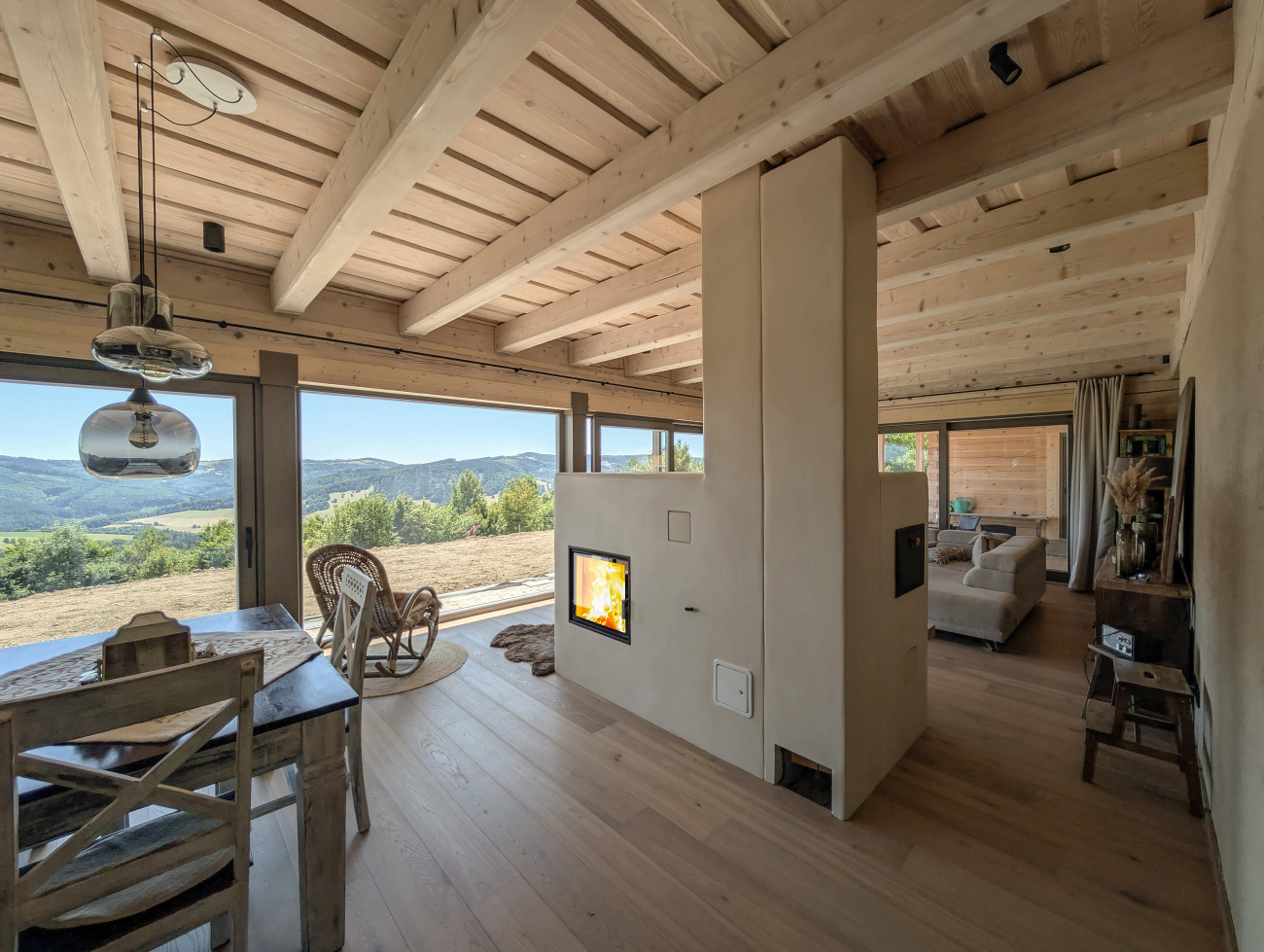 |
From a construction perspective, it is a truly massive accumulation unit. The chamotte fireplace is designed for a single dose of up to 20 kg of wood. The fire is visible from both sides thanks to the design tunnel glazing with Hoxter GT63/51 doors, which naturally connects the stove with the living area and the kitchen.
"For the investors, it was important that the stoves were not just a technical device, but a place for living,” says Křivonožka. "That’s why they have a spacious lounge area for relaxation, the baking oven is accessible from the kitchen, and from the living room, there is a wooden bench attached to the stoves' construction.”
Beneath the lounge area is a hidden hot water absorber, but the entire assembly seems calm and natural from the outside. A great deal of credit goes to the surface treatment.
Clay as a logical choice
The theme of clay is not limited to the stoves in this house. Clay plaster is used throughout the entire interior of the log cabin. Not only for aesthetics but primarily for the quality of the indoor environment."Clay works wonderfully with humidity, the interior is stable and pleasant thanks to it,” explains Jan Křivonožka. "It has a completely different smell, a different touch, and a different energy than standard surfaces. In such a house, it just makes sense.”
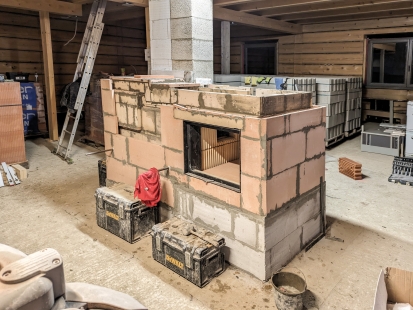
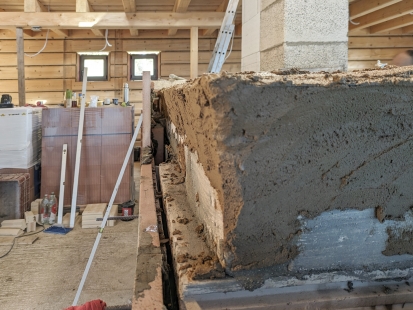
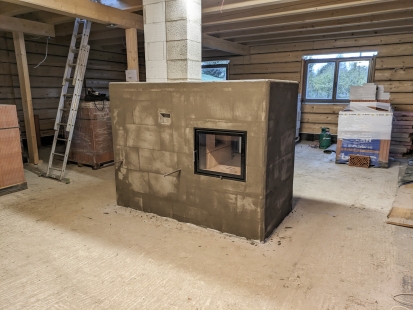
The clay plaster on the stoves was realized by Bohdan Nebesář, who prepares the material himself, always tailored to the specific project. In this case, a different color was chosen to allow the stoves to subtly stand out in the interior. The surface is additionally treated with a special wax finish for higher abrasion resistance.
"The layer of clay on the stoves is not as thick as on the walls of the house,” adds Křivonožka. "Here it is more about a design and architectural element than about humidity regulation. Nevertheless, the difference is noticeable – a well-made clay plaster feels completely different at first sight and touch than classic stucco.”
One refueling a day
From an operational perspective, the stoves are designed with an emphasis on simplicity and comfort. Most of the year, one refueling a day is sufficient."The firebox is fully loaded, the wood burns out, and the stoves then radiate heat for at least 24 hours,” describes Křivonožka. "The heat is radiant, even, and does not overheat the interior. This is exactly the type of heat that suits a log cabin and clay surfaces.”
The entire system operates without electricity. No fans, no network-dependent regulation. Just fire, mass, and accumulation.
"For the investor, it is true independence,” concludes Jan Křivonožka. "Just a few meters of dry wood a year, and the house functions. In today's times, this is not only a return to proven principles but also a very relevant way to think about housing.”
Text: Alena Křečková
Photography: Křivonožka Stove Company
The English translation is powered by AI tool. Switch to Czech to view the original text source.
0 comments
add comment
Related articles
0
28.07.2026 | Heat storage stoves in Kácov
0
08.12.2025 | Tiled stoves with modern technology in a traditional Krkonoš cottage
0
01.06.2025 | Fireplaces as the Heart of the Home: Craftsmanship in Contemporary Architecture
0
22.04.2025 | Modular fireplaces that adapt to any space
0
24.06.2024 | Krb v srdci Beskyd jako technická a řemeslná výzva
Fireplace in the Heart of the Beskydy Mountains as a Technical and Craft Challenge
0
28.11.2023 | Acremulating stoves save heating costs
0
20.09.2023 | Heat-retaining concrete stoves
0
07.09.2022 | <lang>Teplovodní krby jsou hitem. Objevují se v rodinných domech i rekreačních objektech.</lang>
<lang>Water-heated fireplaces are a hit. They are appearing in family houses as well as recreational properties.</lang>