
Heat storage stoves in Kácov

Publisher
advertorial
28.07.2026 10:50
advertorial
28.07.2026 10:50
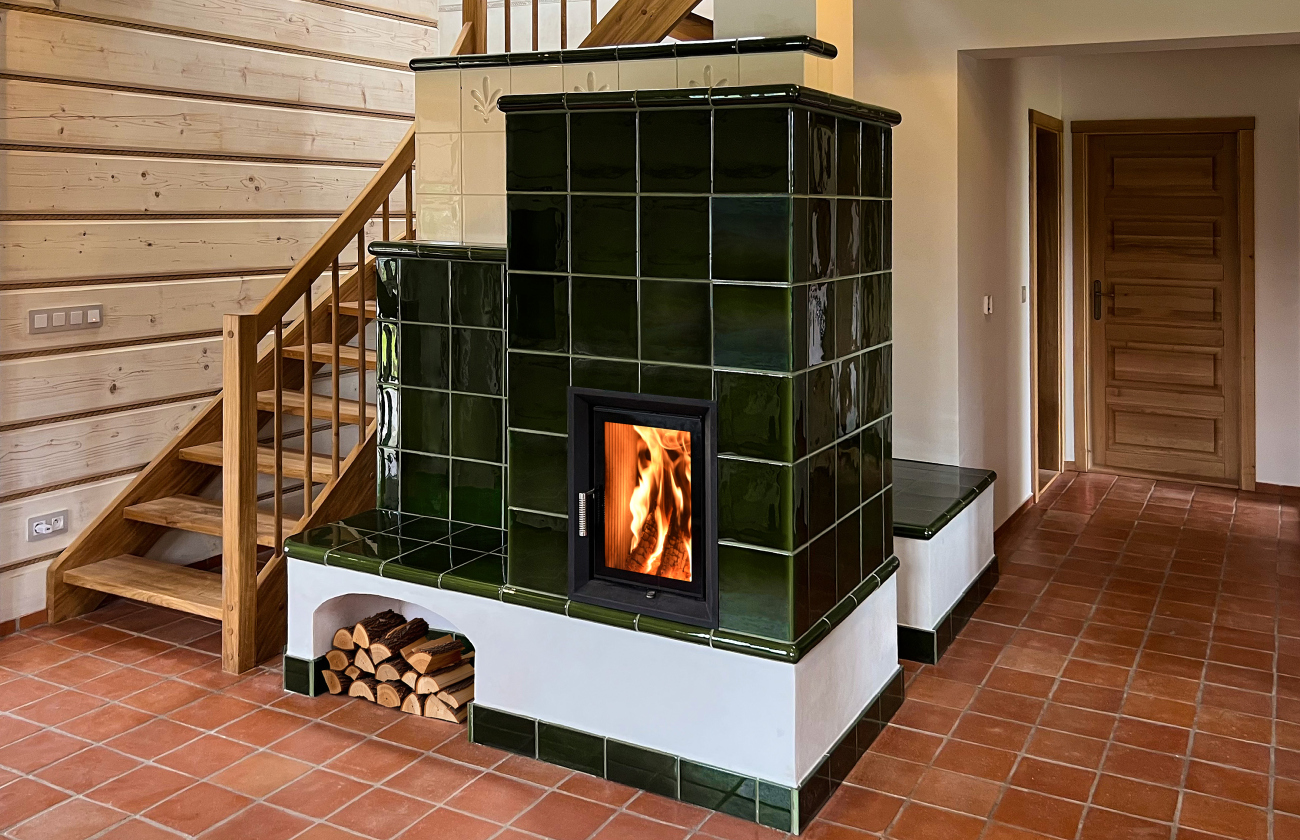 |
Water and fire can surprisingly understand each other very well, especially when fire produces energy and water subsequently becomes its carrier and acts as a heat storage. This synergy is increasingly being reflected in heating principles, where it is possible not only to produce heat but, above all, to effectively accumulate, regulate, and utilize it over time. And this is precisely the role that water plays in the realization of hot water accumulation stoves in a half-timbered family house in Kácov.
The renovation of the traditional building required a sensitive approach that respects the character of the structure while also meeting current demands for comfort and energy efficiency. The authors of the project chose a heating system using massive accumulating stoves, which serve as a central heat source, but not in the traditional sense, rather as a technologically advanced whole that connects radiant heat with hot water distribution.

"We wanted to create a solution that would work reliably, efficiently, and at the same time naturally fit into the character of the half-timbered house. Wood is a logical choice here, and accumulation makes the whole system sensible," says stove maker Martin Kasl from Kamnářství Pohoda.
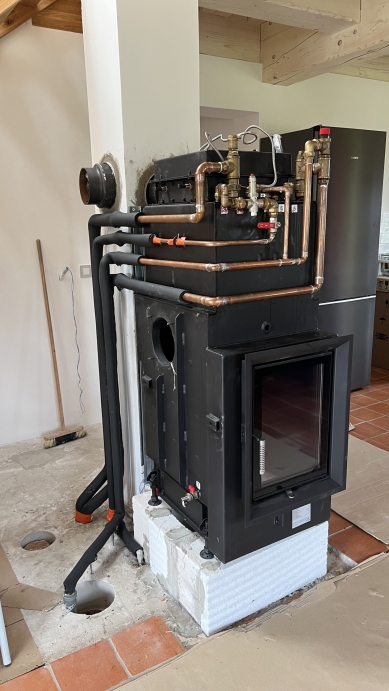
The foundation of the implementation is the Hoxter WHE 37/50 stove insert, which serves as the primary source of thermal energy. Its combustion chamber is designed for high efficiency and stable operation, while the integrated exchanger cleaner minimizes maintenance needs and contributes to long-term constant combustion parameters.
Water as a Heat Storage
The fundamental element of the entire accumulation system is water. The stoves are connected to a large accumulation tank, where the thermal energy generated by burning wood is stored. This principle allows for the separation of heat production from its distribution – enabling heating in an optimal mode and using the heat gradually according to the current needs of the house.The underfloor heating follows the accumulation tank, ensuring uniform heat distribution within the interior. A sophisticated control system dynamically adjusts the performance of the circulation pumps based on the outdoor temperature. This brings stable thermal comfort without fluctuations, overheating, or cold zones.


From a construction perspective, the stove insert offers the option of lateral flue gas exhaust, which significantly expands the layout possibilities of the stove. This detail enabled the efficient connection to a draft accumulation system made of heavy fireclay elements. Thus, the stoves fulfill not only the hot water function but also serve as radiant accumulating heaters, which gradually provide heat to the interior with high comfort.
"A significant advantage is the combination of two principles – hot water and accumulation. The user gains not only control over the distribution of heat in the house but also retains the quality of radiant heat, which is irreplaceable in living spaces," adds Martin Kasl.
This combination represents a crucial benefit for the entire solution. While water ensures efficient heat transfer and regulation within the heating system, the massive accumulating mass of the stoves prolongs its radiation into the interior even long after the fuel has burned out. The result is an environment that feels natural, stable, and comfortable – without the need for constant fueling or regulation.
Banador
text Alena Křečkováphoto Kamnářství Pohoda
www.banador.cz
The English translation is powered by AI tool. Switch to Czech to view the original text source.

0 comments
add comment
Related articles
0
17.02.2026 | Heavy accumulation stoves with clay plaster as the dominant element of the log cabin
0
08.12.2025 | Tiled stoves with modern technology in a traditional Krkonoš cottage
0
01.06.2025 | Fireplaces as the Heart of the Home: Craftsmanship in Contemporary Architecture
0
22.04.2025 | Modular fireplaces that adapt to any space
0
24.06.2024 | Krb v srdci Beskyd jako technická a řemeslná výzva
Fireplace in the Heart of the Beskydy Mountains as a Technical and Craft Challenge
0
28.11.2023 | Acremulating stoves save heating costs
0
20.09.2023 | Heat-retaining concrete stoves
0
07.09.2022 | <lang>Teplovodní krby jsou hitem. Objevují se v rodinných domech i rekreačních objektech.</lang>
<lang>Water-heated fireplaces are a hit. They are appearing in family houses as well as recreational properties.</lang>