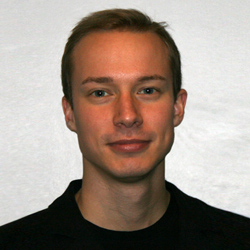
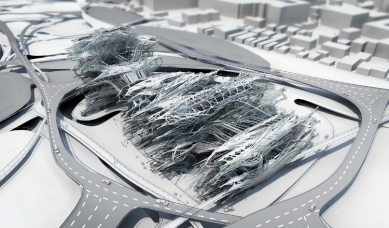
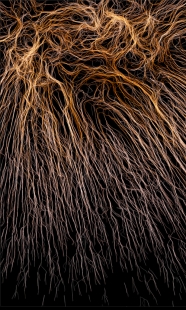
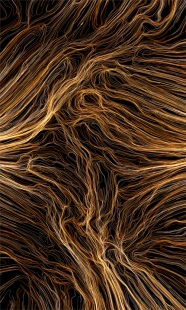
Architect Josef Musil is a graduate of Miloš Florián's studio FLO|W and a postgraduate program at the University of Pennsylvania in the USA. Since his studies, he has been continuously dedicated to digital architecture. During his visit to Prague a few months ago, he held a lecture for students of the FLO|W studio about his work and academic experiences. Digital architecture is still a relatively new discipline in the Czech Republic. Some fully exploit its possibilities, while others "flirt" with it in school, and their projects often feature carefully graphically refined presentations, models, and videos. For some, these projects may be incomprehensible, perhaps even eccentric. Terms like scripting, generating, and parameters seem distant from "commonly presented" architecture. However, in Josef's discussion, all these words sound natural, make sense, and together describe a phenomenon comparable to when in the past an architect got a computer on their desk next to their drawing board: they can still use both, and it is up to them when and which tool to choose. From our conversation after the lecture and later via email, an interview emerged that reveals and perhaps brings closer the perspective on architecture and the work of an architect through new (useful?) tools.
Jana Kazimour Hladíková: What should one expect from parametric or digital architecture? How do you understand this discipline? Josef Musil: The longer I work in this field, the more I see how broad the term digital architecture is. I expect digital architecture to provide flexible solutions to specific problems, the ability to consider multiple criteria, to offer a comprehensive solution rather than a simple answer, and to create designs that allow for diverse characteristics suitable to local requirements, without fear that this diversity will result in disproportionately more work. Digital architecture allows for the introduction of complexity into the project and thus takes multiple criteria into account at both technical and conceptual levels. A project can often be simplified because the architect is unable to translate their cohesive idea into a 3D representation (e.g., a 3D model); sometimes, however, they may give up on seeking better solutions simply because they cannot imagine them. Sophisticated programs and scripts allow for detailed modeling of very complex geometries and also enable freer work in an environment with many unknowns.
What do these described possibilities of work mean to you in your everyday practice? For me, it means high efficiency, freedom in creating topology rather than specific dimensions, while having the capability to incorporate these specific dimensions at any time. The decision-making is based on a high number of generated alternatives, some of which may be intentionally flawed, thus offering unexpectedly better solutions.
What is digital architecture like in the Czech Republic and in other countries you have had the chance to experience from this perspective? In the Czech Republic, I mainly had the opportunity to study digital architecture; its applications have been found mainly in concepts and ideation competitions. My experience is that compared to studying at UPenn (University of Pennsylvania - note of the author), it is perceived more as a technical tool and detached from the theoretical foundation - how people think when designing. Digital architecture has its natural genesis and development, which also includes the evolution of other sciences.
Some people fear DA or outright condemn it for distancing from people, the architect. How then to "grasp" it? Fear may stem from the unknown or from a negative previous experience. Lifelong education on the side of those who are unfamiliar with the field, and a critical view of the results from those who are creating in the field, should help to alleviate fear. The opinion that this direction distances itself from people might partly stem from ignorance of the topic. Writing a script is more about describing a mode of thinking, and a whole range of research projects focus on interactive work with physical models.
What tool is or can digital architecture (DA) be for an architect? It can be both a technical and conceptual tool, as mentioned in previous questions. Standard parametric software offers a multitude of technical aids for detailed modeling of the entire geometry with the help of a simple user interface. Writing a script allows for the use of nonlinear processes and is much closer to the mode of thinking. It thus provides an original approach to design at a conceptual level. Due to the fact that these two approaches can be processed with the same tool, digital architecture offers a very powerful and universal instrument for design.
Why did you apply to the FLOW studio? I was attracted to dynamic systems. Designs that account for change and are able to respond to it. And last but not least, to delve freely into the depth of the problem.
What projects have you worked on? The first project was based on a tensegrity system. Other projects involved dynamic structures and manufacturing systems based on the natural deformation of materials.
How did you actually come to the tools you are currently using? I have always used the tools that offered efficient utilization at the time. I am still learning new programs and programming languages, the use of which is becoming increasingly easier. An architect is not a computer programmer and does not need to understand all the complexities of script optimization.
What insights did you value after studying at FA? What did FLOW bring you? FA definitely provided me with very good technical equipment and an interest in further study. FLOW allowed me to engage in projects that I personally considered important and interesting. I believe this is an important element for every student - support for inner conviction.
How do you continue since your studies and where do you aim your work? My work focuses on applying the aforementioned tools in the everyday work of an architect.
How do you retrospectively evaluate your work in school studios? I think I learned a lot. For my further development, both successful and unsuccessful projects were equally important.
Can you compare FA and other schools you have had the opportunity to study at? My comparison with studying at UPenn includes a much closer approach of the teacher to the student, valuing questions on contexts and discussions, frequent project presentations, and high work commitment from students.
What are your experiences from practice, what is your opinion on digital architecture in the work of an architect? In which phases of the project are these tools useful? In practice, these tools are invaluable. Each project undergoes a large number of smaller or larger changes up to the last moment. Digital tools not only allow these changes but also help explore them more quickly. The earlier in the project these tools are utilized, the greater advantage they gain throughout the project. Many projects are continuously reworked and simplified because some criteria were not considered due to the lack of knowledge of their specific value. There are many digital tools, and for individual standard phases of the project, some are more suitable and some less. In general, though, parametric models based on topology and rules have a simpler transition to the next phase, where the topology is recycled and used to generate additional details.
What project are you currently working on? Currently, I have been working on several projects simultaneously. In the project for the National Bank of Kuwait, I worked on generating internal offices within complex spaces, for the airport in Panama on generating double-curved roofing considering manufacturing constraints and procedures. In the project for the National Museum in Abu Dhabi, we are generating naturally looking stone structures considering manufacturing processes.
The term "generation" sounds strange in connection with architecture to some, appearing closer to fields like statics, engineering, and IT. What role does the architect play in generation? Can they be replaced by someone who will only deliver results to the architect as one of the collaborating professions? Digital architecture is still designed, even though the term "generate" is used. What is being designed are the rules for generating. These rules can stem from aesthetics, geometry, manufacturing constraints, environmental requirements, statics, and other elements of architecture. The resulting geometry is not directly manipulated but is a computer-generated result of all the designed rules, therefore the term "generated" fits the final geometry. From this, logically follows my opinion that a digital architect cannot become a profession, if we agree with the notion that an architect is someone who not only selects from available options but primarily creates them.
Josef Musil (*1984) is an architect and "computational designer". He studied at FA ČVUT, primarily in the FLO|W studio of Miloš Florián during his master's studies. There, he also defended his diploma project in 2010, LightCells - Parametric High-Rise Building for Prague. During his master's studies, he spent one year at TU Munich and after completing FA ČVUT, he studied the postgraduate program MArch II at the University of Pennsylvania (USA) with the support of a Fulbright scholarship and a scholarship from the Zdeněk Bakala Foundation. He has worked as an architect and participated in research in Philadelphia, New York, Munich, Prague, and London, where he is currently part of the Specialist Modelling Group at Foster and Partners. In the future, he is considering further education in the field of civil engineering and computer science.
The English translation is powered by AI tool. Switch to Czech to view the original text source.