
Sunlight in attic rooms with roof windows

Publisher
Tisková zpráva
20.11.2006 00:05
Tisková zpráva
20.11.2006 00:05
 |
Sunlight in attic living spaces
One of the important criteria in the design of lighting openings in buildings is the requirement for sunlight in living rooms. Roof windows are generally not shaded by external obstacles, and if they are not oriented to the north, sunlight is satisfactory. However, there may be cases, especially in urban developments, where the influence of neighboring buildings shortens the potential sunlight for attic rooms with roof windows. Requirements for sunlight in rooms
A living room is considered to have adequate sunlight if the following conditions are met [1]:- solar radiation must hit a critical point in the plane of the internal glazing at a height of 300 mm above the center of the lower edge of the lighting opening, but at least 1200 mm above the floor level in the evaluated room – see Figure 1,
 |
Fig. 1 Control point and angle of ineffective solar radiation impact on a roof window [1]
- the height of the sun above the horizon must be at least 5 °,
- the plan angle of the solar rays with the main straight line of the window plane must be less than 25 ° , which is considered the so-called ineffective angle of incidence, under which the room is not deemed sufficiently sunlighted (solar rays incident at an angle less than 25 ° reflect, and only a small portion of direct sunlight penetrates into the room),
- the total area of the window calculated from the composite dimensions must be equal to at least 1/10 of the floor area of the room,
- minimum sunlight duration is 90 minutes (neglecting cloud cover) and is determined for the period from March 1 to June 21 using a shading diagram [1] – see Figure 3. The required sunlight duration can be replaced by a balance, in which the total duration of sunlight in days from February 10 to March 21 inclusive is 3,600 minutes (over 40 days with an average sunlight duration of 90 minutes) [1].
Requirements for sunlight in apartments
According to the requirements of ČSN 73 4301 Residential Buildings [1], sunlight is considered adequate:- for apartments: if the sum of the floor areas of all living rooms is at least 1/3 of the sum of the floor areas of all its living rooms.
- for detached family houses, duplexes, and end-of-row houses: the sum of the floor areas of sunlighted living rooms must be at least 1/2 of the floor area of all living rooms in the apartment.
 |
The following illustration shows an example of a shading diagram for a south-facing roof window, shaded by two external obstacles with heights of 5 and 10 m.
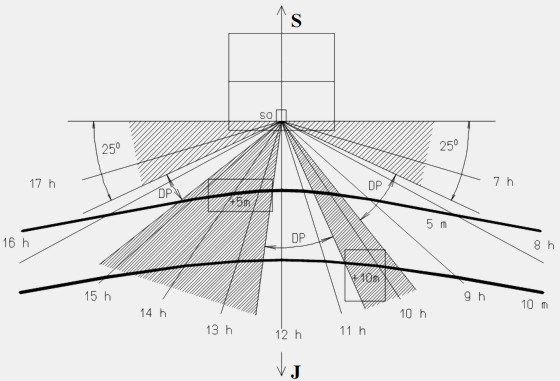 |
Fig. 3 Example of a shading diagram for a south-facing roof window shaded by external shading obstacles, DP...possible sunlight duration, so...roof window
Protection of attic spaces from overheating and glare
Sunlight is essential for a healthy indoor climate in a living room. On the other hand, it is necessary to design shading for roof windows to protect the interior from excessive overheating, especially in the summer season, and in cases where there could be a deterioration of visual comfort due to glare. Limiting solar gains can be addressed during the design of the building itself, primarily through the suitable orientation of interior spaces in relation to cardinal directions and overall layout and structural solutions. Where sunlight is not a requirement, roof windows can be oriented to the north; in other cases, fixed or movable devices for regulating direct sunlight can be used [1]. Awnings, roller blinds, or shades may be used. Shading is placed in the space between the panes for some types either on the external or internal side of the glazing. Generally, external shading devices are considered the most effective for windows. They are recommended in light colors to reflect sunlight. For roof windows, external shading awnings are also used. These, on the other hand, are designed in dark colors (which absorb sunlight) and are separated from the outer surface of the glazing by an air gap.
The theoretically possible amount of solar radiation energy in kWh that can fall on an area of
 |
Fig. 4 Theoretically possible amount of solar energy falling on the surface of the roof window [2]
The amount of solar energy that passes through the glazing into the room is reduced by the effects of reflection and absorption of solar radiation on the glass and shading devices. For determining solar gains, the solar radiation energy falling on the window glazing is reduced using the overall solar transmittance, known as the g-value [-], also referred to as the solar factor. This value represents the ratio of the total solar radiant flux transmitted through the glazing to the incoming solar radiant flux, expressed for the relative spectral composition of solar radiation according to the directive
Figure 5 shows a comparison of the total solar transmittance (solar factor) of clear double glazing (g1=0.79) and thermally insulating double glazing (g2=0.60), considering the impact of shading devices on reducing total transmittance [5].
 |
g1 ... solar factor of clear double glazing (value without shading g1=0.79),
g2 ... solar factor of thermally insulating double glazing (value without shading g2=0.60)
Conclusion
The design of the roof window from the perspective of requirements for sunlight in attic rooms assumes consideration of:- window orientation concerning cardinal directions,
- window size in relation to the floor area of the room and requirements for visual tasks,
- selection of appropriate types of window glazing and type of shading device.
References
[1] ČSN 73 4301 Residential Buildings (2004)[2] Cihelka, J:. Solar Thermal Technology. T. Malina, Prague, 1994
[3] Regulation No. 137/1998 Coll. On General Technical Requirements for Construction
[4] CIE 85 Solar spectral irradiance (1989)
[5] Enclosure for Velux Information No. 3.1-113 (g-value)
The English translation is powered by AI tool. Switch to Czech to view the original text source.