
No More Architecture - Fran Edgerley
Assemble: New Orientations in Architecture
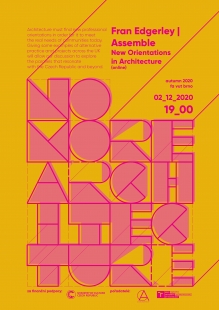
The Faculty of Architecture of the Brno University of Technology, in cooperation with the Architecture Gallery Brno, invites you to a lecture "New Focus in Architecture" by Fran Edgerley from the collective Assemble, which is part of the lecture series "No More Architecture" on the topic of degrowth in architecture. The event will take place online on Wednesday, December 2, 2020, at 7:00 PM via Teams. The lecture will be conducted in English.
The lecture and subsequent discussion will be moderated by Viktória Mravčáková.
The link for online viewing is on YouTube.
For MS Teams organization FA VUT.
FRAN EDGERLEY / ASSEMBLE: NEW FOCUS IN ARCHITECTURE
Architecture must find new professional focuses to be able to respond to the current needs of communities. Through several examples of alternative approaches and projects in the UK, our discussion will explore parallels that resonate in the Czech Republic and beyond.
Fran Edgerley is a partner of the architectural and design collective Assemble, which critically examines the processes that create our built environment. Fran's work focuses on the possibilities of collective and cooperative relationships formed by various social and environmental structures. She is currently working on the creation of a new social center in London, which also serves as a means to challenge land commodification and ownership. Last year, she also contributed to a film about the invisible architectures of language.
NO MORE ARCHITECTURE
Our contemporary society faces perhaps the greatest challenges in its history - the climate crisis and loss of biodiversity, alongside growing social inequalities, the migration of war and climate refugees, etc. Architecture also shares a part in this state - the construction industry accounts for 40% of global carbon emissions, and real estate represents the most advantageous form of investment, leading to speculation, the financialization of housing, privatization of services, and public space, all contributing to the further growth of social inequalities. We must reconsider the current premises of architecture based on growth (the creation of new). It is not enough, for example, to design low-energy houses or implement green roofs - some of the measures considered "sustainable architecture" in the Czech context. Although they may be regarded as progressive (though not commonly implemented), this is insufficient.
We must strive for a more radical redefinition of architecture. It is essential to discuss what role architecture should play in our society and how it can genuinely contribute to improving the living conditions of everyone, without negative impacts on the environment. Let us contemplate architecture of care, maintenance, renovation, or simply repurposing. Architecture that serves the community instead of capital and does not harm, but rather supports social ties and environmental processes. In the words of Jeremy Till and Tatjana Schneider, the solution is not always "adding more stuff to the world." Crises cannot be solved solely through technology (as many suggest); it requires a transformation of our behavior, or - better yet - our desires.
Investments and growth and the rationality associated with these concepts share something in common with a certain type of rationality of "sustainable architecture" and is also linked to a particular way of practicing architecture. If we truly want to confront the challenges of the planetary crisis, we need to change the type of rationality (ways of thinking) as well as architectural practices.
The goal of the lecture is not to present an overview of projects by the architect or studio, but rather to detail the process (including, for example, related political and bureaucratic processes) and the (social and environmental) consequences of a specific selected project. We would like to utilize the lecture series as inspiration for students' practices and (future) architects, broadening their ideas about how they can work - how they can choose clients, find collaborators, initiate projects, or gain support for their ideas. We also value the implementation of sustainability and ethical standards into the structure of the office. As part of the lecture series, we also invite other experts such as curators, theorists, urban planners, landscape architects, etc.
The lecture series "No More Architecture" is held with financial support from the Ministry of Culture of the Czech Republic.
More information >
The lecture and subsequent discussion will be moderated by Viktória Mravčáková.
The link for online viewing is on YouTube.
For MS Teams organization FA VUT.
FRAN EDGERLEY / ASSEMBLE: NEW FOCUS IN ARCHITECTURE
Architecture must find new professional focuses to be able to respond to the current needs of communities. Through several examples of alternative approaches and projects in the UK, our discussion will explore parallels that resonate in the Czech Republic and beyond.
Fran Edgerley is a partner of the architectural and design collective Assemble, which critically examines the processes that create our built environment. Fran's work focuses on the possibilities of collective and cooperative relationships formed by various social and environmental structures. She is currently working on the creation of a new social center in London, which also serves as a means to challenge land commodification and ownership. Last year, she also contributed to a film about the invisible architectures of language.
NO MORE ARCHITECTURE
Our contemporary society faces perhaps the greatest challenges in its history - the climate crisis and loss of biodiversity, alongside growing social inequalities, the migration of war and climate refugees, etc. Architecture also shares a part in this state - the construction industry accounts for 40% of global carbon emissions, and real estate represents the most advantageous form of investment, leading to speculation, the financialization of housing, privatization of services, and public space, all contributing to the further growth of social inequalities. We must reconsider the current premises of architecture based on growth (the creation of new). It is not enough, for example, to design low-energy houses or implement green roofs - some of the measures considered "sustainable architecture" in the Czech context. Although they may be regarded as progressive (though not commonly implemented), this is insufficient.
We must strive for a more radical redefinition of architecture. It is essential to discuss what role architecture should play in our society and how it can genuinely contribute to improving the living conditions of everyone, without negative impacts on the environment. Let us contemplate architecture of care, maintenance, renovation, or simply repurposing. Architecture that serves the community instead of capital and does not harm, but rather supports social ties and environmental processes. In the words of Jeremy Till and Tatjana Schneider, the solution is not always "adding more stuff to the world." Crises cannot be solved solely through technology (as many suggest); it requires a transformation of our behavior, or - better yet - our desires.
Investments and growth and the rationality associated with these concepts share something in common with a certain type of rationality of "sustainable architecture" and is also linked to a particular way of practicing architecture. If we truly want to confront the challenges of the planetary crisis, we need to change the type of rationality (ways of thinking) as well as architectural practices.
The goal of the lecture is not to present an overview of projects by the architect or studio, but rather to detail the process (including, for example, related political and bureaucratic processes) and the (social and environmental) consequences of a specific selected project. We would like to utilize the lecture series as inspiration for students' practices and (future) architects, broadening their ideas about how they can work - how they can choose clients, find collaborators, initiate projects, or gain support for their ideas. We also value the implementation of sustainability and ethical standards into the structure of the office. As part of the lecture series, we also invite other experts such as curators, theorists, urban planners, landscape architects, etc.
The lecture series "No More Architecture" is held with financial support from the Ministry of Culture of the Czech Republic.
More information >
The English translation is powered by AI tool. Switch to Czech to view the original text source.
0 comments
add comment