
Scientists tested how to treat local wood for the production of urban furniture
 |
In the experiment, researchers are collaborating with a company that specializes in making benches and other wooden furniture. Because common wood growing in the Czech Republic tends to change shape or succumb to wood-decaying fungi relatively quickly, the company most often uses jatoba, wood from Brazil, in its production. Its degradation is minimal and it is resistant to fungi.
In exploring ways to increase the durability of wood from local sources, experts from the Faculty of Forestry and Wood Technology primarily focused on beech, whose wood is commonly used in interiors. "The key is the gaseous acetylation process. This technology uses an organic component based on acetic acid, which allows us to change the very cellular structure of the wood. The result is a material that resists wood-decaying fungi, does not crack, and does not deform even under the most challenging conditions without the need for further maintenance," described the process Jakub Dömény from the Department of Wood Science and Wood Processing Technologies. According to him, the surface of the wood in outdoor environments will naturally acquire a gray patina over time, while the material remains solid and stable indoors. Moreover, the method is applicable to other types of wood, such as ash.
The chemical modification was first tested on small samples, and then they moved to a pilot scale with samples approximately 70 centimeters long. Tests of the modified wood in a simulated outdoor environment yielded very good results. In addition to beech and ash, researchers also tested spruce and birch, which is likely to withstand future climate changes as well.
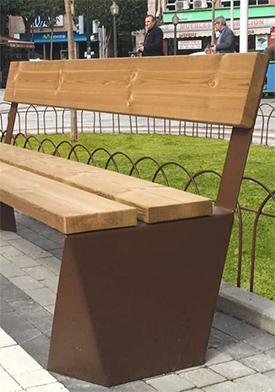
The goal of the project was also to create a prototype of outdoor seating furniture, which will include a solid wood component made from chemically treated wood, thus allowing the extensive use of local wood species.
The English translation is powered by AI tool. Switch to Czech to view the original text source.
0 comments
add comment