
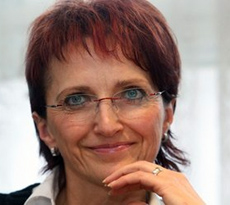
Minister of Culture Hanáková is terminating her position
 |
Hanáková will be the 13th minister to leave Prime Minister Petr Nečas's (ODS) government. Speculation about her departure intensified after she abruptly dismissed the director of the National Theatre, Ondřej Černý, last September.
Fifty-four-year-old Hanáková stated that she decided to resign after today’s meeting with TOP 09 Chairman Karel Schwarzenberg and the leader of the Starostové a nezávislí (STAN) movement, Petr Gazdík. Neither participant wanted to comment on the results of the meeting after it concluded. Schwarzenberg informed ČTK only after the minister’s statement that he wants to choose a new minister carefully and without haste.
“Working in the government, as I have experienced it in 18 months, requires full commitment, but also a strong political mandate. At this moment, I do not feel sufficient support from Karel Schwarzenberg and Petr Gazdík, who hold the position of the minister of this department, therefore I have decided to resign from my position as of June 30,” said Hanáková.
She has held the ministerial position since December 2011 and had little prior experience in high politics. The former mayor of Vizovice, Hanáková is a member of the Starostové a nezávislí movement, which has long cooperated with TOP 09.
The minister stated that she is not attached to her position. According to her, the office completed most of the tasks it had when she took office. She considers the approval of the law on property settlement with churches and the law on support for cinematography to be her successes. She believes that some long-standing issues in the area of heritage care have also progressed.
However, some long-term problems within the ministry have not moved forward during her tenure. Given that the aforementioned regulations were prepared for a long time, Hanáková's contribution to their enactment is not too significant. Not only after the dismissal of the National Theatre director did opponents speculate that she is not the main person running the ministry.
The wave of discontent that this sudden move caused may have paralyzed the minister in her attempt to address the situation at the National Gallery. She did not dismiss its director, Vladimír Rösela, even after her advisory committee returned the concept for the future direction of the NG three times. After Rösela's departure, a part of the professional public and artists long called for his dismissal, but the minister only decided to take this step in mid-April.
Hlaváč, a possible successor to Hanáková, told ČTK today that he has already communicated his ideas and conditions for leading the ministry to TOP 09. However, he did not negotiate further with the party leadership. “That was a courtesy inquiry, to see if I would respond positively if it were officially offered to me. I said yes. As far as I know, others have also been approached,” he told ČTK. He added that the final decision will likely not be with TOP 09 or STAN, but with Prime Minister Nečas. He particularly wants to support the area of live arts.
In addition to Hlaváč, other candidates for the ministerial position include former head of ČT and AMU Ivo Mathé, MP Stanislav Polčák, and senator Jiří Šesták. However, a source from the governmental coalition has previously confirmed that Hlaváč is the favorite.
Alena Hanáková has not had an easy situation - there has long been speculation that the Ministry of Culture is one of the governmental offices that could be abolished as part of cost-cutting measures. There is consideration that after the adoption of the law on settlements with churches, there is less of a significant reason for the continued existence of the Ministry of Culture. People from the live arts criticize the situation where up to a third of the budget goes to the functioning of contributory organizations, and they claim that the ministry merely redistributes money.
The English translation is powered by AI tool. Switch to Czech to view the original text source.
0 comments
add comment