
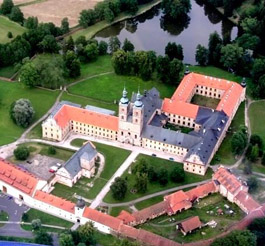
The Premonstratensian Monastery in Teplá has undergone repairs
 |
The story of the founding of the Teplá monastery is connected to the Third Crusade organized by Henry VI. Hroznata was supposed to participate in this expedition in March 1188. Since he did not eventually set off for the Holy Land, he promised to establish a monastery in compensation. He then called Premonstratensian monks from Strahov in Prague to join it. Hroznata also entered the Teplá canonry and received the monastic habit directly from Pope Innocent III. After being captured by marauding knights on July 14, 1217, he died in prison.
In 1232, the monastery church was solemnly consecrated by the Bishop of Prague. The first mass was also attended by the Czech King Wenceslas I. The flourishing monastery was decimated by the plague in 1380, and German settlers began to settle in the region from 1381. During the Hussite Wars, the monastery was spared from pillaging and notably thrived due to the policies of Abbot Zikmund Hausmann (1458 to 1506).
Difficult times began for the monastery during the Reformation; however, several abbots successfully faced these challenges. The monastery sustained considerable damage during the Thirty Years' War. In 1641 and 1648, it was plundered by the Swedes. In 1659, the convent and prelature buildings were completely destroyed by fire. Their present form is the result of a baroque reconstruction from the time of Abbot Raimund II. Wilfert. The monastery also prospered in the 18th century, and the Abbot of Teplá, Karel Reitenberger, was the founder of Mariánské Lázně.
In 1950, the monastery, like other monasteries in Czechoslovakia, was closed and served as a barracks for the Czechoslovak People's Army for 28 years. Only the church and library were accessible from 1958. After the army's departure, the buildings continued to deteriorate. It was not until 1990 that the monastery was returned to the Premonstratensians. Today, the Teplá canonry has 18 members and manages parishes in many locations in Western Bohemia.
The area of the Teplá monastery is unique, for example, the Church of the Annunciation, which illustrates the transition from Romanesque to early Gothic style and is the first hall triple nave in the Czech Republic. At the same time, it shows a cross-section of architectural development, which continued until the 20th century. The baroque appearance of the buildings in the complex was contributed to by the architect Kilián Ignác Dientzenhofer.
The monastery library is significant, being the second largest of its kind in the Czech Republic. With over 100,000 volumes, it serves as a treasure trove of information for researchers. Of these, there are 1,149 manuscripts (45 medieval codices). It houses two very important Germanica, namely the Poenitentionale with an old German prayer written around 830, and the so-called Codex Teplensis, the first translation of the New Testament into German created before 1400.
The English translation is powered by AI tool. Switch to Czech to view the original text source.
0 comments
add comment