
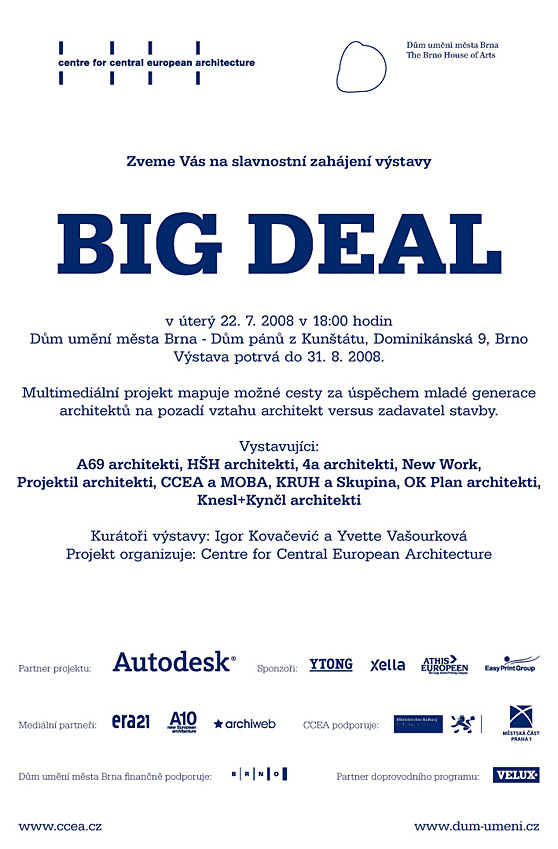
Big Deal
search for "large contracts"
 |
date of the event: July 23 - August 31, 2008
exhibition opening: on Tuesday, July 22, 2008 at 6:00 PM, House of Lords from Kunštát, Dominikánská 9, Brno
press conference: on Tuesday, July 22, 2008 at 11:00 AM, House of Lords from Kunštát, Dominikánská 9, Brno
event location: House of Lords from Kunštát, 1st floor, Dominikánská 9, Brno
the Big Deal project was prepared by: CCEA
exhibition partner in Brno: House of Arts of the City of Brno
exhibitors:
A69 architects (Boris Rodčenkov, Prokop Tomášek, Jaroslav Wertig), HŠH architects (Petr Hájek, Tomáš Hradečný, Jan Šépka), 4a architects (Jan Schindler, Ludvík Seko, Peter Hudák, Leigh D'Agostino), New Work (Svatopluk Sládeček), Projektil architects (Roman Brychta, Adam Halíř, Ondřej Hofmeister, Petr Lešek), CCEA, MOBA (Igor Kovačević, Yvette Vašourková), KRUH, Group (Marcela Steinbachová), OK Plan architects (Luděk Rýzner), Knesl+Kynčl architects (Jiří Knesl, Jakub Kynčl)
 |
"A fleeting glance at contemporary Czech architecture makes the existence of a generation of architects, now between 35 and 40 years old, unmistakably clear. It is here, we can call it strong and successful, but with a more precise characterization, difficulties arise: It only derives from age and with it, approximately, entry into architecture. There is a lack of a generational program, closeness of opinion, and expression. There are no generational associations, clubs, or magazines. There is no clear periodization breakpoint to mark the entry point of the generation. According to established criteria, this generation does not actually exist. Yet it does."
Vladimír Czumalo, quote from the introductory text of the Big Deal catalog
The aim of the BIG DEAL project is not to provide a comprehensive view of the work of the studio. The project does not follow a PR strategy for presenting the studio and avoids biographical exhibition models; it seeks to penetrate the background of the architects’ work, getting "inside" their creative process. Architecture is more directly connected, dependent, and reliant on the initial input from the client - the commissioning party than other artistic disciplines, whether from the private or public sector. The selection of exhibiting architectural studios in the Big Deal project covers the entire range of ways in which young studios can access their first (breakthrough) commissions.
"We are searching for how architectural studios emerged in the post-revolutionary period when the market economy began to function again, and when the builder - commissioning party appeared in forms other than state. We discovered eight relationships between architect and commissioning party. We assigned an architectural studio to each relationship where that relationship became a turning point for further growth or often even for the very establishment and development of the studio. We used these models as a starting point for mapping the Czech architectural generation with immediate experience of the period of communism." explains Igor Kovačević, the project curator.
We are not exclusively focused on understanding and uncovering the mechanisms of developing an architectural studio. We also want to show the pitfalls that accompany the effort to establish oneself and which are part of the search for paths in the architect's creative process. From the beginning, we were interested in the relationship between architect and builder, whether it is the architect-developer, architect-city, or architect-private investor. The core of the exhibition consists of short film interviews with the founders of the represented studios. We utilized the film medium especially for its authenticity - through the film recording, we convey personal contact, personal "storytelling", the message of a specific architect about experiences in searching for a major commission. BIG DEAL wants to show that the high position reached on the imaginary ladder of success (which is often automatically equated with winning larger contracts or growing the studio) does not need to be the primary criterion for evaluating results. Although creative freedom may seem as the antithesis of growth and success, the numerous failures that each studio sometimes goes through can, in the future, manifest themselves in the architect's strong personal expression.
Maintaining authorship and ideas during design is a task that becomes nearly unmanageable with larger contracts. The line between the architect-creator and the architect-just-providing-a-service is very thin. The selected debuts represent very strong creative expressions of individual authors. Time will tell how this "Big Deal generation" will fare with larger contracts - whether it will choose the path of providing services with an emphasis on the maximum number of constructed meters or the path of architect-thinkers formulating societal ideas.
A69 architects /private entrepreneur and architect/
The Cheb studio was founded in 1994 by a trio of young graduates of the Faculty of Architecture of the Czech Technical University in Prague: Boris Rodčenkov, Prokop Tomášek, and Jaroslav Wertig. In a short time, the studio has completed a number of projects, attracting the attention of professional public and media. The studio does not present itself as a closed entity and showcases its work through various lectures and exhibitions.
www.a69.cz
HŠH architects /public opinion and architect/
The architectural office was established in 1998 by Petr Hájek, Tomáš Hradečný, and Jan Šépka. After winning competitions, the young architects found themselves directly from student desks in the unfamiliar environment of the media jungle, in which they soon began to orient themselves and advocate for their proposals.
www.hsharchitekti.cz
4A architects /developer and architect/
The studio, founded in 1998, represents one of the most progressive Prague studios. The international character of the group and differing pedagogical backgrounds guarantee the diversity of architectural approaches in the studio.
www.architekti4a.cz
New Work /private investor and architect/
The Brno studio of architect Svatopluk Sládeček gains attention mainly due to residential and villa architecture, which he perceives as works of art rather than merely utilitarian buildings.
www.newwork.cz
Projektil architects /competition and architect/
The studio, led by a quartet of young architects, has recently become known as the "library studio". Their designs include the Library and Information Center in Hradec Králové and National Technical Library in Prague. www.projektil.cz
CCEA, MOBA /awareness and architect/
Centre for Central European Architecture, the first independent architecture center in the Czech Republic, was established in 2001 and initiated the reflection of contemporary architecture in the broader Central European region. The duo of architects (founders of CCEA) engages in promoting architecture and architectural thinking, seeking their own architectural identity. Through their practical and theoretical work, they strive to strengthen Central European standing.
www.ccea.cz
www.moba.name
KRUH, Group /awareness and architect/
The civic association Kruh organizes lectures, discussions, excursions, and film festivals about architecture. At the same time, it publishes publications documenting contemporary considerations about architecture. Young architect Marcela Steinbachová is a key figure in this association. With all her strength, she combines her own architectural career with the work of the non-profit organization. In 2007, she founded, with colleagues, the architectural office Skupina.
www.kruh.info
www.skupina.org
OK PLAN ARCHITEKTI /periphery and architect/
The studio was founded in 1998 by Luděk Rýzner. It is located midway between Prague and Brno in Humpolec. Through a marketing approach and active PR, the studio has become visible and extends the range of its activities beyond Humpolec.
www.okplan.cz
Knesl+Kynčl architects /local government and architect/
The studio, founded in 2001, is closely connected with the local Faculty of Architecture at the Brno University of Technology, where both founders actively engage in teaching roles.
www.knesl-kyncl.com
exhibition curators: Igor Kovačević, Yvette Vašourková
production: Zuzana Bodnárová, Igor Kovačević (CCEA)
exhibition production for DumB: Jitka Vitásková
graphics of printed materials and film graphics: Petr Štepán
architecture of the exhibition: MOBA
film producer Big Deal: CCEA
screenplay and direction: Igor Kovačević
assistant director: Karolína Jirkalová
cinematographer: Marko Simić
camera: Aleš Blabolil, György Lászlo
sound: Bojan Bojić, Michal Gabor
editing and post-production: František Krähenbiel, Alexandra Gojdičová
 |
The English translation is powered by AI tool. Switch to Czech to view the original text source.
0 comments
add comment