
The author of the 2026 summer pavilion at Serpentine Gallery will be Lanza Atelier
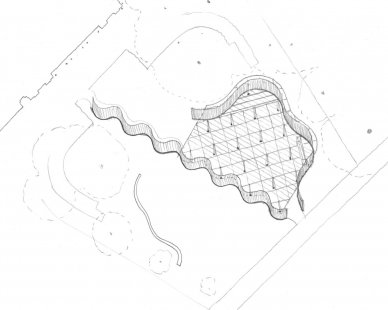
The authors of the twenty-fifth summer pavilion at the Serpentine Gallery will be a pair of Mexican architects from the Lanza studio, who, with their wavy walls made of raw brick, refer to traditional English garden walls. The serpentine shape directly alludes to a specific type of enclosing wall known as the “crinkle crankle brick wall,” which is commonly found in English gardens but originates from ancient Egypt. The origin of these wavy walls is not precisely known, but in September 2020, a similar wall, reaching heights of up to 2.7 meters in some places, was discovered by archaeologists in Luxor, Egypt, in the area of the royal city built during the reign of Amenhotep III, who ruled around 1400 BC. The thin wavy walls originally emerged through the method of “trial and error.” They are characterized by great stability, lower brick consumption compared to regular straight walls, making them more cost-effective. Besides their visual aspect, these protective walls are very practical. They began to appear in Europe from the 14th century, fulfilling a very specific purpose of protecting orchards. In the 17th century, Dutch engineers brought them to England, tasked with transforming marshy areas in the east of the United Kingdom into farmland. The Dutch created an extensive drainage and irrigation system in these areas and then surrounded the land with relatively thin wavy brick walls, which they called “slangenmuur,” meaning “snake wall” in translation. This was a construction element that the English had not known until then. In the 19th century, these walls spread in England to prevent the spread of fires in the landscape. In Suffolk, there are still more than 100 of these wavy walls.
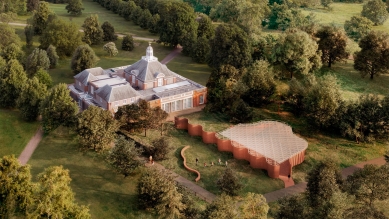
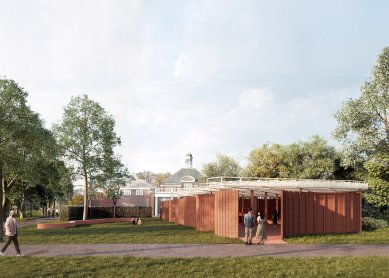
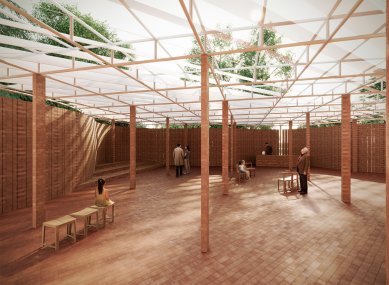
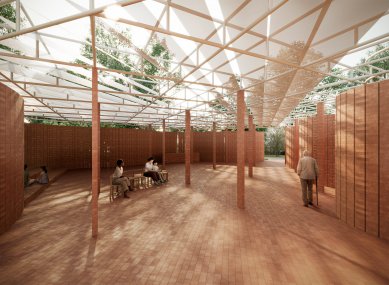
Like traditional brick fences, this year's pavilion will be made of red bricks, thereby also referencing the facade of the nearby Serpentine South gallery. The pavilion will be divided into two parts. One will form a covered communal space with a transparent roof, while the other half will remain open, delineated by a wavy brick bench.
The Lanza studio was founded eleven years ago by the duo of architects Isabel Abascal and Alessandro Arienzo, who live and work together in Mexico City. The authors add about their design: “We are deeply grateful for the opportunity to share our work with the general public and to contribute to the legacy of summer pavilions in the form of architectural experimentation and communal gathering. The project, set within the garden, takes the form of a serpentine wall that simultaneously reveals and conceals: it creates movement, modulates rhythm, and frames the surroundings. In designing the serpentine shape, we were inspired by English wavy walls that surround orchards, helping to moderate the climate, provide shelter, and allow trees to grow. This idea is reflected in the pavilion built from regular bricks, which embodies traditional craftsmanship and the essential ability of architecture to connect people.”
In the history of summer pavilions, this is the second structure designed by a Mexican studio. In 2018, a pavilion by Frida Escobedo was showcased in Kensington Gardens. This year's pavilion will be ceremonially opened on June 6 and will be accessible to the public until October 25, 2026.
More information >
Like traditional brick fences, this year's pavilion will be made of red bricks, thereby also referencing the facade of the nearby Serpentine South gallery. The pavilion will be divided into two parts. One will form a covered communal space with a transparent roof, while the other half will remain open, delineated by a wavy brick bench.
The Lanza studio was founded eleven years ago by the duo of architects Isabel Abascal and Alessandro Arienzo, who live and work together in Mexico City. The authors add about their design: “We are deeply grateful for the opportunity to share our work with the general public and to contribute to the legacy of summer pavilions in the form of architectural experimentation and communal gathering. The project, set within the garden, takes the form of a serpentine wall that simultaneously reveals and conceals: it creates movement, modulates rhythm, and frames the surroundings. In designing the serpentine shape, we were inspired by English wavy walls that surround orchards, helping to moderate the climate, provide shelter, and allow trees to grow. This idea is reflected in the pavilion built from regular bricks, which embodies traditional craftsmanship and the essential ability of architecture to connect people.”
In the history of summer pavilions, this is the second structure designed by a Mexican studio. In 2018, a pavilion by Frida Escobedo was showcased in Kensington Gardens. This year's pavilion will be ceremonially opened on June 6 and will be accessible to the public until October 25, 2026.
More information >
The English translation is powered by AI tool. Switch to Czech to view the original text source.
0 comments
add comment
Related articles
0
31.01.2025 | The author of the Serpentine Gallery's summer pavilion 2025 will be Marina Tabassum
0
24.01.2024 | The author of the Serpentine Gallery summer pavilion 2024 will be Minsuk Cho
0
23.11.2022 | The author of the summer pavilion at Serpentine Gallery 2023 will be Lina Ghotmeh
0
09.02.2022 | The author of the 2022 Serpentine Gallery summer pavilion will be Theaster Gates
1
10.02.2020 | The authors of the Serpentine Gallery summer pavilion 2020 will be Counterspace
0
12.02.2018 | The author of the 2018 Serpentine Gallery summer pavilion will be Frida Escobedo
0
11.02.2016 | The author of the Serpentine Gallery summer pavilion 2016 will be Bjarke Ingels
1
15.02.2013 | The author of the 2013 Serpentine Gallery summer pavilion will be Sou Fujimoto