
Results of the XXth Annual Competition for the Best Urban Project
Last year, for the twentieth time, students of universities that have an urban planning or territorial planning project in their studio program could register for the competition for the best urban project. The competition is organized by the Institute of Spatial Planning of the Faculty of Architecture of the Czech Technical University in Prague under the auspices of the Association for Urbanism and Spatial Planning. Regularly contributing to the competition prizes and costs associated with the exhibition of works are the Faculty of Civil Engineering and the Faculty of Architecture of CTU in Prague, the Faculty of Architecture of VUT in Brno, the Faculty of Architecture of STU in Bratislava, the Faculty of Architecture of Wroclaw University of Technology in Wroclaw, the architectural studio Cigler Marani, the architectural office Atelier 6, the studio Casua, the Urbanism and Spatial Planning Atelier U-24, Sekyra Group, Urbanist Center Brno, the International Visegrad Fund, the Association for Urbanism and Spatial Planning in Slovakia, and the Czech Chamber of Architects.
In the jury of the jubilee XX edition sat Ing. arch. Jan Němec (City of České Budějovice), Doc. Ing. arch. Ivan Vorel, CSc. (FSV CTU), Doc. Ing. arch. Karel Havliš (FA VUT Brno), Dr. Inž. Wawrzyniec Zipser (FATU Wroclaw), Ing. arch. Josef Morkus, Ph.D (Association for Urbanism and Spatial Planning), Ing. arch. Jan Cach (Magistrate of the City of Prague), Ing. arch. Alžbeta Sopirová, PhD. (FA STU in Bratislava), Ing. arch. Laura Jablonská (FA CTU) and Ing. arch. Dana Zákostelecká (Project Atelier Strakonice).
The jury addressed 37 submitted competition works at its meeting on February 20. 25 projects were from CTU in Prague, of which 21 were from the Faculty of Architecture and 4 from the Faculty of Civil Engineering, 8 proposals from FA STU in Bratislava, and 4 proposals from FA VUT in Brno. Ing. arch. Jan Němec was elected chairman of the commission. The competition secretary, Ing. arch. Vít Řezáč was represented during the meeting by Ing. arch. Zuzana Krmelová.
The jury evaluated the idea of the project, the complexity and reality of the proposed solution, ingenuity, but also the quality of the overall presentation. This year's selection represents a broad mosaic of various urban tasks and approaches. Both well-targeted small solutions to identified problems and proposals for entire new urban units were rewarded. Among the typical urban projects, there was, for example, a vision for a village or a research approach to creating quality public spaces.
In the first round of evaluations, 12 works advancing to the second round were selected by preferential votes, in which the jury determined 6 finalist works based on point evaluations. These works were then addressed within individual verbal evaluations and subsequent voting, from which the distribution of rewards and awarded works resulted. Based on individual point assessments, the order of the awards was then determined.
ANNOUNCEMENT OF WINNERS
On March 24, a festive exhibition opening of the awarded works and a public announcement of the winners took place in the premises of the Faculty of Architecture.
Diplomas were handed out by the Dean of the Faculty of Architecture, Prof. Ing. arch. Ladislav Lábus, Hon FAIA. In his speech, he highlighted the opportunity that student competitions provide, allowing their work to be objectively assessed by academic staff as well as practitioners. He sees the value of the Student Competition for the Best Urban Project primarily in the possibility of comparing the approaches of competitors from different universities. Students thus gain valuable feedback that can facilitate not only their further studies at the university but also help them navigate the practical aspects of urbanism before entering practice.
EXHIBITIONS
The exhibition at the faculty lasted until April 4, after which the winning projects moved to the spring conference of the Association for Urbanism and Spatial Planning in Lázní Jeseník, where participants could view them on April 23 and 24.
The works will then be exhibited at the Faculty of Architecture of VUT in Brno from May 4 to May 15. From there, the proposals will go on to the Faculty of Architecture STU in Bratislava from May 25 to June 5.
They will then be on display in Prague again from July 13 to July 16 at the Faculty of Architecture on the occasion of the International Conference AESOP, and in the autumn at the National Technical Library as part of the nationwide event, Architecture Week.
AWARDED WORKS:
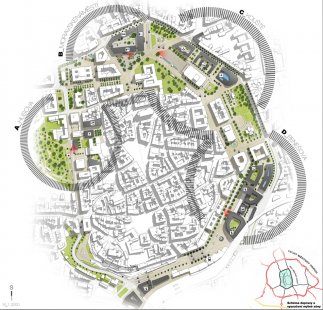
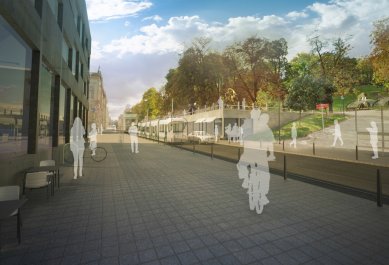
1. PRIZE BRNO CIRCULAR ROAD – HEALING THE CITY
Vladimíra Soukupová, Pavel Čučka, Ondrej Palenčar, Barbora Krátká
VUT Brno, UN5, AT3, Doc.Ing. arch. Gabriel Kopáčik, Dr.
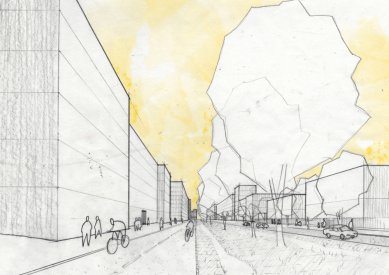
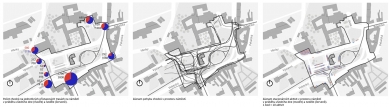
Jury evaluation: The clearly structured work of the students impressed the jury with its effort to connect (“sew”) the existing parts of the settlement structure – the city. The area of the Brno city bypass was subjected to transport, spatial, and functional analysis. Urban structures were evaluated in terms of wider transport relationships, car movement, noise, public transport routes, pedestrian movement, functional distribution of areas, building heights, aesthetic quality, and technical condition of the built environment, quality of the ground floor according to J. Gehl, and the functions of the public spaces. The work described the values, limits, and problems of the area being addressed; references indicated inspirations for solutions. The jury appreciated the effort to find relationships between individual layers, to name problems, and to define places for “healing.” Another appreciated aspect of the work was that it does not focus only on analysis but also seeks solutions in a material, spatial, and functionally successful proposal that tastefully complements and enhances the existing structure of the city. The work of the collective authors has a uniform graphic style, is clearly presented from analysis through concept to design. It addresses current problems of many contemporary cities. Therefore, in the final voting, it received the highest number of votes and placed first among other interesting competition proposals.
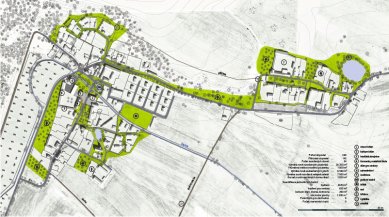
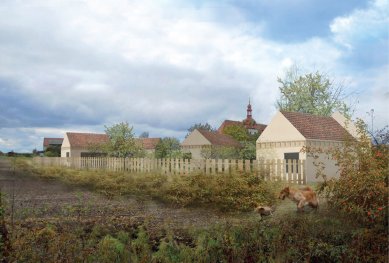
2. PRIZE VILLAGE OF MALÉ A VYSOKÉ BŘEZNO
Miroslav Bachura, František Gattermayer, Magda Havlová, Markéta Součková
FA CTU Prague, Atelier of Jan Šépka and Mirka Tůmová
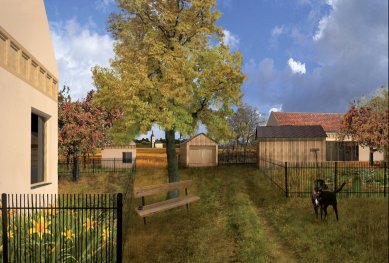
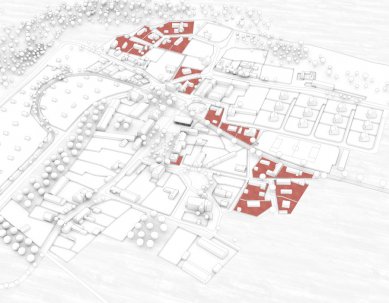
Jury evaluation: The modest work captures attention only at second glance. However, the chosen topic is very current. The borderlands affected by the post-war expulsion of German-speaking inhabitants, collectivization of agriculture since the 1950s, and extensive brown coal mining in the vicinity. These are the stigmas that determine the real environment of many villages. The careful restoration, based primarily on the principles of creating public spaces characteristic of the village through the method of "shaping from within," is perhaps the greatest asset of the submitted work. The authentic experience from a thoroughly understood environment, derived rules for new parceling and spatial regulation, are presented through an urban and architectural study. The application of spatial rules, including architectural types of houses and buildings, clearly shows how to suitably complement not only the missing functions in the village but also how to further shape the spaces of the community with its own genius loci.
3. PRIZE NEW HEART FOR LIBUŠ
Cécilia Cardinaud, Linda Schleppers, Markéta Wallo
FA CTU, Institute of Spatial Planning, Prof. Ing. arch. Karel Maier, CSc.
Jury evaluation: The project, dedicated to a challenging task in a spatially and functionally very heterogeneous and fragmented development, makes good use of the potential of the site. Analyses show the starting points for grasping the task and its solution. Emphasis is placed on connecting Libuš via the metro route and overlapping tram and bus systems not only in the radial direction to the center but also towards large residential complexes between Libuš and the Vltava corridor (Modřany, Novodvorská, Lhotka). This creates conditions for significant concentrations of activities in the addressed area while facing a deficit of civic amenities highlighted in the analyses. The proposed solution responds well to the existing development and natural pedestrian flow directions, creating a spatially well-conceived composition of public spaces and functions in the center. The dimensions of the spaces, massing composition, and scale of the proposed spatial structure are proportional and create an image of a contemporary center without the need for height dominant structures and mass contrasts. The strengths of the proposal also lie in the complexity of the elaboration, which clearly and understandably presents not only the analyses but also the interpretation of the proposal. The proposal is addressed not only in the urbanistic situation and 3D representation but also in views of the objects and open spaces and in the basic layout scheme of the development at the ground floor level. The project is characterized by a well-thought-out concept and the complexity of its presentation.
AWARD COMPLETION OF THE URBAN STRUCTURE DEJVICE - HRADČANSKÁ
Tomáš Kučera
FA CTU Prague, Institute of Urbanism, Atelier Kuzemenský
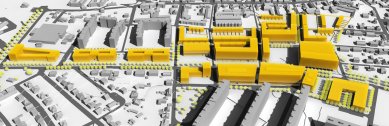
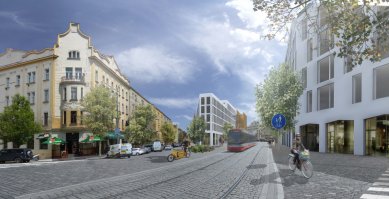
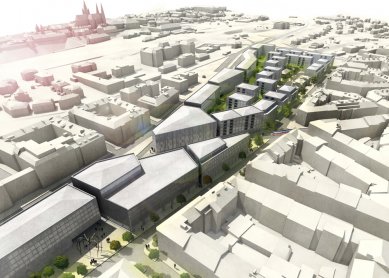
Jury evaluation: The project addresses the popular task of complementing the area of Hradčanská in Prague. The proposed compact urban structure is adequate to the location of the area and connects well to the surrounding development. The proportions of the proposed public spaces seem appropriate. The design dealt well with the limits given mainly by the complex situation of the infrastructure buildings. The jury considers the resolution of the "inner block" with solitary objects with front gardens on an elevated platform above the level of public and semi-public spaces to be debatable. This solution can create uncomfortable corners and leaves minimal space for greenery on the natural terrain. A beneficial compositional element of the design is the extension of Dejvická Street along the route of the historic road. The extended street and the key activities connected to it support the existing values of the shopping street and develop its potential. The importance within the urban structure is also underlined by the proposal for a diversion of the tram line along its route. An interesting element is the intentional closure of the compositional axis from the Písecká Gate (Bubenečská Street – K Brusce). The jury missed a more detailed description of the proposed solution; on the other hand, they welcomed the list of principles on which the author relied. The jury considers the graphic presentation of the proposal to be of very high quality and convincing. The visualizations clearly document the character and atmosphere of the proposed area.
AWARD TRNAVA and its development - western development of the city – Kamenný mlyn zone
Tamara Čendulová
FA STU Bratislava, Institute of Urbanism and Spatial Planning, Doc. Ing. arch. Alžběta Sopirová, CSc.
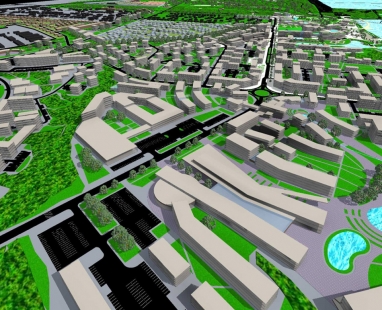
Jury evaluation: The student work "Trnava - western development" contains an extensive analysis of the addressed area from regional contexts to settlement and zonal analyses. It is characterized by in-depth knowledge of the starting points influencing the overall design of the addressed locality, with a clear and comprehensible organic concept that avoids monotony and schematism. The proposed urban structure consists of several functional zones – a central multifunctional, residential, sports-recreational, scientific-research, to an exhibition zone. Individual parts are interlinked in a south-north direction by a boulevard, which is terminated by a roundabout. This roundabout, which forms a local center, was assessed by the commission members as a solution that is not suitable for pivotal spaces. Conversely, the contribution of the work is the optimal incorporation of natural potential into the overall design, whether in the form of an alley or wider green belts, complemented by sports and relaxation activities. Natural elements create dividing spaces between the urban and rural structure of the built environment. The area, in contact with the water surface, provides a place for people to meet and actively spend their leisure time. At the center of the entire structure, this space is designed as an urban embankment, allowing for walks and sitting by the water in cafes and restaurants; within the residential area, it gradually transforms into a natural character, which leads the pedestrian and cycling trail.
The work was awarded for its extensive scope, broad content, and interesting conceptual solution.
AWARD MY SQUARE – EVALUATION OF SQUARE QUALITY
Pavla Kilnarová, Ivana Lelkes, Kristián Škoda
FA VUT Brno, Institute of Design V, Doc. Ing. arch. Gabriel Kopáčik, Dr.
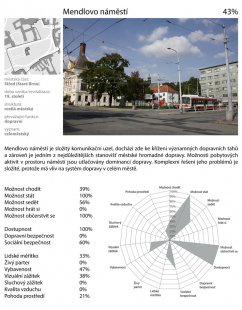
Jury evaluation: The subject of the solution was to create a methodology for evaluating local public spaces. The work analyzed 66 public spaces according to the authors' multi-criteria assessment principles. The second part of the work involved conducting detailed research on the quality of life at Halasovo náměstí according to the methodology proposed by Jan Gehl. The committee appreciated the comprehensive and flexible approach to the issue of public spaces and methodological consistency. The analyses follow one another, and each is appropriately tailored by the authors to the needs of the citizens (e.g., by introducing changes in the survey). The authors invested a great deal of work into their study, yet the whole remains communicative. Part of the multi-criteria evaluation was developed in a synthetic form of cards characterizing individual squares, including a final summary and a proposal on how to achieve improvement. This approach allows for a broader assessment and comparison of the quality of squares in their similarities and differences while promoting this assessment to a considerable extent, e.g., on websites as the authors did. Although this work is predominantly theoretical, it fits very well into the current trend of multidisciplinary works that utilize public participation techniques.
More information about the competition and a collection of awarded projects, including author reports, can be found at the internet address www.gis.cvut.cz.
In the jury of the jubilee XX edition sat Ing. arch. Jan Němec (City of České Budějovice), Doc. Ing. arch. Ivan Vorel, CSc. (FSV CTU), Doc. Ing. arch. Karel Havliš (FA VUT Brno), Dr. Inž. Wawrzyniec Zipser (FATU Wroclaw), Ing. arch. Josef Morkus, Ph.D (Association for Urbanism and Spatial Planning), Ing. arch. Jan Cach (Magistrate of the City of Prague), Ing. arch. Alžbeta Sopirová, PhD. (FA STU in Bratislava), Ing. arch. Laura Jablonská (FA CTU) and Ing. arch. Dana Zákostelecká (Project Atelier Strakonice).
The jury addressed 37 submitted competition works at its meeting on February 20. 25 projects were from CTU in Prague, of which 21 were from the Faculty of Architecture and 4 from the Faculty of Civil Engineering, 8 proposals from FA STU in Bratislava, and 4 proposals from FA VUT in Brno. Ing. arch. Jan Němec was elected chairman of the commission. The competition secretary, Ing. arch. Vít Řezáč was represented during the meeting by Ing. arch. Zuzana Krmelová.
The jury evaluated the idea of the project, the complexity and reality of the proposed solution, ingenuity, but also the quality of the overall presentation. This year's selection represents a broad mosaic of various urban tasks and approaches. Both well-targeted small solutions to identified problems and proposals for entire new urban units were rewarded. Among the typical urban projects, there was, for example, a vision for a village or a research approach to creating quality public spaces.
In the first round of evaluations, 12 works advancing to the second round were selected by preferential votes, in which the jury determined 6 finalist works based on point evaluations. These works were then addressed within individual verbal evaluations and subsequent voting, from which the distribution of rewards and awarded works resulted. Based on individual point assessments, the order of the awards was then determined.
ANNOUNCEMENT OF WINNERS
On March 24, a festive exhibition opening of the awarded works and a public announcement of the winners took place in the premises of the Faculty of Architecture.
Diplomas were handed out by the Dean of the Faculty of Architecture, Prof. Ing. arch. Ladislav Lábus, Hon FAIA. In his speech, he highlighted the opportunity that student competitions provide, allowing their work to be objectively assessed by academic staff as well as practitioners. He sees the value of the Student Competition for the Best Urban Project primarily in the possibility of comparing the approaches of competitors from different universities. Students thus gain valuable feedback that can facilitate not only their further studies at the university but also help them navigate the practical aspects of urbanism before entering practice.
EXHIBITIONS
The exhibition at the faculty lasted until April 4, after which the winning projects moved to the spring conference of the Association for Urbanism and Spatial Planning in Lázní Jeseník, where participants could view them on April 23 and 24.
The works will then be exhibited at the Faculty of Architecture of VUT in Brno from May 4 to May 15. From there, the proposals will go on to the Faculty of Architecture STU in Bratislava from May 25 to June 5.
They will then be on display in Prague again from July 13 to July 16 at the Faculty of Architecture on the occasion of the International Conference AESOP, and in the autumn at the National Technical Library as part of the nationwide event, Architecture Week.
AWARDED WORKS:
1. PRIZE BRNO CIRCULAR ROAD – HEALING THE CITY
Vladimíra Soukupová, Pavel Čučka, Ondrej Palenčar, Barbora Krátká
VUT Brno, UN5, AT3, Doc.Ing. arch. Gabriel Kopáčik, Dr.
Jury evaluation: The clearly structured work of the students impressed the jury with its effort to connect (“sew”) the existing parts of the settlement structure – the city. The area of the Brno city bypass was subjected to transport, spatial, and functional analysis. Urban structures were evaluated in terms of wider transport relationships, car movement, noise, public transport routes, pedestrian movement, functional distribution of areas, building heights, aesthetic quality, and technical condition of the built environment, quality of the ground floor according to J. Gehl, and the functions of the public spaces. The work described the values, limits, and problems of the area being addressed; references indicated inspirations for solutions. The jury appreciated the effort to find relationships between individual layers, to name problems, and to define places for “healing.” Another appreciated aspect of the work was that it does not focus only on analysis but also seeks solutions in a material, spatial, and functionally successful proposal that tastefully complements and enhances the existing structure of the city. The work of the collective authors has a uniform graphic style, is clearly presented from analysis through concept to design. It addresses current problems of many contemporary cities. Therefore, in the final voting, it received the highest number of votes and placed first among other interesting competition proposals.
2. PRIZE VILLAGE OF MALÉ A VYSOKÉ BŘEZNO
Miroslav Bachura, František Gattermayer, Magda Havlová, Markéta Součková
FA CTU Prague, Atelier of Jan Šépka and Mirka Tůmová
Jury evaluation: The modest work captures attention only at second glance. However, the chosen topic is very current. The borderlands affected by the post-war expulsion of German-speaking inhabitants, collectivization of agriculture since the 1950s, and extensive brown coal mining in the vicinity. These are the stigmas that determine the real environment of many villages. The careful restoration, based primarily on the principles of creating public spaces characteristic of the village through the method of "shaping from within," is perhaps the greatest asset of the submitted work. The authentic experience from a thoroughly understood environment, derived rules for new parceling and spatial regulation, are presented through an urban and architectural study. The application of spatial rules, including architectural types of houses and buildings, clearly shows how to suitably complement not only the missing functions in the village but also how to further shape the spaces of the community with its own genius loci.
3. PRIZE NEW HEART FOR LIBUŠ
Cécilia Cardinaud, Linda Schleppers, Markéta Wallo
FA CTU, Institute of Spatial Planning, Prof. Ing. arch. Karel Maier, CSc.
Jury evaluation: The project, dedicated to a challenging task in a spatially and functionally very heterogeneous and fragmented development, makes good use of the potential of the site. Analyses show the starting points for grasping the task and its solution. Emphasis is placed on connecting Libuš via the metro route and overlapping tram and bus systems not only in the radial direction to the center but also towards large residential complexes between Libuš and the Vltava corridor (Modřany, Novodvorská, Lhotka). This creates conditions for significant concentrations of activities in the addressed area while facing a deficit of civic amenities highlighted in the analyses. The proposed solution responds well to the existing development and natural pedestrian flow directions, creating a spatially well-conceived composition of public spaces and functions in the center. The dimensions of the spaces, massing composition, and scale of the proposed spatial structure are proportional and create an image of a contemporary center without the need for height dominant structures and mass contrasts. The strengths of the proposal also lie in the complexity of the elaboration, which clearly and understandably presents not only the analyses but also the interpretation of the proposal. The proposal is addressed not only in the urbanistic situation and 3D representation but also in views of the objects and open spaces and in the basic layout scheme of the development at the ground floor level. The project is characterized by a well-thought-out concept and the complexity of its presentation.
AWARD COMPLETION OF THE URBAN STRUCTURE DEJVICE - HRADČANSKÁ
Tomáš Kučera
FA CTU Prague, Institute of Urbanism, Atelier Kuzemenský
Jury evaluation: The project addresses the popular task of complementing the area of Hradčanská in Prague. The proposed compact urban structure is adequate to the location of the area and connects well to the surrounding development. The proportions of the proposed public spaces seem appropriate. The design dealt well with the limits given mainly by the complex situation of the infrastructure buildings. The jury considers the resolution of the "inner block" with solitary objects with front gardens on an elevated platform above the level of public and semi-public spaces to be debatable. This solution can create uncomfortable corners and leaves minimal space for greenery on the natural terrain. A beneficial compositional element of the design is the extension of Dejvická Street along the route of the historic road. The extended street and the key activities connected to it support the existing values of the shopping street and develop its potential. The importance within the urban structure is also underlined by the proposal for a diversion of the tram line along its route. An interesting element is the intentional closure of the compositional axis from the Písecká Gate (Bubenečská Street – K Brusce). The jury missed a more detailed description of the proposed solution; on the other hand, they welcomed the list of principles on which the author relied. The jury considers the graphic presentation of the proposal to be of very high quality and convincing. The visualizations clearly document the character and atmosphere of the proposed area.
AWARD TRNAVA and its development - western development of the city – Kamenný mlyn zone
Tamara Čendulová
FA STU Bratislava, Institute of Urbanism and Spatial Planning, Doc. Ing. arch. Alžběta Sopirová, CSc.
Jury evaluation: The student work "Trnava - western development" contains an extensive analysis of the addressed area from regional contexts to settlement and zonal analyses. It is characterized by in-depth knowledge of the starting points influencing the overall design of the addressed locality, with a clear and comprehensible organic concept that avoids monotony and schematism. The proposed urban structure consists of several functional zones – a central multifunctional, residential, sports-recreational, scientific-research, to an exhibition zone. Individual parts are interlinked in a south-north direction by a boulevard, which is terminated by a roundabout. This roundabout, which forms a local center, was assessed by the commission members as a solution that is not suitable for pivotal spaces. Conversely, the contribution of the work is the optimal incorporation of natural potential into the overall design, whether in the form of an alley or wider green belts, complemented by sports and relaxation activities. Natural elements create dividing spaces between the urban and rural structure of the built environment. The area, in contact with the water surface, provides a place for people to meet and actively spend their leisure time. At the center of the entire structure, this space is designed as an urban embankment, allowing for walks and sitting by the water in cafes and restaurants; within the residential area, it gradually transforms into a natural character, which leads the pedestrian and cycling trail.
The work was awarded for its extensive scope, broad content, and interesting conceptual solution.
AWARD MY SQUARE – EVALUATION OF SQUARE QUALITY
Pavla Kilnarová, Ivana Lelkes, Kristián Škoda
FA VUT Brno, Institute of Design V, Doc. Ing. arch. Gabriel Kopáčik, Dr.
Jury evaluation: The subject of the solution was to create a methodology for evaluating local public spaces. The work analyzed 66 public spaces according to the authors' multi-criteria assessment principles. The second part of the work involved conducting detailed research on the quality of life at Halasovo náměstí according to the methodology proposed by Jan Gehl. The committee appreciated the comprehensive and flexible approach to the issue of public spaces and methodological consistency. The analyses follow one another, and each is appropriately tailored by the authors to the needs of the citizens (e.g., by introducing changes in the survey). The authors invested a great deal of work into their study, yet the whole remains communicative. Part of the multi-criteria evaluation was developed in a synthetic form of cards characterizing individual squares, including a final summary and a proposal on how to achieve improvement. This approach allows for a broader assessment and comparison of the quality of squares in their similarities and differences while promoting this assessment to a considerable extent, e.g., on websites as the authors did. Although this work is predominantly theoretical, it fits very well into the current trend of multidisciplinary works that utilize public participation techniques.
More information about the competition and a collection of awarded projects, including author reports, can be found at the internet address www.gis.cvut.cz.
The English translation is powered by AI tool. Switch to Czech to view the original text source.




0 comments
add comment
Related articles
0
22.03.2018 | Results of the XXIII. edition of the competition for the best urban project
0
04.03.2018 | XXIII. edition of the competition for the best urban planning project - invitation to the announcement
0
19.11.2016 | Results of the XXII. edition of the competition for the best urban planning project
0
21.03.2013 | Results of the XVIII. year of the competition for the best urban planning project