
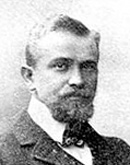
František Grossmann
*3. 8. 1876 – Pustějov, Czech Republic
†8. 11. 1933 – Ostrava, Czech Republic
Biography
After gaining the necessary experience, he operated an independent construction company in Frýdek from 1904. In the spring of 1906, he transferred his license to Moravian Ostrava, where he opened a construction office together with architect František Fiala. Their firm then carried out larger church constructions in Mariánské Hory, Hrabůvka, and Chabičov, as well as the so-called Jubilee School in Štramberk. However, in September 1911, both partners parted ways and continued to operate their construction businesses independently. This occurred shortly after the firm Grossmann & Fiala received large contracts for the reconstruction of industrial facilities at the Zárubek mine in Polish Ostrava and partially the Michal mine in Michálkovice between 1910 and 1915. During the interwar period, he became one of the most successful construction entrepreneurs in Ostrava, executing a number of large industrial and residential projects, such as the contract from Vítkovice Ironworks for the construction of cement plants in Štramberk, where he also built office houses and worker accommodations near the Kotouč quarry (1921). The city of Nový Jičín also awarded him a larger contract for the construction of a group of residential buildings. Among his private projects were residential and office buildings for industrial manager Josef Kobliha in Moravian Ostrava (1922–1923), a villa for general practitioner Dr. Vilém Kožuch in Přívoz (1927), and weekend houses in the Beskydy Mountains for the head of the administrative department of the Northern Railway's inspectorate, Dr. Leu Belz (Kunčice pod Ondřejníkem), and bank prokurist Jaroslav Hůlka (Čeladná). In 1925, he received an order from the Czechoslovak Tourist Club in Štramberk for the construction of Rašín's lodge. A year later, the German tourist association Beskidenverein entrusted him with the reconstruction of the Ostrava Lodge on Lysá hora. In 1932, representatives of the Sokol in Mariánské Hory, Antonín Záviš and Antonín Kuchař, ordered him to carry out their private buildings, which became the subject of attacks by the Social Democratic press against the Ostrava National Democrats, as Grossmann's firm was considered German.
He was a great lover of art and culture, which was reflected in the execution and luxurious furnishings of his own villa, built between 1922 and 1923, along with the representative seat of the firm. He collected art objects, especially paintings, sculptures, porcelain, and furniture, which he acquired at auctions and from sold castle furnishings. His national characteristics were not entirely clear-cut. He was born into a Czech family, as was his wife; however, before World War I, he declared himself to be of German nationality, and after the state coup in 1918, he identified with the German part of Ostrava society.
At the end of the 1920s, he carried out several projects of significant financial volume. However, after the onset of the economic crisis, his clients stopped paying him, and the resulting receivables became difficult to collect.
After gaining the necessary experience, he operated an independent construction company in Frýdek from 1904. In the spring of 1906, he transferred his license to Moravian Ostrava, where he opened a construction office together with architect František Fiala. Their firm then carried out larger church constructions in Mariánské Hory, Hrabůvka, and Chabičov, as well as the so-called Jubilee School in Štramberk. However, in September 1911, both partners parted ways and continued to operate their construction businesses independently. This occurred shortly after the firm Grossmann & Fiala received large contracts for the reconstruction of industrial facilities at the Zárubek mine in Polish Ostrava and partially the Michal mine in Michálkovice between 1910 and 1915. During the interwar period, he became one of the most successful construction entrepreneurs in Ostrava, executing a number of large industrial and residential projects, such as the contract from Vítkovice Ironworks for the construction of cement plants in Štramberk, where he also built office houses and worker accommodations near the Kotouč quarry (1921). The city of Nový Jičín also awarded him a larger contract for the construction of a group of residential buildings. Among his private projects were residential and office buildings for industrial manager Josef Kobliha in Moravian Ostrava (1922–1923), a villa for general practitioner Dr. Vilém Kožuch in Přívoz (1927), and weekend houses in the Beskydy Mountains for the head of the administrative department of the Northern Railway's inspectorate, Dr. Leu Belz (Kunčice pod Ondřejníkem), and bank prokurist Jaroslav Hůlka (Čeladná). In 1925, he received an order from the Czechoslovak Tourist Club in Štramberk for the construction of Rašín's lodge. A year later, the German tourist association Beskidenverein entrusted him with the reconstruction of the Ostrava Lodge on Lysá hora. In 1932, representatives of the Sokol in Mariánské Hory, Antonín Záviš and Antonín Kuchař, ordered him to carry out their private buildings, which became the subject of attacks by the Social Democratic press against the Ostrava National Democrats, as Grossmann's firm was considered German.
He was a great lover of art and culture, which was reflected in the execution and luxurious furnishings of his own villa, built between 1922 and 1923, along with the representative seat of the firm. He collected art objects, especially paintings, sculptures, porcelain, and furniture, which he acquired at auctions and from sold castle furnishings. His national characteristics were not entirely clear-cut. He was born into a Czech family, as was his wife; however, before World War I, he declared himself to be of German nationality, and after the state coup in 1918, he identified with the German part of Ostrava society.
At the end of the 1920s, he carried out several projects of significant financial volume. However, after the onset of the economic crisis, his clients stopped paying him, and the resulting receivables became difficult to collect.
The English translation is powered by AI tool. Switch to Czech to view the original text source.