
The court in Semily will most likely return the furnishings of the Hrubý Rohozec castle to the Walderode family
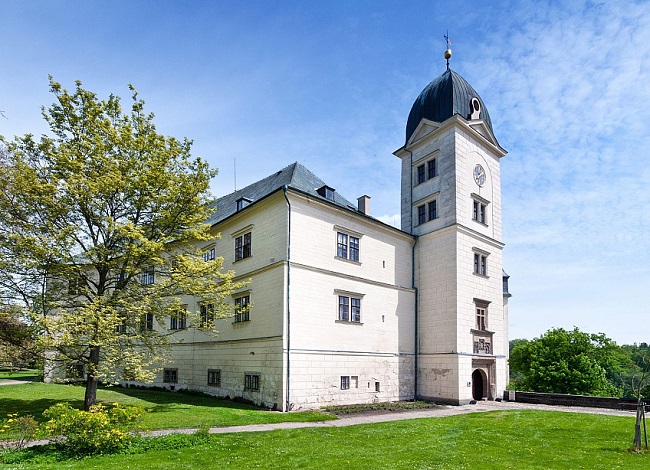 |
Semily - The District Court in Semily is likely to grant the lawsuit for the return of part of the furnishings of the State Castle of Hrubý Rohozec in Turnov in the Semily region to the heir of the Walderode family. Judge Michal Polák told reporters today that this is his preliminary opinion, and the verdict will be issued at the end of February. It concerns more than 4,000 items described on 113 sheets, specifically furniture, paintings, weapons, and candlesticks.
"According to my preliminary legal opinion, nothing prevents those items from being returned. But of course, the participants still have the opportunity to convince me in their closing statements," said the judge.
The return of the furnishings from the state castle is part of a vast restitution case that has been ongoing for three decades. The noble family has been seeking the return of their property since 1992, mostly unsuccessfully. The dispute involves not only the castle but also forests and land in the Semily, Jablonec, and Liberec regions. They have so far regained a quarter of a hectare of municipal forest near Žďárek in the Liberec area. Karl des Fours Walderode did not live to see this, as he passed away in 2000 at the age of 95. The claim for the return of the property is being made by Johanna Kammerlander, his widow.
Walderode lost his estate in Turnov and the surrounding area after World War II as a German based on the Beneš decrees. In 1947, Czechoslovak authorities returned his citizenship, but it was revoked again after he emigrated following the communist coup in February 1948, and he regained it only after the regime change in 1992. The courts then took years to address whether he was entitled to the return of his billion-dollar property. The opportunities for the noble family increased based on a ruling from the Constitutional Court (ÚS) two years ago. According to it, justice must be based on the authorities' decision to restore Czechoslovak citizenship from 1947, which fulfills the basic condition for the return of property.
The Semily judge reiterated today that the fundamental question of whether the plaintiff in the dispute is a legitimate party is considered resolved based on the ÚS's decision. However, he noted that he would dismiss the heir's lawsuit against the National Heritage Institute (NPÚ) for the items that could not be located. There are several hundred of these.
Kammerlander's legal representative, Roman Heyduk, told reporters today that after 80 years, it is difficult to trace what all was in the castle at that time. "Nobody knows that. The problem is that there is a list from 1953 that we used, but it is again just a list from the archive. And it really cannot be traced. And a number of items were stolen, that needs to be acknowledged. Such was the time. In 1967, someone stole 20 valuable weapons from there," he said.
The NPÚ's legal representative did not want to comment on today's court proceedings, but during the hearing, he pointed out that the castle's furnishings are a cultural monument. "They must remain in the territory of the Czech Republic," he stated.
How Kammerlander will decide to handle the furnishings if they are returned, Heyduk does not know. "My opinion is that they will not move from the castle, that they are simply reminders that cannot be exported," he added.
Regional spokesperson for the NPÚ Lucie Bidlasová previously told ČTK that the castle's furnishings collection consists of 23,000 inventory units, of which about a quarter are verifiably core items. Additionally, there is a library with approximately 10,000 volumes. This is not being discussed in this phase of the dispute, and according to Heyduk, it has not been documented.
The English translation is powered by AI tool. Switch to Czech to view the original text source.
0 comments
add comment