Interview with Tania Ruiz

Publisher
Filip Šenk
24.07.2013 07:00

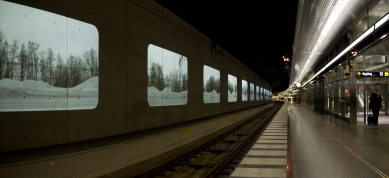
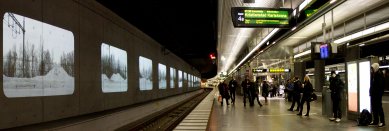
Tania Ruiz Gutiérrez was awarded in the framework of the European Prize for Urban Public Space for the year 2012. Her video projection "Elsewhere" has been a part of the main train station in Malmö, Sweden since December 2010. The space of the main train station is free of advertisements, instead dominated by a total of 360 meters of artistic video projection.
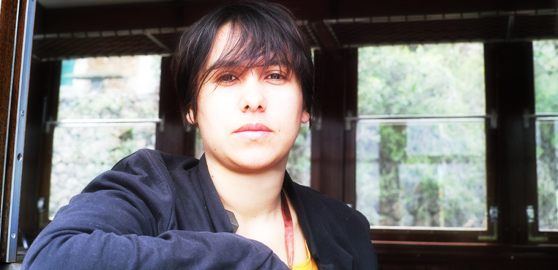
Tania Ruiz Gutiérrez was born in Chile, grew up in Colombia, and has been living in Paris since 1999. She studied film production in Colombia and continued her studies in art in Paris. Today, she also teaches at the University of Paris VIII. In Prague, she participated in the reSITE conference and her project is simultaneously exhibited as part of the ongoing presentation of the European Prize for Urban Public Space at the Jaroslav Fragner Gallery.
Filip Šenk: How can an artist contribute to the quality of public space or architecture?
TRG:
Your question has two dimensions. Typically, the role of the artist is primarily to create some forms of ornamentation. However, I hope that in the project we are currently discussing, the role of the artist was different. That’s because the artist, namely me, was part of the project from its inception. The artwork is an integral part of the entire building. Without it, the building would not be complete. As a result of being a fixed component of the artwork, the space of the building is completely different. The projection runs seventeen hours a day, and when you visit the place at a time when it is turned off, the transformation of the environment is completely evident. I would never have thought that the difference could be so significant.

FŠ: Were you on site when the projection was first turned on? Was the change really that strong?
TRG:
Yes. However, I had already been there many times during construction. One of the things that I realized thanks to the project is how much the perception of movement, speed, and time depends on scale. We were at the station already with trains, testing the ideal proportions of the projection for the viewer. Before the actual launch, there were many adjustments, including color adjustments. The concrete wall has a slightly greenish hue, so we had to adapt the colors of the film accordingly. At the beginning, the architects thought it would be best for us to draw a frame or a window on the wall. That wasn’t possible because the vibrations would shift the image from a pre-prepared frame, and also, the impression of a kind of fresco directly on the building material is much nicer.
I would never have thought, especially since I come from the south, that the Swedes would be able to complete the station well ahead of the original schedule. There was plenty of time for everything. Months before the planned completion, we were already able to test the technical aspects of the projection. We started in the summer, while we were supposed to finish everything by December. The conditions were ideal. It was also quite strange. The station was completed, projectors turned on, everything was functioning six months before the scheduled opening date. Therefore, we could test the projection in various climatic conditions, refining everything down to the smallest detail.

FŠ: What did the adjustments and changes bring?
TRG:
I spent one week at the station just adjusting the color. That’s quite unusual because everyone thinks that film has a standard quality usable everywhere. Six people worked for two years on adjusting the movement of individual frames to eliminate vibrations. They are all low-budget films that I shot all over the world. I wanted the fluidity of the image to be perfect because some people feel unwell from vibrating images, and because I wanted to achieve the impression of the entire station in motion.

FŠ: Do the films have a story? What do the films show?
TRG:
They are without a clear story. It is a moving panorama. The chosen places are geographical or political boundaries. A large part of it consists of the peripheries of major cities worldwide. The natural landscape, vegetation hints to the viewer where it might be, but they can never be sure. Many places around cities are completely anonymous. It could be the outskirts of Paris, followed by the outskirts of Cairo or Delhi. In a globalized world, the differences between them are not as significant. The work focuses on mobility as one of the characteristic expressions of today's world. The station itself represents local mobility, which connects through the work to global mobility reflecting political and globally economic conditions.

FŠ: Can your work be perceived as a political gesture?
TRG:
I have been thinking a lot about this lately. Art in public spaces should not be dogmatic. It should have several layers of meaning. I expect that in the case of my work, many people will later realize that the piece has its content in this dimension of critical commentary on the asymmetrical relationship to globalization. For Europeans, the world is constantly shrinking, while for people in other parts, it is expanding because they cannot cross borders.
You are at the station, where the world is projected. You can easily notice that the installation gives a certain sense of closure. The viewer is exposed to the outside world while being protected by the air-conditioned space. It’s a bit like a tourist in an air-conditioned bus. They travel for something, to be part of something else, a new environment, while simultaneously trying to detach from it, to be somewhat disrupted from it. They are elsewhere. And that is the title of the installation - "Elsewhere".

FŠ: Are the films soundless?
TRG:
The station itself provides the sound effect, the films are silent. The soundtrack is constantly renewed. The images move slowly, creating an impression of continuity of movement through the landscape. There are 1500 films, nearly 90 hours. The order of individual frames changes itself thanks to a system that we devised. The arrangement is not random; the overall film changes itself to create a new sequence, so an average viewer will see the same film at the same time once every three years. For me, the position of "seeing ghosts" was also important for the perception of movement. It's the same as on a train; you see something when you pass by it, perhaps only out of the corner of your eye, but you never have the opportunity to verify whether that was really the case. And at the same time, it makes the projection more attractive and mysterious.

FŠ: Is it a signed work? Does your name appear among the sequences?
TRG:
Not in the film, but there is a sign with my name at the station. But of course, that doesn’t interest people. They mainly look at the images, whether they like them or not. Children particularly enjoy it. Recently one mother told me that she hates my installation. I was surprised and asked why, and she replied that her children never want to board the train when it arrives because they want to keep watching the projection.
I liked the idea that people start discussing the films - "what country could this be?" and so on. Whenever there was any advertising in the landscape, we erased it during editing. We removed most of the graphic signs.

FŠ: Haven't you been approached to use it in other places around the world?
TRG:
Not yet. I’m not sure if I would accept it. It takes many years; it took six years in total. Maybe I would prefer to focus on something new. We also adjusted the perspective, the time of the film; the work was long and demanding.

FŠ: Another realization is in Vancouver, where, as I understand, viewers are directly involved.
TRG: Yes, it’s in a rather inhospitable place. I’m not interested in having my own style, so in the case of Vancouver, I again reacted to the specific site. There are various overpasses and underpasses at different levels around it. Lots of concrete, and overall, it doesn’t seem like a place for people, even though it’s a city. Therefore, I proposed a beautiful decorative object that changes. It looks like a vase or urn, which has a video surface, changing patterns that are generated based on the movements of people around. Thermal sensors track how people move, and subsequently, the trajectories are projected onto the surface of the object. The vase is something prehistoric, a shape familiar to humans since ancient times. I wanted to combine advanced technologies with archaic technology, its cultural remnant. I believe it revitalizes the place, brightens it. It also has a somewhat symbolic dimension because it leads to reflections that people are the engine of public life.

FŠ: Can you describe in a few words what the goal of your work in Malmö is?
TRG: To improve public space. To provide non-violent stimuli for reflections. To allow the viewer to be alone with themselves. The best thing you can give people is free time. Time when you don’t have to do anything, nothing is expected of you.

FŠ: Is recognition important to you?
TRG: Definitely, it has primarily symbolic value. There is no money in it; it’s not an art prize, but for urban public space. It shows that art can significantly improve public space. It’s great when someone notices that. If it can improve a specific place, maybe it can improve society as well. Who knows.
The English translation is powered by AI tool. Switch to Czech to view the original text source.
0 comments
add comment