
The first relocated building in the Czech Republic was the Chapel of Mary Magdalene in Prague, 70 years ago
 |
Prague - In past decades, many Czech monuments have suffered due to enthusiastic construction efforts, often quite insensitively. Some of them have irretrievably disappeared, but others were fortunate enough to continue existing in a different location. The most well-known case is the relocation of the church in Most in 1975, which had to make way for coal mining. However, the very first relocation of a structural object in the Czech Republic was the rescue of the Chapel of St. Mary Magdalene in Prague. This unique initiative began on February 2, 1956.
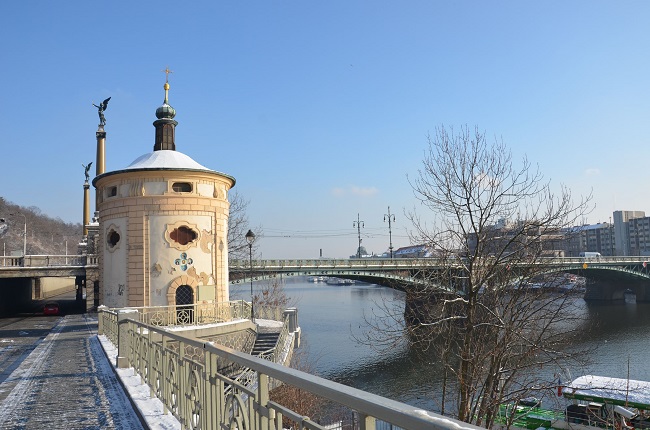
The circular, single-story early Baroque chapel was built on the former monastery vineyard beneath Letná in 1635 by the provost of the Cyriak monastery, which existed across the Vltava River at today's Curie Square. The Chapel of St. Mary Magdalene originally stood close to the Svatopluk Čech Bridge. Winegrowers and loggers often stopped by the monument with a rich history on the banks of the Vltava. After the Josephine reforms, it primarily served as a warehouse. It then passed into the ownership of the city of Prague and has been used by the local Old Catholic parish since 1908.
In the mid-20th century, the chapel faced demolition due to the reconstruction of the waterfront and the construction of a tram line. Some eyewitnesses say it possibly "spoiled the view" of Stalin's monument in Letná. The rescue of the chapel was initiated by the structural engineer and concrete worker Stanislav Bechyně, who came up with the idea of how to move it: "It was thoroughly reinforced inside with a wooden structure, externally it was clamped with four iron hoops, a reinforced concrete ring, and it was moved along twelve rail tracks to its present location,” described the former director of the Prague Steam Navigation Company, Štěpán Rusňák. The chapel was moved 30.75 meters upstream on the Vltava to a pre-prepared bastion above the river, and it finally settled in its new location on February 4, 1956. It was then reconstructed.
The transfer of the chapel is commemorated by stained glass from the 1950s, created by Alena Novotná - Gutfreundová. They depict other scenes from the chapel's history from its foundation until the mid-20th century, such as grape harvesting, the rest of loggers, the stay of the Swedes in Prague, or the construction of Čech Bridge. Among the interior furnishings of the chapel, particularly remarkable are the wall frescoes representing biblical plants and notable ceiling stuccos. Above the entrance is an image of Christ surrounded by saints Cyril, Methodius, Wenceslas, and John Huss. The Chapel of St. Mary Magdalene is usually accessible during the Night of Churches.
The history of the Chapel of St. Mary Magdalene is colorful. The charming structure with a dome, a spire, small windows, and impressive frescoes was designed by the Italian architect Giovanni Battista de Barrifis. During the concluding phase of the Thirty Years' War, it was occupied by the Swedish army, which fired from there at Prague students defending the Old Town in 1648. When the situation calmed, the Cyriacs returned to it. The chapel found itself in an unenviable situation in 1783 when Joseph II dissolved it along with the monastery. The desecrated chapel then served for a long time as a wood storage, later the director of the nearby Civic Bath had a goat stable in it, and even a pigeon loft and sheepfold. The chapel began to glimpse better times in 1908 - at that time, it was acquired by the city of Prague, cleaned and repaired, and then lent to the Old Catholic Church.
Less than 20 years later, the relocation of the entire building of the Church of the Assumption of the Virgin Mary in Most occurred in the Czech Republic. The late Gothic temple, weighing 12,000 tons, was moved along tracks by 841.1 meters to escape destruction due to coal mining. In the stripped interior of the church, the vault was initially reinforced with a spray of epoxy resin, and the load-bearing columns were also reinforced, and the walls were strengthened. The original temple foundations were gradually replaced by reinforced concrete slabs, on which strong grids were then laid, separating the church from its foundations. In mid-September 1975, the church with an underground crypt was loaded onto 53 chassis from Plzeň’s Škodovka factory. The monument "traveled" along a gently curved path, was pushed along four tracks, pushed from behind, and slowed from the front with hydraulic cylinders. The tracks were not laid over the entire route but were gradually moved - those that the church had already left were placed in front of it. The operation lasted from September 30 to October 27, 1975, the church moved at an average speed of 2.16 centimeters per minute, and technically it was a world unique case.
The English translation is powered by AI tool. Switch to Czech to view the original text source.
1 comment
add comment
Subject
Author
Date
...Vida!...
šakal
30.01.26 09:21
show all comments