
Industrial and construction production in the Czech Republic increased year-on-year in March
 |
Industrial production was primarily driven by the metalworking industry. Production also grew in the chemical, food, and beverage industries, although, according to statisticians, the influence of a lower comparative base was evident. Conversely, the high comparative base was responsible for the decline in production in the repair and installation of machinery and equipment sector. The value of new orders in the monitored sectors increased by 1.2 percent year-on-year in March.
Although the year-on-year growth of production in March may initially appear optimistic, the significance of this figure for the remainder of the year should not be overestimated, " said UniCredit Bank economist Martin Komrska." "March was the first month when the economy was affected by the conflict in the Middle East. It is unclear whether the growth rate in industrial production remained in positive figures primarily due to companies' efforts to quickly stockpile before the feared shortages or price increases related to disruptions in global supply chains," he added.
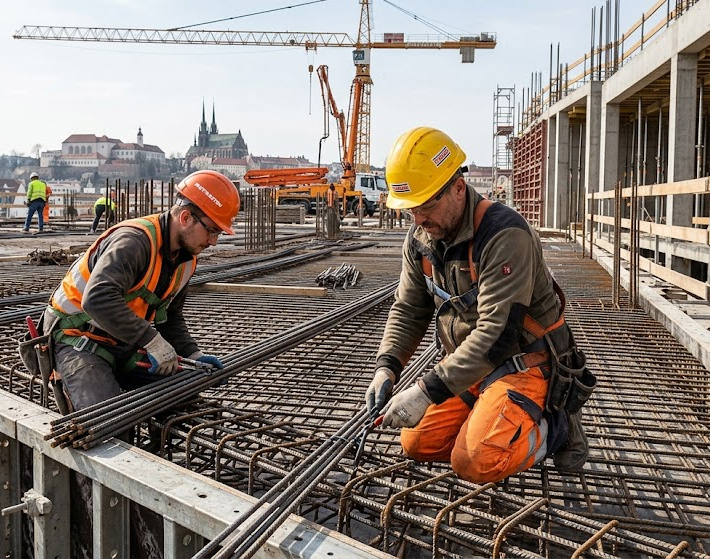
Construction production was driven upward by civil engineering, which grew year-on-year by 10.8 percent. Engineering construction, which includes the construction of roads or telecommunications and energy networks, recorded a year-on-year decline of 5.8 percent. Authorities issued 5,497 building permits in March, which is 13.4 percent more year-on-year, and construction began on 2,979 apartments, which is 5.5 percent less compared to March last year. A total of 2,688 apartments were completed, which represented a year-on-year decline of 1.2 percent.
Overall, the construction sector did not perform poorly in March according to experts. The decline in engineering construction, namely in the construction of transportation or energy buildings, was attributed by Bank Creditas economist Petr Dufek to the high comparative base. "Once the budget was approved with a delay, it also opened up space for the continuation of major construction projects in the field of transportation infrastructure," Dufek stated.
March exports rose by 6.5 percent year-on-year to 459.1 billion crowns. Similarly, imports increased by six percent, reaching 427.2 billion crowns. According to the CZSO, trading with other means of transport, such as aircraft, ships, locomotives, or bicycles, and cars contributed significantly to the positive balance of foreign trade. Trade in computers and electronic devices also had a favorable effect on the overall balance. However, trade in coke and refined oil products negatively impacted the overall balance.
Vice-Chairman of the Association of Exporters Otto Daněk considers the March result of foreign trade to be unexpectedly good. However, he pointed out that there are increasing factors that will negatively affect the trade balance. "These are primarily high energy commodity prices in connection with the conflict in the Middle East. If high energy prices were to have a more permanent character, the Czech Republic, as a net importer of energy, would face a deterioration in terms of trade and pressure on the growth of import value," he stated.
Analysts consider the conflict in Iran a threat to the performance of the Czech industry and construction sector. They will primarily be affected by higher costs caused by rising oil and other commodity prices, which are imported from the Persian Gulf. Iran blocked the main transport route, the Strait of Hormuz, after it was attacked by the United States and Israel.
The English translation is powered by AI tool. Switch to Czech to view the original text source.
0 comments
add comment