
The Brno landmark of Vladimír Fischer is celebrating 111 years
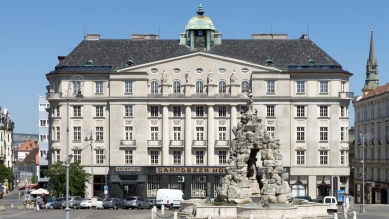
In celebration of the 111th anniversary of the completion of the former Cyril and Methodius Savings Bank at Zelný Trh in Brno, architects and historians who have long been dedicated to the history and restoration of this building gathered at the Grandezza Hotel. The monumental structure by Vladimír Fischer is one of the most significant examples of Czech national architecture in pre-war Brno and still serves a public function – since 2012, it has operated as a five-star hotel, shaped by a sensitive reconstruction by architect Ondřej Kukral.
The Cyril and Methodius Savings Bank was established in 1882 as the first significant Czech financial institution in then predominantly German Brno. The construction of the savings bank falls within a period of pronounced representative architectural rivalry between Czechs and Germans, which fully erupted in Brno after the demolition of the city walls. The Cyril and Methodius Savings Bank has been located at Zelný Trh since 1887, but with the growing significance of the institution, the need for a representative headquarters also increased.
A new monumental building was constructed between 1913 and 1915 on the site of four older houses according to the design of Vladimír Fischer (1870–1947), one of the most important Czech architects of his generation and a later professor at the Brno University of Technology. Fischer’s design combined a representative urban house with a richly articulated facade and a significant artistic-craft component. The architect invited other Czech artists and crafts firms to collaborate – the artistic-craft production was provided by the Prostějov firm Vulkania, and the allegorical sculptures on the facade were designed and executed by sculptor Václav Hynek Mach, who also created a collection of sculptures on the building of the former District Health Insurance Fund in Brno.
The construction was complicated by World War I, but the then-owners of the savings bank decided to complete it. The builders Leopold Čupr (1879–1959) and Ludvík Němeček (1883–undated) were commissioned for the work. Despite difficulties with supply and a lack of labor, the building was completed by the end of 1915, becoming the largest savings bank in Brno and later one of the largest in Czechoslovakia. The building served its original purpose until the late 1960s, after which it housed the Faculty of Law (1969–1990) and the Faculty of Economics and Administration of Masaryk University (1991–1997).
Restoration with an Emphasis on Authenticity
The current appearance of the building is due to architect Ondřej Kukral, the main designer of the Grandezza Hotel. In the past, he has participated in the restoration of numerous historically valuable objects, including the newly protected chateau in Ratboř near Kolín by Jan Kotěra.
“Our goal was to return the Cyril and Methodius Savings Bank its nobility and at the same time open it up to new use. This is always crucial because only a new function will ensure further life for architecturally valuable buildings. We worked with original elements to keep them legible, but at the same time naturally fit them into the concept of a modern five-star hotel," said Ondřej Kukral.
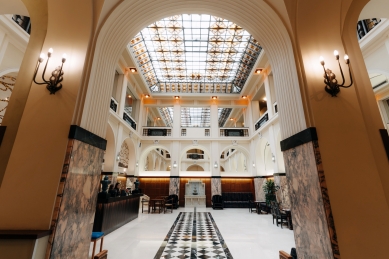
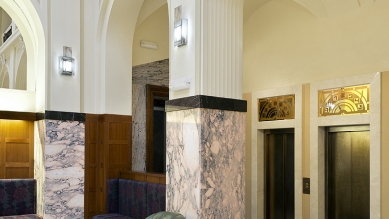
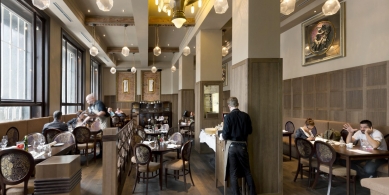
The architects approached the building with the vision of a palace, whose dignity must be apparent after the entire reconstruction is completed – equally in the exterior and in the interiors. In practice, this meant carefully distinguishing between valuable preserved layers that needed to be precisely maintained or restored, and later alterations that did not add value to the building. The preserved core includes the facade, entrance hall, lunette above the entrance doors, and doors of the former vault. Conversely, in parts of the building where historical interventions were neither architecturally nor historically valuable, the team could afford more radical solutions – an example being the placement of a new restaurant or the addition of elevators to the light well.
One of the key tasks was the restoration of the facade. Instead of a simple paint job, which quickly ages, the team mixed samples from various types of sands and cements so that the new surfaces would closely resemble the original plaster in both color and texture. Historical windows and many other authentic details were also restored and preserved.
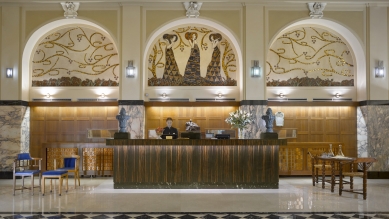
Particular attention was required for the painted ceiling in the hotel's reception hall. When work commenced, it was significantly damaged. The team therefore designed a new decoration that harmonizes with the motifs on the carpets and is complemented by linden leaves as a symbol of Czechness – a reference to the Czech identity of the savings bank.
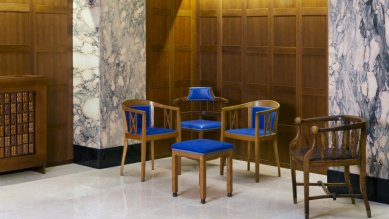
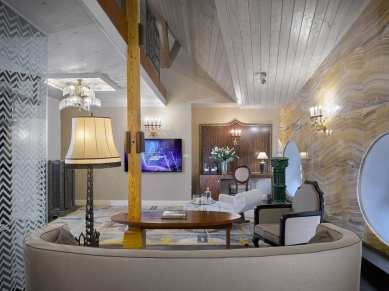
The presidential suite also carries a reference to the tradition of modern Czech architecture, with an interior inspired by Loos's villa. The suite's furnishings include an original chair by Austrian architect Adolf Loos.
The Vault Where the Venus of Věstonice Resided
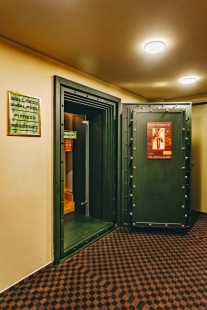
Among the original elements that the reconstruction worked with were the doors of the former vault of the savings bank. It was in this vault that the figurine of the Venus of Věstonice was stored for approximately two years, having been transferred here immediately after its discovery in 1925. Kukral's team decided to preserve the historical doors. Today, they lead to the massage room, which is part of the hotel wellness area alongside the whirlpool and gym.
“Grandezza is proof that historical objects retain enormous potential. A sensitive approach to reconstruction enabled the preservation of the unique atmosphere of the house while simultaneously offering maximum comfort to guests," added Ondřej Kukral.
Grandezza Today
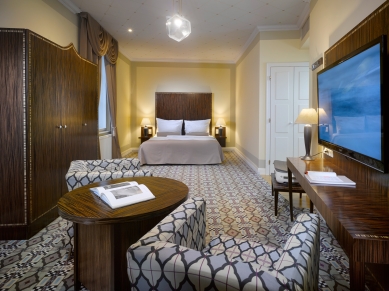
The Grandezza Hotel has been in operation since May 2012. It offers 75 rooms with a capacity of 150 beds overlooking Zelný Trh and St. Peter and Paul Cathedral and maintains a public function in the ground floor through the Grandezza Restaurant, which has been awarded by the international gastronomic guide Gault&Millau, and the Momenta Café. The whole represents a convincing example of how sensitive conversion of historical architecture can combine heritage value, contemporary operation, and a vibrant urban ground floor.
The Cyril and Methodius Savings Bank was established in 1882 as the first significant Czech financial institution in then predominantly German Brno. The construction of the savings bank falls within a period of pronounced representative architectural rivalry between Czechs and Germans, which fully erupted in Brno after the demolition of the city walls. The Cyril and Methodius Savings Bank has been located at Zelný Trh since 1887, but with the growing significance of the institution, the need for a representative headquarters also increased.
A new monumental building was constructed between 1913 and 1915 on the site of four older houses according to the design of Vladimír Fischer (1870–1947), one of the most important Czech architects of his generation and a later professor at the Brno University of Technology. Fischer’s design combined a representative urban house with a richly articulated facade and a significant artistic-craft component. The architect invited other Czech artists and crafts firms to collaborate – the artistic-craft production was provided by the Prostějov firm Vulkania, and the allegorical sculptures on the facade were designed and executed by sculptor Václav Hynek Mach, who also created a collection of sculptures on the building of the former District Health Insurance Fund in Brno.
The construction was complicated by World War I, but the then-owners of the savings bank decided to complete it. The builders Leopold Čupr (1879–1959) and Ludvík Němeček (1883–undated) were commissioned for the work. Despite difficulties with supply and a lack of labor, the building was completed by the end of 1915, becoming the largest savings bank in Brno and later one of the largest in Czechoslovakia. The building served its original purpose until the late 1960s, after which it housed the Faculty of Law (1969–1990) and the Faculty of Economics and Administration of Masaryk University (1991–1997).
Restoration with an Emphasis on Authenticity
The current appearance of the building is due to architect Ondřej Kukral, the main designer of the Grandezza Hotel. In the past, he has participated in the restoration of numerous historically valuable objects, including the newly protected chateau in Ratboř near Kolín by Jan Kotěra.
“Our goal was to return the Cyril and Methodius Savings Bank its nobility and at the same time open it up to new use. This is always crucial because only a new function will ensure further life for architecturally valuable buildings. We worked with original elements to keep them legible, but at the same time naturally fit them into the concept of a modern five-star hotel," said Ondřej Kukral.
The architects approached the building with the vision of a palace, whose dignity must be apparent after the entire reconstruction is completed – equally in the exterior and in the interiors. In practice, this meant carefully distinguishing between valuable preserved layers that needed to be precisely maintained or restored, and later alterations that did not add value to the building. The preserved core includes the facade, entrance hall, lunette above the entrance doors, and doors of the former vault. Conversely, in parts of the building where historical interventions were neither architecturally nor historically valuable, the team could afford more radical solutions – an example being the placement of a new restaurant or the addition of elevators to the light well.
One of the key tasks was the restoration of the facade. Instead of a simple paint job, which quickly ages, the team mixed samples from various types of sands and cements so that the new surfaces would closely resemble the original plaster in both color and texture. Historical windows and many other authentic details were also restored and preserved.
Particular attention was required for the painted ceiling in the hotel's reception hall. When work commenced, it was significantly damaged. The team therefore designed a new decoration that harmonizes with the motifs on the carpets and is complemented by linden leaves as a symbol of Czechness – a reference to the Czech identity of the savings bank.
The presidential suite also carries a reference to the tradition of modern Czech architecture, with an interior inspired by Loos's villa. The suite's furnishings include an original chair by Austrian architect Adolf Loos.
The Vault Where the Venus of Věstonice Resided
Among the original elements that the reconstruction worked with were the doors of the former vault of the savings bank. It was in this vault that the figurine of the Venus of Věstonice was stored for approximately two years, having been transferred here immediately after its discovery in 1925. Kukral's team decided to preserve the historical doors. Today, they lead to the massage room, which is part of the hotel wellness area alongside the whirlpool and gym.
“Grandezza is proof that historical objects retain enormous potential. A sensitive approach to reconstruction enabled the preservation of the unique atmosphere of the house while simultaneously offering maximum comfort to guests," added Ondřej Kukral.
Grandezza Today
The Grandezza Hotel has been in operation since May 2012. It offers 75 rooms with a capacity of 150 beds overlooking Zelný Trh and St. Peter and Paul Cathedral and maintains a public function in the ground floor through the Grandezza Restaurant, which has been awarded by the international gastronomic guide Gault&Millau, and the Momenta Café. The whole represents a convincing example of how sensitive conversion of historical architecture can combine heritage value, contemporary operation, and a vibrant urban ground floor.
The English translation is powered by AI tool. Switch to Czech to view the original text source.
0 comments
add comment