Walla Mulla Park: HOMELESS SHELTER

Interview with Czech-Australian Architect Vladimír Sitto

Interview with Czech-Australian Architect Vladimír Sitto

Publisher
Jiří Horský
18.11.2011 06:00
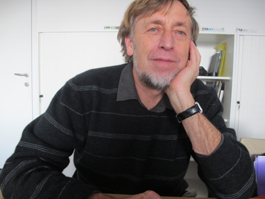
Vladimír Sitta, born in Brno, studied at the Agricultural University, Department of Landscape Architecture from 1964 to 1969. In 1981, he emigrated to Australia. His company Terragram designs in Australia, Asia, and the USA, winning several international competitions. He is a laureate of the Berlin P. J. Lenné Prize in 1981, 1986, and the President’s Prize of the Australian Institute of Landscape Architects in 2002.
The following interview is not entirely typical for an architectural portal. It is conducted with a landscape architect, which is not a field commonly frequented on the media scene, and it also does not present photogenic objects of new constructions. Let us add right at the beginning that this time the architect’s client is also atypical: he is a city resident, but a resident "without a home". Therefore, the interview touches upon social aspects in addition to the usually discussed design process. The main actor is a Czech-Australian architect who offers the domestic reader a detailed insight into the functioning of mechanisms of Australian democracy at the community level.

Unlike usual practices, the interview was created "at a distance" in the form of email correspondence between Prague and Sydney.
Mr. Architect, could you characterize your latest project – the revitalization of a park for the homeless in Sydney?

V. Sitta: To begin, I would say that Walla Mulla Park was a place – and still is – where drugs such as heroin, crack, alcohol, and other so-called substances were sold – that's about how it's said in Brno – that affected and affect human behavior. It's a stage of civilization where the curtain never comes down…
However: Walla Mulla Park – the name is Aboriginal, and there are disputes about the transcription – is part of the so-called inner city, but it lies outside the so-called Central Business District. It's about a 10-minute walk from here. The part we are talking about is called Woolloomooloo. The urban structure represents a mix of old, traditional, and low-rise social housing. The developers originally wanted to roll over this area and turn it into a second Malešice – I'm sure you know that ghastly place in Prague, painted over with fake greenery, where you can even find parrots in the trees! In the new version, the tropical birds have already gone extinct; I wonder if it's the influence of climate skeptics? This area became the stage for the so-called Green Ban, during which the unions opposed this intention and declared a total and successful boycott of construction companies. It was much more dramatic than it appears described like this. Journalist Juanita Nelson Junez uncovered corruption and vanished without a trace… This activated a portion of the population that cared about the livability of the city and social justice. Instead of mega-blocks, low-rise social housing was built, creating an illusion of a human community. Of course, this cannot be synthesized. However, the social ghetto was not the most fortunate solution…
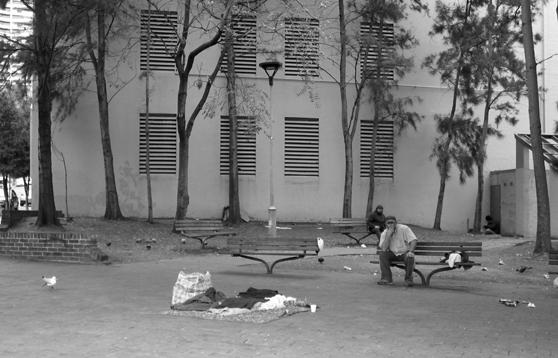
The park actually arose from the demolition of an old part of the city – understand, it's about the “age” of about eighty years – after the construction of the local railway in the early 1970s. Originally, there were about six terrace houses – a place with a few benches, you could say a small park, which gradually became the domain of asocial elements with a whole spectrum of behaviors: violence, vandalism, mess… For the authorities, it was something like a hot potato. On one hand, limited integration of these people into the shelter; on the other, public pressure for the municipality to do something about it. This dragged on for years, and only the independent mayor Clover Moore, evidently inspired by mayors of cities like Curitiba and Bogotá, came up with the initiative to return the city to the people. Many parks, streets were reconstructed, and new bike paths were created – previous mayors never even thought of that; they were satisfied with a shiny limousine and a sense of importance. In Australia, it was usually the case that the one who did nothing and thus didn’t annoy anyone was elected.
I don't want to pull you into Sydney politics, but there’s a lesson for Prague. The project dragged on quite a bit. About as long as in the Czech Republic when you want to plant a tree; everyone shouts, but they can bulldoze a highway whether someone likes it or not.
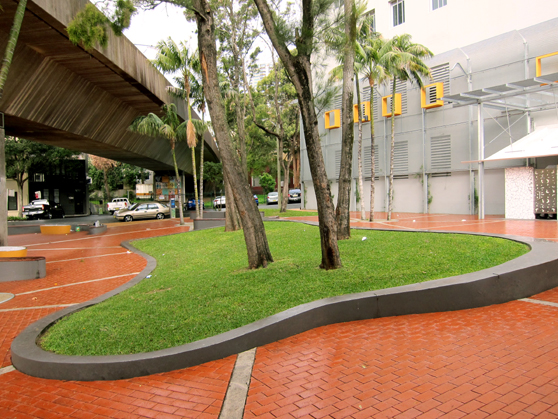
As for the size of the park, by the way, the second one under the viaduct, which is somewhat larger, has just been completed; it’s about 1,100 square meters. Costs 1.1 million AUD.

How would you characterize the client – that is, the city administration?

The City of Sydney is a leviathan, consisting of many departments that don't communicate much with one another. Explaining this organizational structure is quite difficult; even individual departments do not exactly know the missions of the others. It’s a bit like a kitchen with a group of cooks, each trying to implement their own spices. It's obvious that this could lead to a backlash.
With a certain humor, we say here that fees are painful…

And what about public influence?
Thanks to the so-called Westminster system, democratic expressions of citizens are limited to local government. They like peace and will do anything for it.
The federal government is something else entirely. The Iraq War provides an example, where 65 percent of citizens were against it, huge demonstrations occurred, and yet Australia got involved…
It was clear that the project would provoke mixed reactions. Citizens of upscale residences would prefer to see homeless people swept off the face of the planet, while those people have nowhere to go. It's literally an encyclopedia of human tragedies, and from my own experience, i.e., from conversations with homeless people, I know that not all of them are living in a world with their brain cells killed off.

What priorities did you approach the reconstruction with?

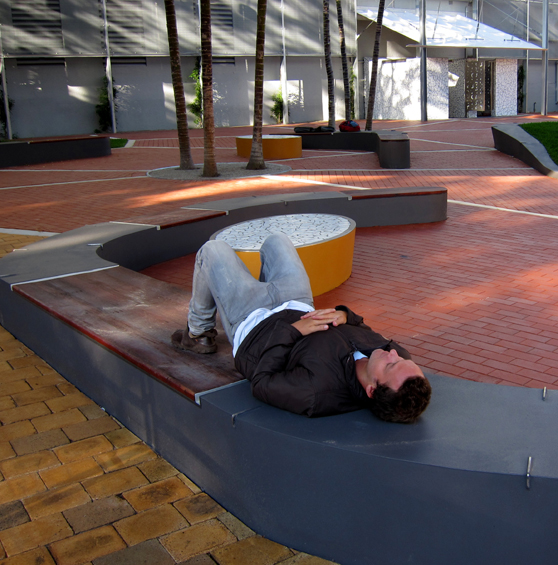
Of course, we wanted to improve their conditions, but our proposals for lockers and showers were rejected. There were also concerns that the benches were too wide and that people would sleep on them…
But what of it? It’s a public place after all!
The brief, which we partly wrote ourselves, looked something like this:
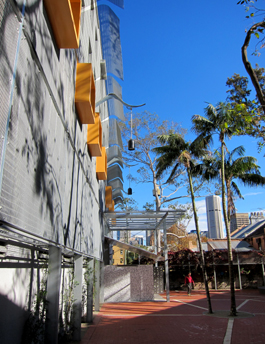
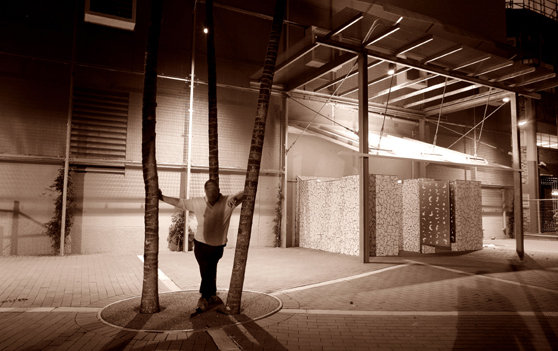
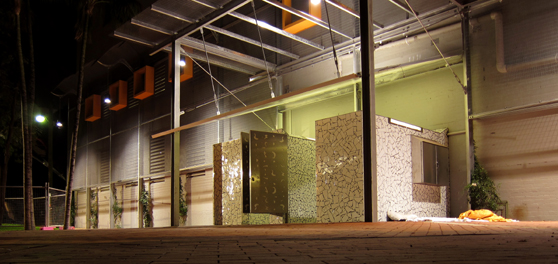
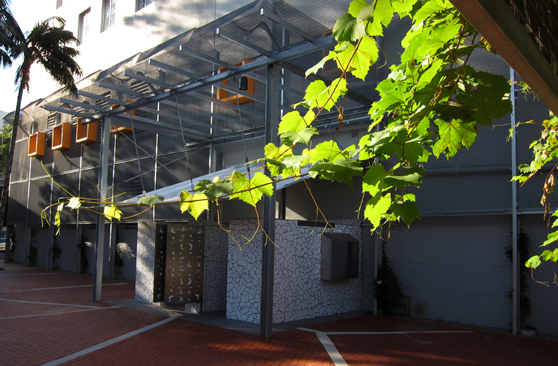
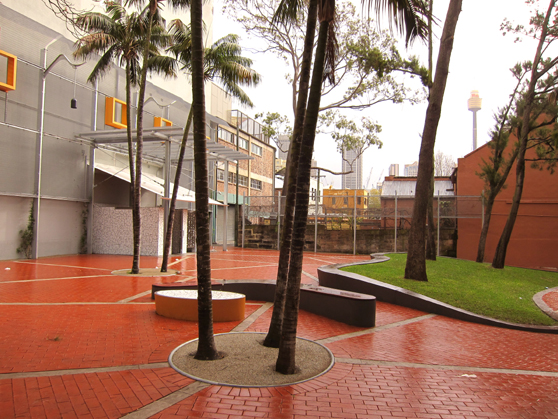
— No nooks to hide drugs — The park must look like any other; this was a requirement from the mayor, which we reluctantly accepted — It must be visible if someone is in the restroom — High light intensity – residents threw blankets over the lights – it’s almost impossible to cover the lights used, and the authorities refused to reduce the lighting intensity — Visual permeability — Ease of daily cleaning – the arrangement of benches is partially dictated by the mechanics used — Preservation of some original vegetation — Access to toilets for the disabled — Coverage of the facade with trellising, as a prevention against advertisements and scribbles (Graffiti) — No drains X No mulch – needles, etc. — Protection of vegetation from detergents – hence raised edges around the palms — Slope of the restroom roof preventing storage — Surface of walls that deters graffiti and inside everything in stainless steel – vandalism remains a problem.
Despite the difficulty of the process in the initial phase, we were able to sneak a few changes into the project that had been previously rejected by other departments. With each new set of drawings, the benches suffered from swelling. The eye of a vigilant bureaucrat wouldn't catch that, and as I’ve known them over the years, going back to the original drawings wouldn't have occurred to them. The turnover of officials also contributed to this… I hope that this search service, which collects everything about the municipality, does not find this; otherwise, it would be a disaster.


Could you describe the construction elements? That is, the specific interventions in the park that you recommended?

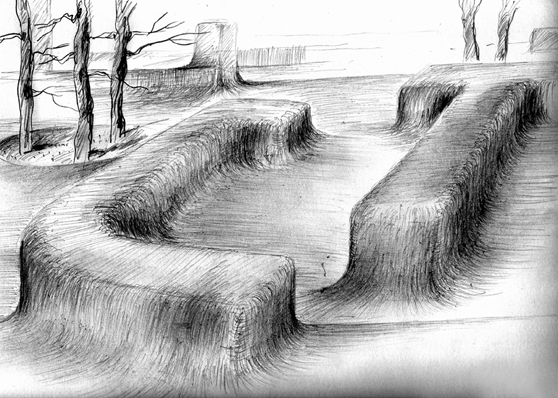
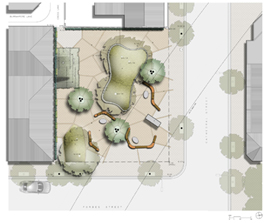
Essentially, it was about creating seating – areas for smaller groups of people, also a total renovation of the restrooms, cutting down poor-quality trees, and overall increasing visual permeability and access to sunlight. The municipality promotes recycling, and some of the concrete pavement was cleaned and reused. Essentially, we turned the tiles over. The choice of bricks for the rest of the pavement is dictated by the absence of any drain – drugs were hidden there. And also by the desire to create a slightly more domesticated environment. The distribution of seats and tables is further dictated by the cleaning equipment, its radii, etc.

How does the park work today?
It pleases me to see homeless people sprawled out on our benches. In many places, backs have been installed in the middle of benches to make lounging difficult, at least not without pain…
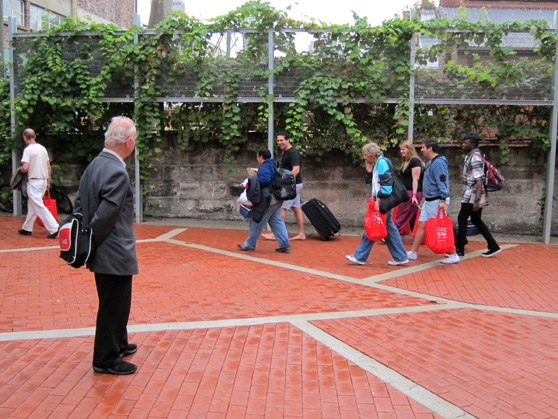
And I also enjoy that passersby today take a shortcut across the park…

In the Czech Republic, architects have long demanded holding competitions, but it is a futile struggle…

May I ask how you obtained the contract for the park?
Australian post-colonial authorities do not like competitions; they prevent them from controlling their subjects. Competitions in this country have a sad, I would say tragic history. It would take a long time to explain. Starting with Canberra and ending with the recent competition for a large part of the unused harbor in Sydney.
There is a fear that politicians will lose power, money, and developers.
You ask about competitions: It's true that we've won the largest projects in competitions, but not all were realized, and for example, on Docklands in Melbourne, we resigned even though we already had the contract… Just look at that horror today. Sometimes it just doesn’t work out, and judging by the results, I’m glad we backed out, although the financial pain is like rheumatic fever. You probably know that, it's with you forever.
Local authorities have something like bidding procedures. In it, you prove that you're a suitable firm, fill pages with nonsense about methodology, provide all sorts of insurance, resumes, and the risks that the construction would represent. The latter is a figment of a permanently damaged brain, but we find it rather amusing. One of the risks I mention is the fleeting appearance of an irresistibly attractive lady who distracts the excavator operator. He might then accidentally dig down another unfortunate soul who happens to be around. A new risk we proudly discovered is a reckless bird that confuses air with a toilet. Sometimes we spend a good week or more just stitching it together. The offer has about fifty pages or more. Then the politburo meets, a bunch of bureaucrats, each with incontinence devices, and they shuffle through the offer. We must write it in such a way that they don't start worrying that there will be problems. Problems of the world dissolve right from the start. Well, and then of course, counting pennies. In my opinion, the winner will be the one who fears the least or the one who has a patron in the politburo. Maybe we got the project because it was already the fourth offer, to shut my nagging mouth. I still don’t know. I know they invited six firms, but they didn’t give us the protocol; colonial administration doesn’t do that.
The so-called process that follows is a chapter in itself, and I begin to breathe rapidly just thinking about it. I forgot to add that the politburo makes a recommendation, which must be approved by the uber politburo, often consisting of bored ladies, ambitious individuals, and occasionally idealists who are dogmatically green. Sometimes it’s a formality, sometimes not, because a bored lady approves even a house design and dislikes flat roofs and differences in general; she lives in her 19th century, even if she has an iPhone in her handbag.
So, in response to your question: it was an offer that we happened to get. The rest is a question of persistence and the ability to engage in undisguised trickery. I think the result is okay, although that’s for others to judge and also for time.

Original state

I apologize, but in your attitude, I sense - rarely so distinctly - a strong social sentiment…

I am a communist and I am not. Even a blind person sees the broken future better than we do.

Thank you for the interview.
Jiří Horský


Walla Mulla Park
location:
Woolloomooloo, Sydney
client:
City of Sydney
author:
Terragram
architect:
Chris Elliott Architects
contractor:
Hansen Yuncken
execution:
2008 — 2011


The English translation is powered by AI tool. Switch to Czech to view the original text source.
1 comment
add comment
Subject
Author
Date
Krása
Albert
18.11.11 01:33
show all comments

Related articles