Gardens of the Masters in Xi'an

Czech-Australian Vladimír Sitta for the second time

Publisher
Jiří Horský
16.02.2012 09:00
From April to October last year, the World Horticultural Expo took place in the ancient Chinese city of Xi'an. It is little known that Australia was represented by Czech-Australian landscape architect Vladimír Sitta. Together with his team at Terragram, he designed the exhibition Garden of Passages.
The motto of the exhibition was the phrase "harmonious coexistence of the city and nature." The organizers created an environment full of flowers, green grass, and water. At the same time, they combined these natural factors with the rich history of Xi'an, local folklore, and humanity's desire to protect the environment and maintain low emissions of harmful substances. The area spanned 418 hectares, of which 188 hectares were water surfaces.
At the end of last year, the editorial team of Archiweb conducted an interview with Vladimír Sitta about the homeless park in Sydney. This time, we return to Sitta's work with his own text about the project for the horticultural Expo in China. The article was written before the closure of the exhibition there.
Assignment

They call it the Gardens of Masters – Master Gardens. Our team, Terragram, was chosen by the organizers for Australia. Note – just on the side: as a non-member of the Australian Institute, and thus a black sheep, I wouldn't have had a chance otherwise. (I refuse to be organized and I am still surviving, even though the local chamber occasionally makes our life difficult.) A budget of 250,000 USD is hard to compare with the Czech Republic; I would say about 1.5 million Australian dollars, in China stones and labor are very cheap.
Otherwise, do what you want, they said. However, they politely asked that the local understanding of the Masters Garden be present. I must add that we received quite a bit of freedom and liberty, which is almost impossible from a public institution in Australia. It cannot be denied that the country today offers one of the freest and most open creative environments – if one is lucky and is not a local dissident like Ai Weiwei.

Despite the evident freedom, there was self-censorship, influenced by the capabilities of local builders. Xian is not Shanghai, where you can get anything today, and so the project became a testing of the possible. We were perhaps too cautious in some aspects, on the other hand, I would have liked to let them do a few things again, which we were convinced they could handle without issues. This turned out to be a big problem; the Chinese builder is very reluctant to rework something, even when you can prove his mistake. At that moment, he becomes a master of obstruction, but I have no idea if he has his head on the block for not meeting deadlines. We chose technologies and materials like stone, of which we hoped local craftsmen could manage.
In comparison to other authors, we may not have fared the worst. We believe that despite the variable quality of work, our garden will know how to age.

For foreigners and perhaps even for the Chinese themselves, the search for authenticity is becoming increasingly difficult. Modernity, or rather the idea of modernity, along with a lack of interest in the city's materiality, transforms the urban environment, while the countryside remains almost untouched. Money is like a devastating flood. So, the hungry visitor at the Great Wall is welcomed not by donuts but by a Subway sandwich. The present is something transitional; we must immediately move into the future.
China today is a paradise not just for architectural icons, which, despite declarations of dedication to democracy, willingly serve local potentates. (For example, Koolhaas and his CCTV – unused for years after it was slightly scorched by the fire of the adjacent hotel.) The country is simultaneously a trash can for Western architecture.
One cannot help but notice the frenetic dances of real estate pirates and various shakers, connected with modern mandarins, who, under the promise of lucrative contracts, squeeze the maximum from naive Western firms for the minimum of money, if any at all. The current economic crisis only plays into this. Many Western firms are willing to invest weeks, sometimes months, without having the certainty of any contract.
New cities are rapidly growing. Who else is capable of building a multi-story hotel in a week? Construction is ongoing 24 hours. China today consumes more than fifty percent of the world's cement production.
The quality of designs is something completely different. Every country produces kitsch, only in China, it is much more monumental. But avant-garde can also be found. Chinese architects are slowly penetrating the West, which only confirms their ambition to be the best.
This desire was the most distinctive thing that emerged from discussions with students of architecture and landscape architecture in Beijing and Xian. And as I know Chinese work ethics and Confucian philosophy, I have no reason not to believe them.
I think there is a lesson and a warning here for spoiled Europeans; Australia, of course, does not escape this.

Obsession with Time

Unlike our previous projects, we had relatively enough time in China. There, it is common to expect a project, if not today, then tomorrow. The blame also lies with Western architects. One Australian colleague even boasted that he spent less than a minute on individual apartments – of which there were hundreds. This dates back to Mao. In 1959, the country celebrated the tenth anniversary of the proclamation of the people’s republic. At that time, Mao gathered 12,000 people who worked in sixteen-hour shifts on a vast palace complex at Tiananmen – opposite the Forbidden City in Beijing. No one believed it was possible back then. Not even the Soviet advisors, who were still welcome at that time. It took ten months to build. For comparison: A nice pair of former Federal Assemblies can fit into this building… It is interesting that China could have had its own High Line already at the beginning of the 50s. However, Mao saw smoking factory chimneys as the future, and thus the architectural vision concerning massive urban fortifications turned into a huge demolition site.
In China today, building for the sake of building itself is the norm. Empty shopping malls and residential blocks are not exceptions.
All of this exists there with the silent blessing of the party, whose leading role is unquestioned, although I must say that our hosts were much more sarcastic and mischievous during the second visit...


Our Bridge Between Yesterday and Today

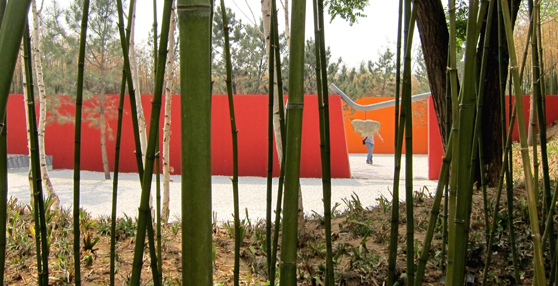
Traditional Chinese gardens served privileged individuals. In the harsh mass tourism with thousands of jostling visitors, the contemplative atmosphere has almost been lost. The wishes of the organizers for the garden to attempt to find inspiration in historical precedents while simultaneously releasing thousands of visitors during the exhibition had to lead to compromises. How to reconcile the immensity of crowds with the tranquil life of a park in the post-exhibition period? The duration of stay is very short, further amplified by the vast area of the site. Dozens of exhibitions, omnipresent loudspeakers, souvenir vendors, and marching military units compete for attention.
The visitor suddenly finds themselves in a labyrinth of a modern hortus conclusus and is already anesthetized by sensory overload. One day, however, the visual circus will dissipate, and only trees, lawns, water, and birdsong will remain. Perhaps then this garden will be able to reveal its evocative layering and enter an unhurried phase, where reconciliation with time will prevail.
Hortus conclusus remains a valid paradigm. Its fundamental parameters can be found in almost all Master Gardens.
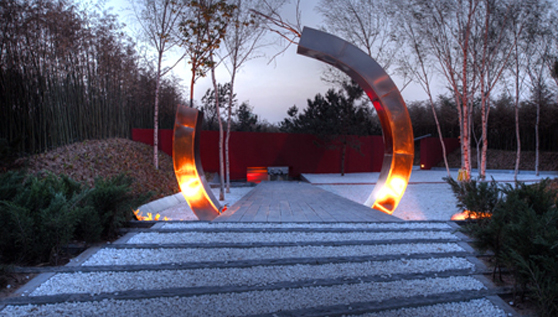
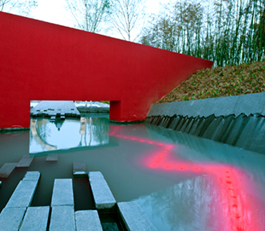
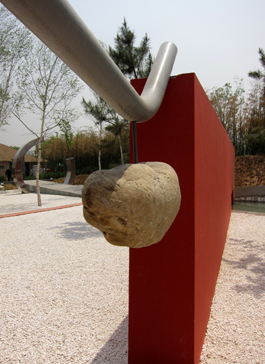
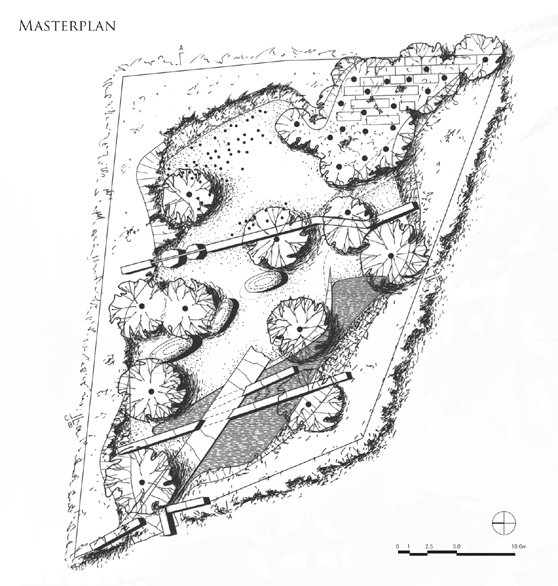
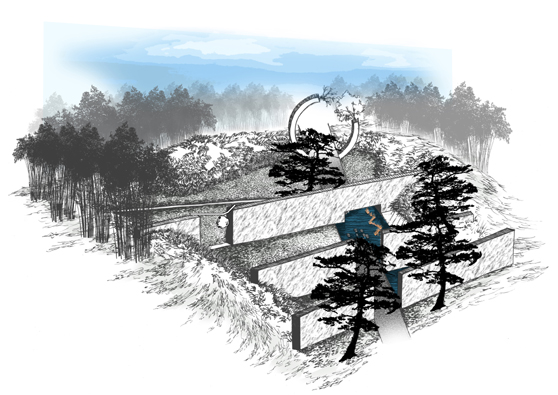
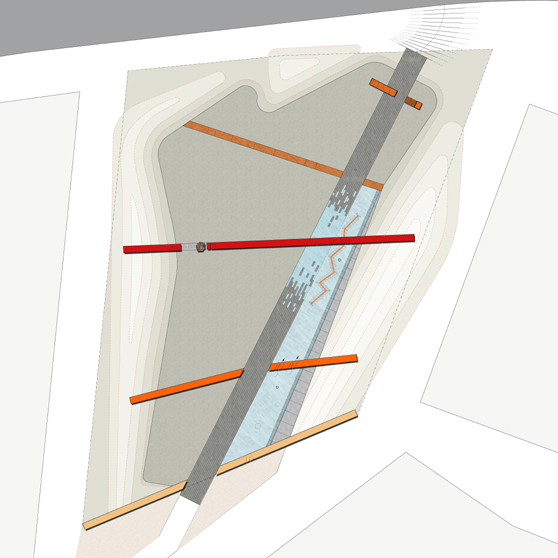
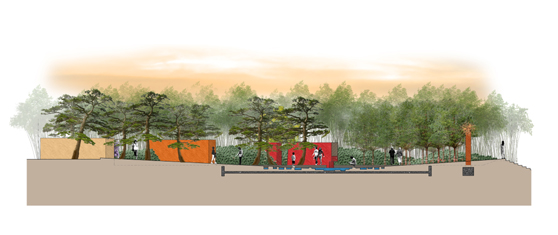
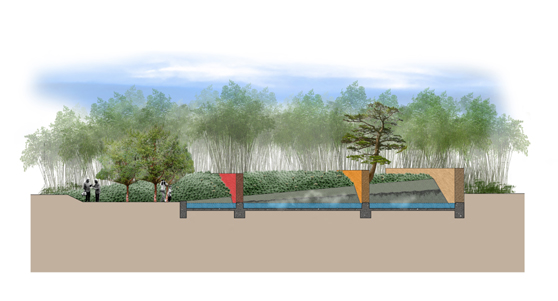
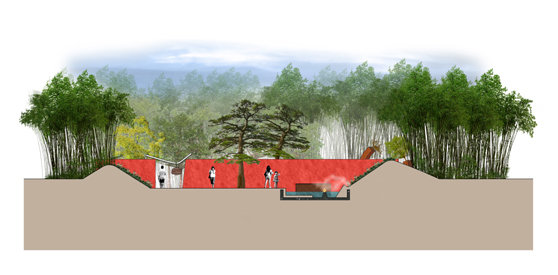
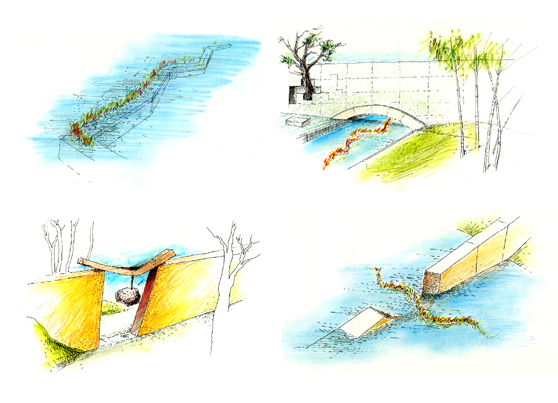
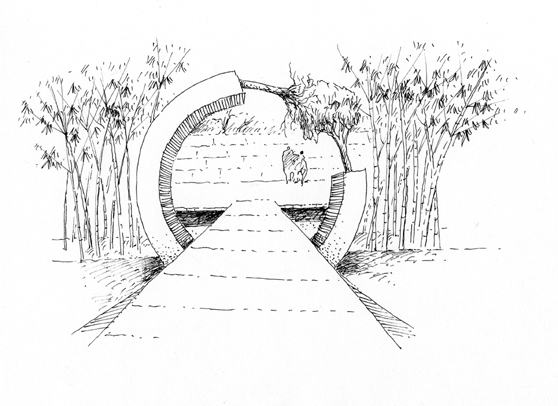
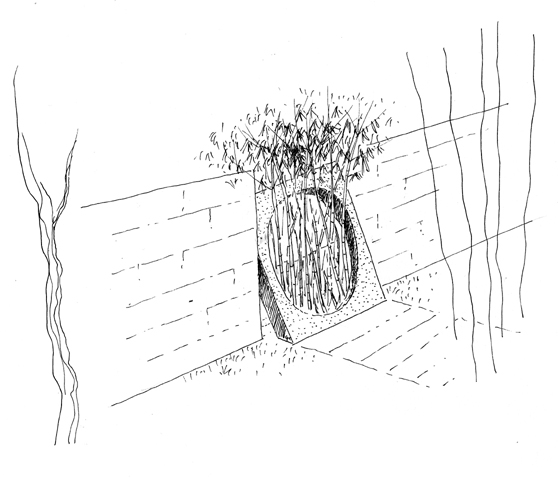
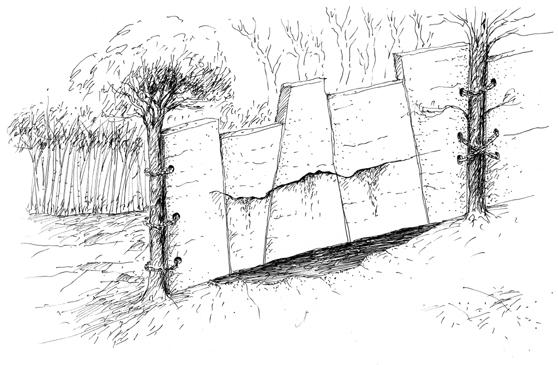
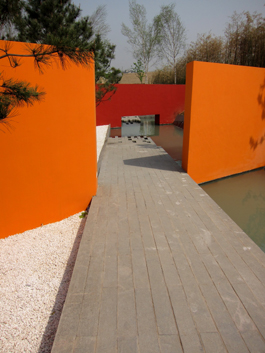
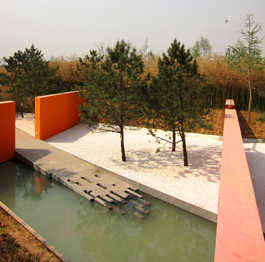
The entry to our Garden of Paths is clearly defined by a linear gesture: a stone ribbon. It seemingly breaks in one part, disappears beneath the surface, only to reemerge behind a seemingly submerged lunar gate. The continuation of the ribbon can be traced as a reflection – what happens behind the gate is upside down.
Perhaps in that, one can see an image of contemporary China or even a metaphor for life. This gesture is meant to appear only as a fragment of a text, no literal instructions; it is up to each individual to fill in the story themselves.
In the original design, each space had a slightly different symbolism. Due to the impossibility of guaranteeing maintenance, we had to abandon some of the ideas.
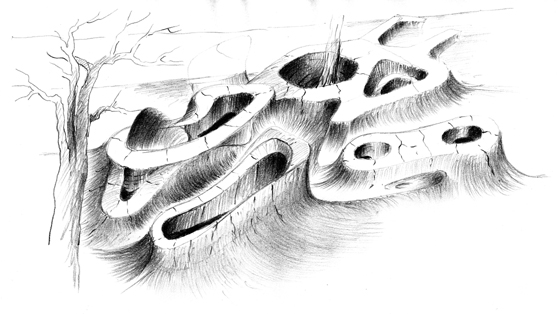
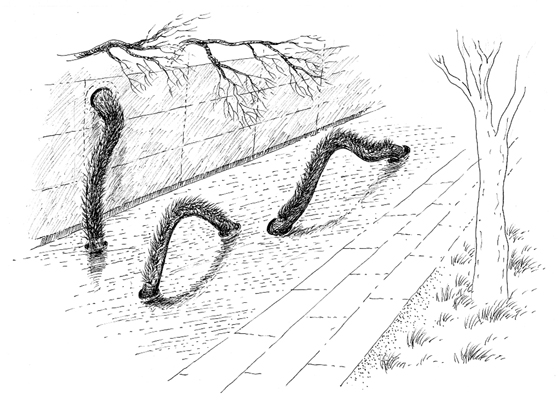
In one part, for example, strange green hills were installed that would "strip" in winter and reveal the text: "Create one planet" in Mandarin. As you know, China did not sign the Kyoto Protocol. Neither did the USA or India.

Losses…

Only the flames dancing gently above the water surface were not permitted. They were probably scared we would set the water on fire. A few words about the history of this idea. The capital of the Middle Kingdom was Xi'an – until they moved it to Beijing. And from there come the famous figures of the Terracotta warriors. Their "tomb" is located just 30 kilometers from the exhibition site. Originally, we had chosen fire as the main creator of the space – the fire that was at the beginning of the firing of these underground armies and is associated with the Place. But how to control that entire process from a distance of 15,000 kilometers? Despite the initial obsession, we eventually lost interest in firing the garden space. By the way, those tombs of the armies were actually a landscape – a scale landscape. Hundreds and hundreds of meters, hundreds and hundreds of soldiers, including leadership. For two thousand years, no one knew about the underground. Until the 70s of the last century… The emperor supposedly had all the workers and potters executed. Only one of his mandarins possibly knew the secret. And when he died, the secret vanished. Traditional methods of erasing history in totalitarian systems. But this is happening even today, in other systems, perhaps not as drastically, but perhaps through the erosion of traditionally humanist values.

… and Finds

We originally intended to replace fire with dry ice. But then it turned out that this could not be done either. However, the Chinese installed a fire extinguisher just in case, and quite prominently… Also, the anarchic scattering of poppy seeds by visitors into the garden space did not take place. There was probably a concern that it would not only stay in the garden. On the other hand, the gate of the life cycle received a poor translation: They confused corten steel with stainless steel. This clinical material beautifully reflects light, giving off a strange, perhaps even surreal chill.
Quite a charm of the unintended.


Post Mortem

I cannot assess the extent to which there was a dialogue with the viewer. The Chinese are very polite, especially towards foreigners, and are reluctant to give negative responses; they prefer to avoid it. While they told us it was a very Chinese garden, who knows? The search process was long. We made a lot of sketches and various concepts. Perhaps we failed, but no one can say that we did not try.

Vladimír Sitta


The English translation is powered by AI tool. Switch to Czech to view the original text source.
0 comments
add comment

Related articles