
The Constitutional Court gave associations a chance to fight more effectively against land use plans
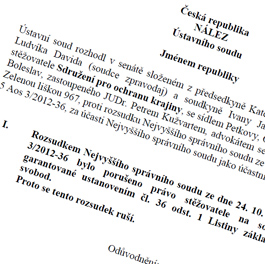 |
According to the ÚS, it would be absurd at first glance if a landowner could not submit a proposal to annul the zoning plan simply because they joined with other residents of the same municipality and are acting together. "The fact that a citizen prefers to pursue their interest through an association with other citizens cannot be held against them," stated the reporting judge Ludvík David in the ruling.
Courts should now always assess whether the specific zoning plan affects the subjective rights of the association. According to the ÚS, it depends on a reasonably thinking judge, who, aware of the societal significance of spatial development and civic associations, can determine whether the association is entitled to participate in proceedings concerning the annulment of generally binding measures.
On the other hand, the judges emphasized that the active legitimacy of associations cannot be without limits. Justice must take into account, for example, the goals of the association and its established presence in the specific locality. "However, it is not possible to exclude the formation of an ad hoc association for purposes related to the zoning plan," the ruling states.
A similar problem addressed by the ruling, according to Aleš Ziegler from the Green Circle, occurs in many other administrative processes, such as zoning and building proceedings. "The ruling significantly expands the rights of local citizens’ associations to invoke the court and their right to a favorable environment for living. It enables them to challenge illegal zoning plans in court," he told ČTK.
The Association for the Protection of the Landscape, whose representatives did not attend today's announcement, is based in Březno in Mladá Boleslav, focusing on the surroundings of the villages of Petkovy and Domousnice, and particularly on the Čížovky nature park. The aim of the association is the protection of the natural and landscape environment, including cultural and historical values. "We are happy that the formalist law was somehow brushed aside by the constitutional court, which said that administrative courts must also consider what civic associations have in their activities. Because we were denied active legitimacy when the zoning plan for the municipality of Petkovy was illegally made," said Dagmar Benešová from the association to ČTK.
The association challenged the zoning plan for Petkov, objecting to the threat of development in the nature park. According to Benešová, the association seeks to change two building plots in the nature park, where there was previously a construction ban. "The councilors were not even aware that at some point during the proceedings regarding the park's area, some two building plots quietly emerged. No one knew except the mayor and the owners of those plots," she added.
However, the Regional Court in Prague, in accordance with established decisions of Czech justice, concluded that the civic association does not have so-called active legitimacy for such a proposal. The association's appeal will now have to be reconsidered by the Supreme Administrative Court.
The interpretation of the law that Czech courts have upheld so far has practically led to the conclusion that only the owner of a plot or property affected by the zoning plan could submit a proposal against it.
The English translation is powered by AI tool. Switch to Czech to view the original text source.

0 comments
add comment