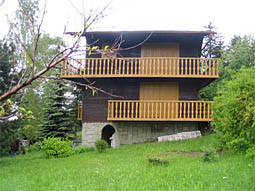
Moving to cottages, people often address the housing of children
 |
Besides Prague, the movement to cottages mainly concerns Brno, but it is not uncommon in Ostrava or Plzeň as well. However, according to experts surveyed, it is already less relevant in Liberec, mainly due to the proximity of nature and mountains.
Recreational properties are used for permanent living by approximately 14 to 20 percent of their owners, with more than half not ruling out their permanent use in the future, believes Ondřej Diblík from Lexxus, who refers to the results of an older study from the Faculty of Science at Charles University. The census conducted seven years ago showed that about 12,500 people live permanently in cottages and chalets.
The main motivation for them is usually not renting out an apartment, but passing it on to future generations, Diblík assesses. "If people were to rent out their regulated rental apartment 'illegally', they risk eviction. The only option is to rent out their apartment in personal ownership and live in a recreational property. We believe that such cases are rather rare," he stated.
Some people choose living in cottages and chalets as a cheaper alternative to buying a family house. "After thermal insulation and other modifications, the investment is lower. However, it is slightly compensated by the quality of living," informed Jan Kratochvíl from MEXX Reality. The condition is usually a well-accessible city within about 30 kilometers.
"90 percent of the time, it involves living in cottages or chalets, however, there is also a trend of acquiring various 'mobile objects' or various ecological buildings or 'improved' log cabins," stated Radim Koliba from Hot-Reality.
Most of the people moving out of cities in this manner are primarily seniors. Koliba estimates their proportion to be around 70 percent. "However, this trend can also be observed among the middle-aged population who want to exchange the busy city life for living in nature and commute for work or have professions that do not require regular attendance at work. I estimate this to be about an additional 15 percent," he added.
Cottaging represents a unique phenomenon in the Czech Republic. "The Central Bohemian recreational area with more than 100,000 recreational properties and a density of ten properties per square kilometer likely has no equivalent in the world. The highest concentration is found at a distance of 20 to 30 kilometers from the center (of Prague)," said Diblík.
The English translation is powered by AI tool. Switch to Czech to view the original text source.
1 comment
add comment
Subject
Author
Date
Stěhování na chaty a chalupy.
Petr
04.01.09 11:53
show all comments