
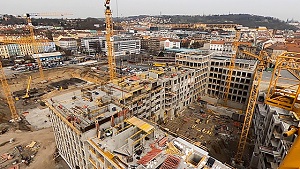
Construction in the Czech Republic rose by 9.3 percent last year after two years of decline
 |
"Construction performed well in December, with production increasing both year-on-year and month-on-month, and growth was seen in both building and engineering construction," said Radek Matějka, director of the agriculture and forestry, industry, construction, and energy statistics department of CZSO.
Production in building construction, which includes building structures, increased by 2.3 percent year-on-year in December, while engineering construction, which encompasses the building of roads, telecommunication, and energy networks, rose by 10.9 percent. For the entire year, building construction recorded an increase of 8.6 percent and engineering construction by 10.5 percent, with production in both sectors growing year-on-year in every quarter of last year.
In 2025, the construction of 35,819 apartments was initiated, which was a year-on-year decline of 2.2 percent according to statisticians, following growth from the year before. However, the number of completed apartments increased, rising by 11.5 percent year-on-year to 33,742. The regions with the most apartments started and completed were Prague, the Central Bohemian Region, and the South Moravian Region.
The number of apartments that began construction in the last month of the year decreased year-on-year by 11.2 percent to 2,774. The number of completions increased year-on-year by 56 percent to 2,988.
The estimated value of construction projects that were approved by authorities last year reached 503.3 billion crowns, which was 13.3 percent less year-on-year. The decline was mainly due to new engineering projects and non-residential buildings. In 2025, 51 projects were granted permits with budgets exceeding one billion, but they had no significant impact on the overall decrease in the estimated value of constructions, the statisticians noted.
They also added that the estimated value of construction permits issued in December fell year-on-year by nearly 55 percent to 36 billion crowns, attributed to a high comparative base. "After model adjustment excluding constructions with budgets over one billion crowns, the estimated value would have decreased by a tenth," added Petra Cuřínová, head of the construction and housing statistics department of CZSO.
According to her, last year was one of the most successful years in construction in the last 25 years. The results from last year approached the successful years of 2008 and 2009, Cuřínová stated at today's press conference. In the previous two years, construction was in decline, yet she noted that the year-on-year growth of construction output last year was not solely due to a lower comparative base. Year-on-year growth in construction was recorded in every month of last year.
In the first 11 months of last year, the Czech Republic recorded the second-largest year-on-year growth in construction output among all measured countries in the European Union. Higher growth was only recorded in Slovenia. Conversely, the largest decline in construction output was noted in France and Germany. On average, construction in the European Union grew by 0.7 percent from January to November.
According to data for the first to third quarters of last year, approximately 214,000 people worked in construction, which is 5.3 percent of all employees in the Czech Republic. The average salary was 42,354 crowns, having increased by a tenth year-on-year. According to 2024 data, 41 percent of all employees were people with secondary education without a high school diploma. In 84 percent of cases, they were men, with an average age of 45.
The English translation is powered by AI tool. Switch to Czech to view the original text source.
0 comments
add comment