
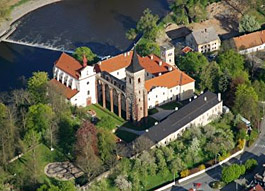
The Sázava Monastery is awaiting a complete renovation for more than 100 million
 |
"The repairs will not only apply to the monastery itself, but also to the adjacent land, the cave of St. Procopius and its surroundings, or the garden," she added. It is necessary, according to her, to address the ingress of moisture into the lower floors of the building, to reconstruct all engineering networks, and to ensure archaeological surveys. The curator estimates that this will take eight to ten years.
This year, work will begin on the roof. The monastery received one million crowns from the state for this, but this will only cover part of the work. Once completed, a new castle exhibition will begin to be built on the first floor of the monastery. It could be completed in three to four years. It will not be a classic tour route, as visitors to monuments are used to. Visitors will be able to sit on and touch the exhibited historical furniture, Matoušová revealed.
The current exhibition about Old Slavic Sázava presents the monastery in the context of the Cyril and Methodius tradition. However, the tour route is influenced by the time of its creation, namely the 1980s. Therefore, guides try to enrich the interpretation with stories about monasticism and hermitism and supplement it with legends and tales related to Sázava and its surroundings. "The problem is that in many cases it's just a word to which nothing can be shown. In the future, we want to combine verbal information with visual in the exhibition," Matoušová added.
The pilgrim Procop founded a community in Sázava at the beginning of the 11th century, which was later elevated to a convent of the rule of St. Benedict by Duke Oldřich. In 1032, the first partially private monastic buildings were also constructed. For nearly three-quarters of a century, Slavic monks lived there, and Sázava then represented a unique center of Old Slavic literature and liturgy. In 1096, Latin monks from Prague settled in the monastery, but it remained a center of spiritual and literary education and the development of artistic crafts. The fate of the monastery closed in 1785 when Joseph II dissolved it.
In 2000, part of the monastery was returned to the descendants of the Schwarz family. The year before last, the restitutor sold her share to the state.
The English translation is powered by AI tool. Switch to Czech to view the original text source.
1 comment
add comment
Subject
Author
Date
počty
Milan
11.05.08 04:31
show all comments