
Heritage experts and architects will debate contemporary construction
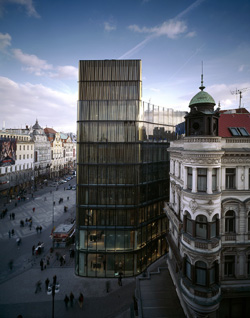 |
| DaM, Palác Euro in Prague, 2000 - 2002 |
"We do not oppose contemporary architecture; however, it must be of high quality," said Goryczková. According to her, heritage protectors are often perceived as those who slow down development and refuse modern construction, and this perception should be adjusted by the project. "There is no difference between old and new, but between quality and poor quality," added Biegel.
The project will bring, for example, debates with architects and creators of modern buildings such as Vlad Milunić or Emil Přikryl. Milunić built the famous Dancing House in Prague, while Přikryl is known, among other things, for the award-winning reconstruction of the former brewery into Galerie Benedikta Rejta in Louny.
NPÚ aims to open a dialogue and clarify the positions of heritage protectors, architects, and other involved parties, such as representatives of local government and politicians if they want to join the discussions.
A discussion forum will open on the website - individual examples of buildings to discuss will be divided into four chapters. The first section, titled New in the Old, will feature new buildings that successfully complement or enrich the historical environment. An example is the National Technical Library (NTK) in Prague and the Dancing House.
In the second category, on the other hand, there will be examples of irreversible losses, which the project organizers consider to be the department store Myslbek in Prague's Příkopy or the Špalíček in Brno. The third chapter collects examples of so-called buildings behind the curtain, i.e., inconspicuous but drastic reconstructions. As an example, the project mentions the Palladium department store in Prague, which appears acceptable from the outside but represents an oversized new block inside.
In the last section, titled The Living City, there will be positive examples of successful reconstructions of public spaces, such as the Upper Square in Olomouc.
The project will gradually focus on various places. It will start in Liberec, continue in Ostrava, Prague, Brno, and Hradec Králové. It will last until March next year.
The English translation is powered by AI tool. Switch to Czech to view the original text source.
2 comments
add comment
Subject
Author
Date
UMĚLÁ POLEMIKA
de ardoise
20.10.10 09:04
Re UMĚLÁ POLEMIKA
Vích
20.10.10 10:13
show all comments