
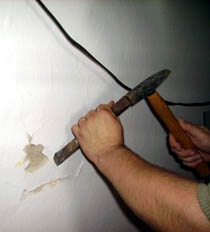
The most common complaints about apartments are cracks in the plaster
 |
"The causes of defects are the undue haste of everyone, especially investors, who want the construction completed so they can sell or rent it," said Václav Kučera from the Technical and Testing Institute for Construction in Prague, to ČTK. Sometimes a building is completed within half a year, when concrete actually takes two years to cure, plaster works for a year, and foundations settle for four years. "In the past, when there was less rush, these phenomena did not occur because the building, including plastering, structure, and roof matured during construction," noted Kučera, who deals with expert assessments of buildings.
One example of defects was noted by the owner of a new apartment in Vestec near Prague. "Shortly after moving in, the floor bulged due to moisture, and we couldn't use the room for nearly two months. The contractors blamed one another, and the handling of the complaint dragged on," he told ČTK. The flooring company resolved the issue about two months after the complaint. The defects related both to the apartment and the entire building. For instance, mold appeared in the eaves of the roof, the shingles were poorly laid, and there was a lack of sealing around the lightning rods. The entire complaint process lasted two years, and even now, with the building having stood for about three years, not everything is, according to the owner of one of the apartments, in order.
A resident of a new residential building in Milovice, Central Bohemia, complains about water leaking into the roof. Even after six months, the company had not resolved the issue. He also noted problems with window sills that have poor slopes. During rain, water leaks under the plaster, damaging it. The owners have also experienced other issues. "They built us a sidewalk and then immediately ruined it with a truck loaded with concrete blocks meant for another construction," said a resident of Milovice to ČTK.
A new apartment can only be occupied after obtaining an occupancy permit. This is an official rather than technical performance. "Occupancy permits are issued by officials who check if it meets the project and building permit requirements, but they do not concern themselves with the technical aspect," said Kučera. According to him, a developer should sell the property only after the materials have settled and the defects have been removed. However, demand for apartments is high, and developers accommodate prospective buyers and try to complete new buildings as quickly as possible.
Large development companies confirm that defects arise mainly due to natural physical processes. However, they claim to handle complaints quickly. "Generally, the period for resolving complaints is one month from submission. In 90 percent of cases, we resolve complaints faster," said Ondřej Šuch from the largest construction company on the market, Skanska. According to him, the company records complaints as a percentage of the total number of apartments sold.
Similarly, according to Finep spokeswoman Pavla Temrová, the company does not delay in handling complaints. "Standard complaints are resolved by our company within 15 days, at the latest within 30 days," said Temrová, adding that some defects require longer resolution times due to adherence to technological timelines. During the three-year warranty period, the number of apartments without complaint defects is above 85 percent, according to her, depending on the complexity of individual projects.
"If we are to name a statistically most frequent client complaint, it would be the appearance of minor cracks in the interior plaster arising from the structure's settlement in the years following occupancy," noted the Finep spokeswoman. According to her, most of the complained defects in Finep's projects are due to technological negligence by individual contractors.
However, one resident of Prague's Barrandov, who bought an apartment from Finep, is not satisfied with the speed of complaint resolution and the willingness to address them. He claims that complaints have dragged on since moving in, which was several years ago. "I complained about peeling plaster on the balcony. They just kept repairing the surface. Eventually, they admitted that the tiles were poorly laid, allowing water to seep through," he told ČTK. Due to the unwillingness to address complaints, several owners have filed lawsuits against the company.
Central Group stated that for an apartment with an average value of three million crowns, approximately 2000 crowns are spent on defect remediation. "It is clear from this that the share of complaints relative to the volume of completed construction is entirely negligible," said Miluše Netolická, the sales director. The largest share of defects consists of cracks in plaster, which she states are a result of the natural maturation of the plaster and the building's overall settling into the ground. "This process naturally takes about two years from completion," she added.
Companies are increasingly building new apartments. According to data from the Czech Statistical Office (ČSÚ), over 20,200 apartments began construction in the first half of the year, which is 14.2 percent more than in the same period last year. The office and analysts agree that growth was mainly influenced by favorable conditions in the mortgage market, higher loan values in building savings, support for young couples in acquiring their first apartment, and the anticipated increase in VAT on residential construction starting in January 2008.
The English translation is powered by AI tool. Switch to Czech to view the original text source.
3 comments
add comment
Subject
Author
Date
Kvalita
Václaf
07.11.06 05:53
Finep
Finep
07.11.06 10:16
Finep jsou podvodníci
Karel
14.02.09 08:02
show all comments