
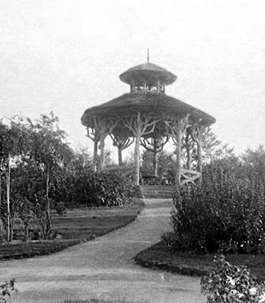
The cork pavilion in the grounds of Konopiště Castle will be renovated
 |
The work is being financed by the National Heritage Institute. According to Krejčová, structural stabilization has already been carried out. "Now the second phase should commence - laying the thatched covering, cladding with cork, and landscaping. About a million crowns are estimated for that," the caretaker noted.
The cork pavilion in the Rose Garden is an unconventional and unique garden structure, both in its construction and materials used, as well as in its artistic value. It was likely built during the overall reconstruction of the estate at the turn of the 19th and 20th centuries, though the exact date of construction is unknown. It is an open building with an octagonal floor plan, supported by wooden columns made from natural oak trees and a stone base. The last interventions date back to the 1950s. "The covering was changed to metal. Then it was just destroyed, people tore off the cork," Krejčová commented.
Originally, the Konopiště castle was founded as a Gothic fortress modeled after French châteaux at the end of the 13th century by Bishop Tobias of Benešov. Over time, many noble families took turns residing at Konopiště, including the Šternberks, Hodějovs of Hodějov, Vrtbás of Vrtba, and Lobkowicz family. In 1887, the estate was purchased by Archduke Franz Ferdinand d'Este, who transformed it into a magnificent residence for the future emperor.
The Sarajevo assassination, in which both the heir to the Austrian throne and his wife, Duchess Sophie of Hohenberg, perished in 1914 in the Bosnian metropolis, became the trigger for World War I. It was planned by a group of Serbian nationalists and carried out by Gavrilo Princip, who was subsequently imprisoned in the military prison in Terezín, where he also died.
The English translation is powered by AI tool. Switch to Czech to view the original text source.
0 comments
add comment