
The castle underwent renovations under Klaus, and according to experts, culture has diminished
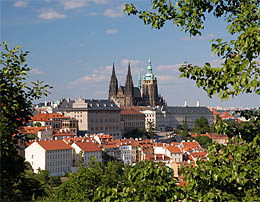 |
Soon after the election of the new president, some works by architect Bořek Šípek, who was among Václav Havel's favored artists, disappeared from the Castle. Klaus's style is reportedly more conservative and traditional. He wants the Castle to resemble the era of the first president Tomáš Garrigue Masaryk as closely as possible. This also means that he respects the then castle architect Josip Plečnik. His wife Livia is also involved, overseeing all modifications. "We are trying to move the Castle towards a conservative spirit," says David Šebek from the presidential office.
However, some experts complain precisely about the conservatism and the absence of modern art at the Castle. "During Havel's era, the Castle was more lively in terms of music: not that there was a great concept, but various initiatives were not blocked...," says music publicist Pavel Klusák, for example. The conservatism in art at the Castle was also criticized by independent curator Kaliopi Chamonikola, who previously worked at the Administration of Prague Castle.
Back in 2004, two respected festivals had to leave the Castle - the Respect ethnic music festival and the international festival Strings of Autumn. The non-renewal of the contract also affected the Leica gallery, which was located in the Supreme Burgrave of Prague Castle until 2004.
Conversely, in 2004, Klaus initiated the Jazz at the Castle music cycle and concerts of classical music Music of Prague Castle, while the tradition of the Summer Shakespeare Festival also continued.
In the spring of 2004, Klaus also opened a permanent exhibition The Story of Prague Castle in the newly reconstructed cellars of the Old Royal Palace. Among the other exhibitions, some of the most interesting included the exhibition of painter Zdeněk Burian (2005), the Gothic art exhibition Charles IV, the Emperor by the Grace of God (2006), and last year's exhibitions of Bohuslav Hasištejnský from Lobkovice and Emil Filla. Since December 2007, an exhibition of Mikoláš Aleš has also been accessible.
According to architectural historian Zdeněk Lukeš, Klaus has no ambition to leave significant architectural footprints at the Castle. "We have tried to make events less ostentatious, less visible, but immensely necessary..." says Klaus. Among the most significant renovations that took place during his presidency is the extensive reconstruction of the Institute of Noble Maidens, completed this January, which took place in several phases over 15 years. After a year and a half of repairs based on the designs of architects Ladislav Lábus and Zdeněk Heřman, the Riding Hall of Prague Castle was opened last May. The building has been transformed into a multifunctional space suitable for concerts and social events. The entire complex of the Vicarage also underwent extensive reconstruction, and the renovated restaurant opened to visitors two years ago. Since 2006, Richter's villa with the adjacent vineyard has also been under repair. Significant construction achievements also include the conversion of the former Lumbe's villa into the presidential residence. Klaus moved in there in the summer of 2005.
During Klaus's tenure, the 15-year dispute between the state and the church over the ownership of St. Vitus Cathedral continued. On Thursday, representatives of the Catholic Church and Prague Castle signed an agreement for its joint use, but the court process is not yet concluded. Most recently, the church filed an appeal against last September's ruling, which awarded the cathedral and adjacent properties to the state.
Changes have also affected the presidential residence at the castle in Lány. Its furnishing has been one of the activities of the first lady Livia since the beginning, who has made hundreds of interior modifications here.
The English translation is powered by AI tool. Switch to Czech to view the original text source.
5 comments
add comment
Subject
Author
Date
absence moderního umení na prazském hrade
mirko baum
31.01.08 08:06
na odlehlém místě Hradu?
Pepito
31.01.08 09:03
xxx
radek martisek
01.02.08 07:42
pokora
pepito
02.02.08 09:50
porád to samé
mirko baum
04.02.08 02:32
show all comments