
Bechyně - builder of the Lucerne and a series of original bridges
 |
Prague - The Prague Lucerna Palace, the ironworks in Hrádek near Rokycany, several proposals for bridging the Nusle Valley in Prague, the original arch bridge in Hořepník in the Pelhřimov region, the bridge over the Chrudimka in Pardubice, the bridge over the Váh in Komárno, and the highway bridge near Senohraby - all of these projects were contributed to by the civil engineer and founder of Czechoslovak concrete construction Stanislav Bechyně. The long-time professor at the Czech Technical University Bechyně died 45 years ago, on October 15, 1973, at the age of 86 in Prague. He is buried in his hometown Přibyslav, where a square in the city's center is named after him.
Bechyně was born on July 20, 1887. In 1910, he completed his studies at the Czech Technical University in Prague and immediately after graduation, he joined the company of Karel Skorkovský, which focused primarily on the construction of concrete structures. It was to concrete construction that the later academic Bechyně dedicated his entire life.
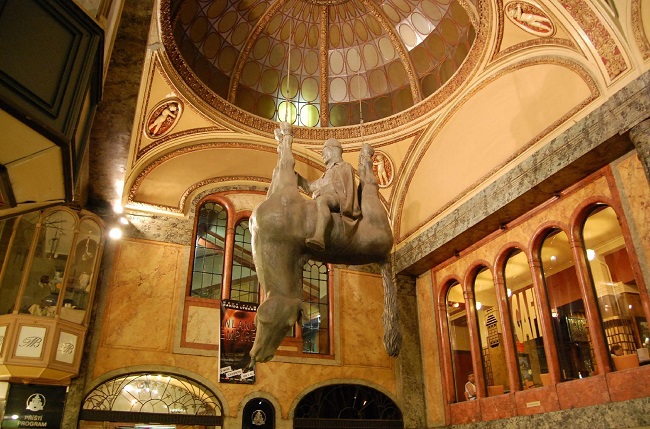
According to his design, columns made of wrapped cast iron and mushroom ceilings were used for the first time in the then Austro-Hungary during the construction of the automobile factory in Prague-Libeň. He also had a long-lasting influence on bridge construction with his realization of the arch bridge structure with a suspended deck and cable in 1913 in Hořepník in the Pelhřimov region. However, his greatest construction achievement was the connection of columns and beams into frame structures, which Bechyně implemented during the construction of the Prague Lucerna Palace in 1919.
In 1919, Bechyně proposed one of the first crossings of the Nusle Valley in Prague with a reinforced concrete bridge, and in 1938 he proposed a lightweight concrete structure. The construction was halted by World War II, and neither was Bechyně's subsequent design for a reinforced concrete bridge with three arches, developed after the war in collaboration with Bohumír Kozák, realized.
In 1920, Bechyně became a full professor (then the youngest) of statics and dynamics at the Czech Technical University, where he worked until 1958.
His creations also include the concrete structure of the ironworks in Hrádek near Rokycany, the cylindrical shell structures of the warehouse in Kostelec nad Labem, industrial buildings of the cement plant in Králův Dvůr, hangars in Letňany and Karlovy Vary, steelworks in Kladno, and the architecturally valued pavilion of the Prague Zoo.
However, his most famous works are his bridge constructions, among which the arch bridge in Pardubice from 1935 and the bridge over the Váh in Komárno from 1955 hold a prominent place. Bechyně also oversaw the construction of the largest arch highway bridge near Senohraby, which was completed in 1950. He was also involved in rescue work on numerous endangered Czech monuments due to construction.
Stanislav Bechyně authored a number of significant writings, some of which have been translated into many languages. All of this elevated him to the ranks of the first Czechoslovak academics after the war. As a professor, he also lectured at the Czech Technical University. He was awarded many orders and prizes, became a member of numerous foreign scientific institutions, and received a state award. In 1958, he retired. Bechyně also privately interested himself in botany.
The English translation is powered by AI tool. Switch to Czech to view the original text source.
0 comments
add comment