
The exhibition commemorates Anna Fárová's fifty-year work for photography
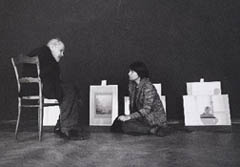 |
The exhibition consists of collages documenting Fárová's work and photographs of authors whose work she followed. "The exhibition shows ten stages of her life, ten stops she went through," said the gallerist.
The theorist of photography Anna Fárová is one of those people without whose influence Czech photography would not have the recognition it enjoys today in the world. A pivotal moment in Fárová's professional life, the daughter of a French professor and a Czechoslovak diplomat, was meeting Henri Cartier-Bresson in 1956. This determined her direction; in 1958 she published his first monograph and through him, she connected with photographers from the Magnum agency, whose work she then presented in Czechoslovakia.
The first of the ten stops of the exhibition focuses on the defining meeting with Bresson and bridging foreign photographers to the Czech audience. In the 1960s, Fárová organized exhibitions in Czechoslovakia featuring Werner Bischof, André Kertész, Elliott Erwitt, and Robert Doisneau.
An important chapter, or rather one of Fárová's lifelong interests, is František Drtikol, the third stop of the exhibition. In 1970, she ensured the transfer of his entire legacy to the Art and Design Museum, where she was appointed. In 1972, she organized a monographic exhibition for him at the museum, which led to the discovery of Drtikol's name and his significance not only for Czech photography.
Another significant name for Fárová was Josef Sudek, whom she met as an eighteen-year-old in his studio in Újezd. For Sudek's eightieth birthday in 1986, she prepared a retrospective at the Art and Design Museum. After his death, she sorted his estate, and after his sister's death, she became the heir to the copyright. She was a tireless interpreter and promoter of his work.
The other stops are dedicated to Fárová's work at the Art and Design Museum, where she worked from 1970 until January 1977 when she was forced to leave after signing Charter 77, as well as to the authors whose work she dedicated her life to, whether they were based at home or in exile. They include Emil Medková, Jiří Toman, Jan Svoboda, Zdeněk Tmej, Jan Saudek, and Josef Koudelka.
The Langhans Gallery is publishing a book with the same title as the exhibition: Anna Fárová & photography - Works since 1956. The exhibition will last until January 1.
The English translation is powered by AI tool. Switch to Czech to view the original text source.
0 comments
add comment