Interwar Modernism in Lviv - Exhibition at GAB
Architecture that survived
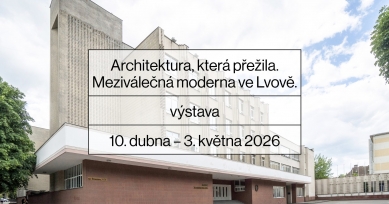
The exhibition, prepared by Ukrainian researcher Myroslava Liakhovych, presents the results of her research focused on the architecture of Lviv between the First and Second World Wars. Interwar Lviv was a place of hope, experimentation, and the search for a common identity; the multiethnic population (Poles, Ukrainians, Jews, Germans, Georgians, Armenians) of the city in the 1920s and 1930s sought to find a common language and express their unity through modernist architecture. Many architectural realizations arose here – office buildings, schools, hospitals, workers' clubs, sacred buildings, and residential houses.
In Lviv, the 1920s saw the predominance of the art deco style, often with neoclassical or historicizing elements, but during the 1930s, most buildings were constructed in the spirit of functionalism and other modern styles such as the international style or expressionism. After World War I, it became the capital of the West Ukrainian Republic, which existed only for a few months, and after the conclusion of the Russo-Polish War in 1921, it remained under Polish administration as the capital of Lviv Voivodeship. Schools, hospitals, community houses, and residential buildings were created – spaces for a new life in a new era.
However, history intervened mercilessly. The Second World War left Lviv without most of its inhabitants – Poles were displaced, Jews were exterminated, and Ukrainians were deported or killed. Buildings remained. Silent repositories of memory, bearing names and stories that have faded away. Today, nearly a century later, the city faces further violence. The Russian invasion once again brings fear, sirens, and destruction. Modernist buildings thus bear new scars, but at the same time, they still stand – as proof of resilience and continuity.
The exhibition presents selected examples of Lviv modernism in both public and residential architecture. Through photographs, archival materials, and 3D scans complemented by authentic sounds of the buildings and their surroundings, it constructs a layered image of the city – its past and present. Architecture here is not just a backdrop to history. It is its bearer. A memory that endures – even as the world around it changes.
A guided tour with the exhibition's author will take place on April 9 at 6:30 PM, and the exhibition will run until May 3. Opening hours are Monday to Friday from 10 AM to 8 PM, entrance is free.
In Lviv, the 1920s saw the predominance of the art deco style, often with neoclassical or historicizing elements, but during the 1930s, most buildings were constructed in the spirit of functionalism and other modern styles such as the international style or expressionism. After World War I, it became the capital of the West Ukrainian Republic, which existed only for a few months, and after the conclusion of the Russo-Polish War in 1921, it remained under Polish administration as the capital of Lviv Voivodeship. Schools, hospitals, community houses, and residential buildings were created – spaces for a new life in a new era.
However, history intervened mercilessly. The Second World War left Lviv without most of its inhabitants – Poles were displaced, Jews were exterminated, and Ukrainians were deported or killed. Buildings remained. Silent repositories of memory, bearing names and stories that have faded away. Today, nearly a century later, the city faces further violence. The Russian invasion once again brings fear, sirens, and destruction. Modernist buildings thus bear new scars, but at the same time, they still stand – as proof of resilience and continuity.
The exhibition presents selected examples of Lviv modernism in both public and residential architecture. Through photographs, archival materials, and 3D scans complemented by authentic sounds of the buildings and their surroundings, it constructs a layered image of the city – its past and present. Architecture here is not just a backdrop to history. It is its bearer. A memory that endures – even as the world around it changes.
A guided tour with the exhibition's author will take place on April 9 at 6:30 PM, and the exhibition will run until May 3. Opening hours are Monday to Friday from 10 AM to 8 PM, entrance is free.
The English translation is powered by AI tool. Switch to Czech to view the original text source.
0 comments
add comment