
About the international competition for the design of the National Library of the Czech Republic
The National Library of the Czech Republic is located right in the center of Prague, in the historic area of Klementinum. However, the fascinating Baroque spaces bring a number of limitations for library operations. The biggest of these is the lack of space. Indeed, librarians here have been grappling with this issue for more than a hundred years, since the end of the 19th century. Over the past decades, various plans have emerged for the construction of a new library and even for the expansion of Klementinum itself, such as by digging underground floors. None of the visions managed to reach a successful conclusion. Thus, at the beginning of the 1990s, piles of unprocessed new acquisitions gradually filled every free space in Klementinum without any meaningful way of managing them. The crisis was then resolved by the construction of a central depository in Hostivař. However, this was merely a temporary solution - currently, the National Library of the Czech Republic manages over six million documents, and experts' forecasts indicate that by 2010, without appropriate intervention, a similar catastrophe would repeat itself. Therefore, the management of the National Library of the Czech Republic diligently worked on the initiation of the construction of a new building, and in 2004 submitted an investment proposal to the Ministry of Culture of the Czech Republic.
The choice fell on Letná
After extensive and diligent searching for the most suitable area for the new building, the decision was made to select land on the edge of Letenská Plain, which is owned by the capital city. Still, at the end of 2004, the city council supported the National Library's proposal with the signing of a Memorandum of Cooperation. The investment proposal for the construction of the new building of the National Library also met with understanding from the members of the parliament - first, on April 21, 2005, it was supported by the Committee for Science, Education, Culture, Youth, and Sports of the Chamber of Deputies, and on June 1, by the Budget Committee. In November 2005, the Ministry of Culture registered the forthcoming architectural competition in the program "Development and Renewal of the Material and Technical Base of State Cultural Institutions with the participation of the state budget for financing the project in accordance with the Decree of the Minister of Finance No. 40/2001 Coll.". The first 1.5 million crowns were allocated for the preparation of competition materials and other preparatory work with this registration. The Council of the Capital City of Prague then decided on January 10, 2006, to sell the land on Letenská Plain, and this decision was joined by the Council of the Capital City of Prague on March 30, which approved the transfer of the land in Letná for the price of 31,516,550 CZK to the National Library for the construction of the new building. The realization of the project, however, will require coordination of the library's construction with the building of the inner city ring road, whose exit is planned not far from the mentioned parcel. The plans of the National Library have also been supported by the government of the Czech Republic in its resolution from June 2006, which anticipates financing of the project from the state budget.
The architects' task was to design a building with storage capacity for 10 million library units, which would provide the National Library of the Czech Republic with a sufficient reserve for at least the next fifty years. In the future library, the public will find, in addition to modern collections dating from 1801 to the present, also a significant part of the collections and reading room of the Parliamentary Library. The concept of the new building, which was part of the assignment for the international architectural competition, is based on the assumption that libraries in the 21st century are gradually transforming from more or less closed institutions providing traditional services tied to their own collections into open institutions with a significantly broader social and cultural scope. In addition to basic services and access to about 300,000 documents in open selections of specialized reading rooms (a total of 1,250 study seats is planned), the new library should also offer an open zone with a literary café, spaces for exhibitions, and for cultural and social activities. Social and relaxation areas will provide an additional 700 seats.
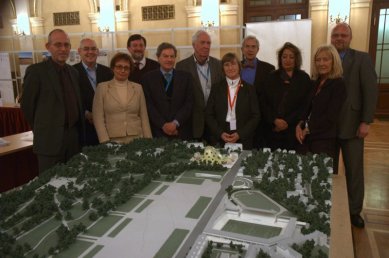
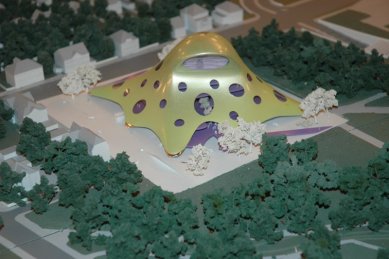
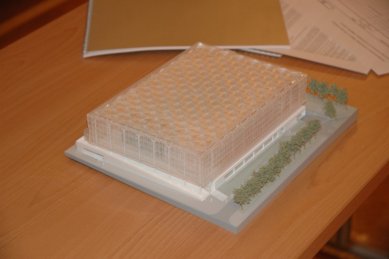
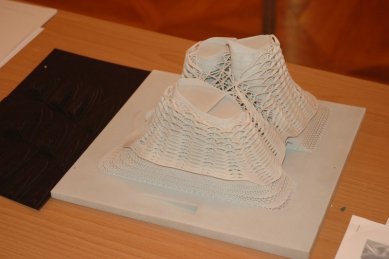
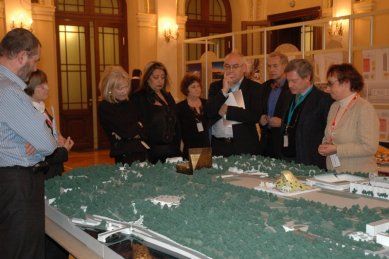
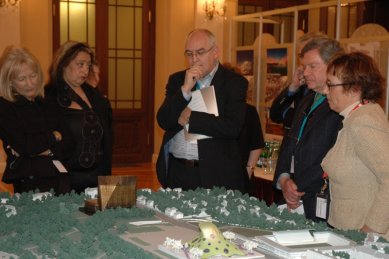
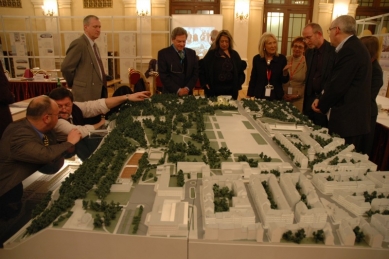
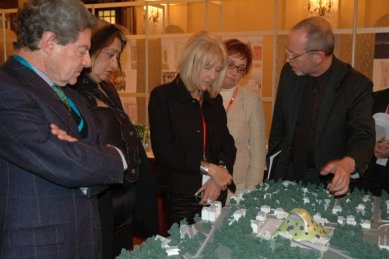
Competition proposals were required to be processed only in English, and in addition to graphic materials, participants had to submit a simple model of the library object at a scale of 1:500 in white. The jury inserted this model into a prepared model of Letná during their evaluation to gain a more accurate idea of how the architects' visions correspond with the immediate surroundings of the future building. Registration for applications closed at midnight on Saturday, July 1. As expected, the announced competition attracted extraordinary attention - after filtering out applications sent through duplicate means and rejecting those who did not meet basic registration requirements, 735 architects and architectural teams from virtually all over the world were registered. Among them, domestic architects had the largest representation, submitting 116 applications. Similar numbers of registrants were also from France or Germany, while other European countries (such as the United Kingdom, Austria, Switzerland, Italy, and the Netherlands) had significantly lower representation. The global interest in the project prepared above the Vltava River is evidenced by applications sent from countries spanning all inhabited continents - North America accounted for 11%; however, the United States had a 71:10 advantage over Canada. Eleven architectural teams registered from five countries in South America, and three from Africa. Surprisingly, the competition received a large response from Japanese architects, with 17 applications sent to Prague. In total, Asian architectural studios accounted for 6% of the registrants, including candidates from Indonesia, Malaysia, and Thailand. There was also one registration from Australia and New Zealand.
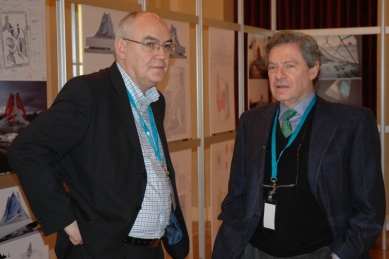
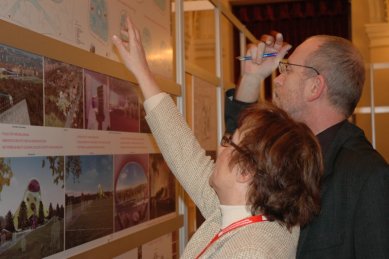
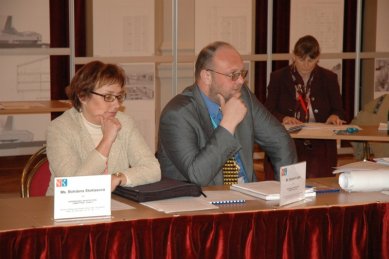
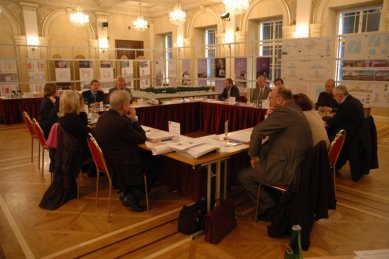
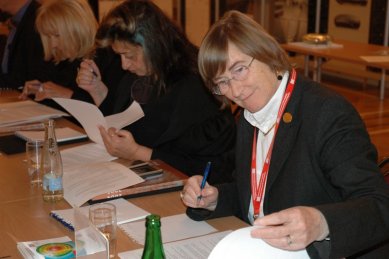
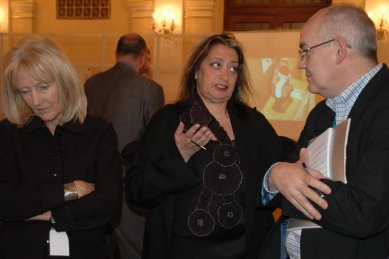
The international jury met for decision-making, composed of: architect Zaha Hadid, Eva Jiřičná, urban planning expert from UNESCO Irene Wiese-von Ofen, architects José Grinberg, Petr F. Bílek, and John Eisler, and environmental expert Tony Mc Laughlin. The director of the Monument Care Department of the Prague City Hall, Jan Kněžínek, represented the capital city on the jury, and Vlastimil Ježek (in close cooperation with the backup juror Bohdana Stoklasová, who coordinated the preparation of the library portion of the construction program) represented the National Library. The jury was introduced to the public on October 23 in the Mirror Chapel of Klementinum, but thereafter its further meetings were closed to the public and took place in strict seclusion from the surrounding world. Architect Eva Jiřičná was elected as the chairwoman of the jury, and architect Petr F. Bílek became the deputy chairman. The actual decision-making of the jury did not take place in the Mirror Chapel, where not even hundreds of architectural proposals would have fit, but at the nearby Slovanský Island, in the large hall of the Žofín Palace. It was necessary to transfer the materials sent by the participants, install exhibition panels, and attach drawings to them.
The jurors began their work with two hours of individual study of each proposal. Shortly after the report from the technical committee, they proceeded to several elimination rounds, resulting in the end of the competition for 224 proposals. After lunch, the jury continued the selection and gradually narrowed it down to just 28 contestants for the next day. The number of suitable candidates was then reduced to 8 finalists on the second day, participants in the II. round of the competition. Invitations to further participate in the competition were sent to them from Prague. At this point, however, none of the jurors knew who had made it to the selected group. Decisions were being made about anonymous proposals, and only the notary, who had stored the identification sheets until the end of the competition, knew the names of their authors.
Soon the general public will also be able to see how challenging it is to decide among hundreds of architectural proposals in such a competition. All competition proposals, including the winning one, will be presented at a large exhibition in the Klementinum Gallery from March 29 to May 31.
Details of the competition and current information can be accessed on the website of the National Library of CR: http://www.nkp.cz/competition library/index.htm
Of Iraqi origin, considered one of the best current architects, works in the United Kingdom. She deals with all fields of design ranging from urban scale through to products, interiors, and furniture, exhibition designs for world museums as well as scenic designs. She lectures at universities specialized in architecture and design, among others at the University of Applied Arts in Vienna. Her invention and courageous work with space and geometry in her designs were awarded in many international competitions (e.g. the Centre for Contemporary Arts in Rome, Cardiff Bay Opera House, the Bergisel Ski-jump in Innsbruck, designs of museums, theatres, and concert halls). Zaha Hadid's built work has won her much academic and public acclaim. In 2004 she became the first female recipient of the Pritzker Architecture Prize.
Eva Jiřičná (chairwoman of the jury) - a prominent architect of Czech origin, working in England. After her studies, she worked at the Research Institute of Fashion and Industrial Design in Prague, from 1968 in London as an architect at the Greater London Council. She is a recipient of the Order of the British Empire 1st class and other awards, honorary doctorates, and professorships at many universities, and is frequently a member of international architectural juries. Since 1982, she has been leading a private studio in London under the name "Eva Jiřičná Architects" (EJA), which has received several international awards. In the Czech Republic, Eva Jiřičná and her studio have been involved in interiors at the Dancing House, in the design of the university library in Zlín, in the Foyer of Sazka Arena, the adaptation of interiors of historical buildings for gallery use, and hotel projects in Prague; among others, she designed a new Orangery in the grounds of Prague Castle.
Renowned architect of Czech origin, works in the United Kingdom. After graduation at the university, she worked in the Research Institute of Fashion and Industrial Design in Prague and since 1968 was an architect at the Greater London Council. She received a Commander of the British Empire and other awards, holds many honorary doctorates and professorships in many universities, and often participates in international architectural juries. Since 1982 she has been a principal of the private studio "Eva Jiřičná Architects" (EJA), which has received many international prizes. In the Czech Republic, she was involved with her studio in designing the offices in the Gehry Building in Prague, the University Library in Zlín, the Foyer of Sazka Arena, refurbishment of interiors of historical buildings for gallery purposes, and projects of hotels in Prague. Among others, she also designed the new Orangery in the grounds of Prague Castle.
Irene Wiese-von Ofen - architect, representative of UNESCO, international expert, invited due to the location of the National Library's new building on the border of Prague's monument conservation area. She served in Essen as deputy mayor and advisor for architecture, urban planning, and city renewal, lectures at universities in Germany, was the president of the International Federation for Housing and Planning in The Hague, Netherlands, and the chairwoman of the German Association for Housing, Urban and Spatial Planning in Berlin. She frequently belongs to or chairs national and international architectural competitions.
An architect, representative of UNESCO, international expert, was invited to sit on the jury with regard to the location of a new building of the National Library on the border of Prague Urban Conservation Area. She worked as a Deputy Mayor of the City of Essen and freelance consultant in Architecture, Town Planning, and Urban Renewal. She is former president of the International Federation for Housing and Planning in The Hague and president of the Council of the German Association for Housing, Urban and Spatial Planning in Berlin. She is a lecturer in many universities in Germany and often participates as chairwoman or member of jury in national and international architectural competitions.
José Grinberg - a prominent Mexican architect, a respected member of the Council of the Colegio de Arquitectos de México. He has been a professor of architecture at Anahuac University for 26 years, receiving several awards, including the first prize for the urban complex CIDECO initiated by Anahuac University in 1986; the first prize in an international competition for a new public library in the state of Jalisco in 2005. Grinberg's architectural and urbanistic solutions are rooted in the understanding of context, program, social implications, and construction technologies. The Grinberg & Topelson Architects studio (1978) has developed numerous projects for residential, educational, health, and cultural buildings (e.g. House of Culture Huayamilpas in Coyoacán, mixed-use building Luis Moya in Mexico City).
Renowned Mexican architect, member of the Merit Board at the Colegio de Arquitectos de México. He is a Professor of Architectural and Urban Design at Anahuac University for 26 years. He received many awards, among others, First Prize for the urban housing complex CIDECO launched by the Anahuac University in 1986, First Prize in the International Competition for New Jalisco State Public Library in 2005. José Grinberg's architectural and urban solutions are rooted in the analysis of the context, program, social implications, and building technologies. The studio Grinberg & Topelson Architects (1978) worked on many projects of residential, educational, health, and cultural buildings (e.g. House of Culture Huayamilpas in Coyoacán, the Luis Moya Mixed-use building in Mexico City).
Petr F. Bílek (deputy chairman of the jury) - a Czech architect with extensive experience from abroad and working as a juror in architectural competitions. Before his departure to the USA, he was awarded a gold medal for the reconstruction project of the National Theatre in Prague (1983). He was also the chairman of the jury for the competition for the Congress Centre in Prague, a jury member for the international AIA competition for the Czech Centre for Architecture in Prague, and the competition for the regional library in Vysočina in 2006. From 1984 to 1994, he designed and realized urban and church buildings in California. Since 1999 he has been a member of the Examination Board at the Faculty of Architecture, and from 1998 to 2000 he was the president of the Czech Chamber of Architects. His significant projects in Prague in recent years include the renovations and designs of diplomatic missions or residences (for the USA, Japan, Canada) and the renovation of Černín Palace.
Czech architect with great experience from his activities abroad as well as from work as a jury member in architectural competitions. Before his departure for the U.S.A. he was awarded a Gold Medal for Reconstruction of the National Theatre in Prague (1983). He was the Jury Chairman of the competition for Congress Centre in Prague and a Jury Member of the AIA Competition for the Czech Centre of Architecture in Prague, competition for the Regional Library of Vysočina in 2006, etc. In 1984-1994 he projected and realized city and church buildings in California. Since 1999 he is a member of the Examination Board of the Faculty of Architecture; in 1998-2000, he was the president of the Czech Chamber of Architects. His most important projects in Prague in recent years include the reconstructions and designs of embassies or residences (for the U.S.A., Japan, Canada) and the reconstruction of Černín Palace.
Vlastimil Ježek - general director of the National Library of the Czech Republic. After several semesters at the Faculty of Civil Engineering at the Czech Technical University, he studied Czech language and history at the Faculty of Arts of Charles University (1990). After graduation, he worked as a publicist and journalist. Until 1993, he was an editor in the cultural section and editor and head of the domestic politics section of the newspaper Práce. For another six years, he led Czech Radio as its general director. In September 2004, he was appointed by the Minister of Culture of the Czech Republic to the position of director of the National Library of the Czech Republic. He is the author of several books and journalistic articles. He is actively involved in the preparation of the construction of a new building for the National Library and the revitalization of the Klementinum area. Director General of the National Library of the Czech Republic.
After several years of studies at the Faculty of Civil Engineering at Czech Technical University, he studied and graduated in Czech language-History from the Faculty of Arts of Charles University (1990). After graduation, he worked as a publicist and journalist. He was an editor of the cultural section, then of the politics section in the newspaper "Práce" until 1993. He led Czech Radio as general director for the next six years. In September 2004, the Minister of Culture appointed him the director of the National Library of the Czech Republic. He is the author of several books and newspaper articles. He actively involves himself in the preparatory work for the construction of a new building for the National Library and the revitalization of the Clementinum premises.
Bohdana Stoklasová - director of the Division for Modern Collections and Services at the National Library of the Czech Republic. She studied librarianship and scientific information at Charles University in Prague. During longer study stays abroad (in the USA in 1992, in the United Kingdom - Bodleian Library, Oxford in 1991, etc.), she focused primarily on automated library processes and standards. She is responsible for the main activities of the library and their development - as a coordinator or researcher, she participates in numerous domestic and international research projects. She is a member of the IFLA Working Group for Guidelines for National Bibliographies; from 2002 to 2005, she chaired the Bibliography Section of IFLA. She led the team that prepared the library part of the construction program for the new building of the National Library.
Director of Library Collections and Services Division of the National Library of the Czech Republic. She graduated in Librarianship and Information Studies at Charles University in Prague. During her long study stays abroad (the U.S.A. in 1992, the United Kingdom - Bodleian Library in Oxford in 1991, etc.) she focused on library automated processes and standards. She is responsible for all main library activities and their development, participating in many Czech and international research projects as a coordinator or researcher. She is a member of the IFLA Working Group for Guidelines for National Bibliographies; from 2002 to 2005, she chaired the IFLA Bibliography Section. She chaired the team preparing the library portion of the new library building project.
Tony McLaughlin - environmental engineer, specialist in environmental technology, working in the United Kingdom. Since 1982 he has been working at Buro Happold (as a partner since 1994). Behind many of Buro Happold's successes and the awards it has garnered for its projects, are the original ideas of Tony McLaughlin, his expertise in the field, and his tendency to seek cost-effective low-energy solutions. He focuses on designing buildings that are aesthetically pleasing, technically well-functioning, and environmentally sound. Notable successes of McLaughlin include: Library in Oxford, National Library of Singapore, Grand Egyptian Museum, and LEED Platinum award for balancing work environment and ecological requirements in the US Green Building in 2004.
Environmental engineer, specialist for technology of the environment. He works in the United Kingdom. He joined Buro Happold in 1982 and became a partner in 1994. Buro Happold's success on many award-winning projects is due to Tony McLaughlin's original ideas, knowledge of his discipline, and a penchant for developing low-energy solutions. He concentrates on designing buildings that are aesthetically pleasing, well-engineered, and environmentally sound. His important successes include the Rothermere Institute Library in Oxford, National Library of Singapore, Grand Museum of Egypt, and LEED Platinum rating for balancing work spirit with high environmental aspirations in HQ Building for Genzyme Corp. in the U.S.A. in 2004.
John Eisler - prominent New York architect of Czech origin. Until 1983 he worked in Czechoslovakia for SIAL Architects, receiving awards in competitions (e.g., for the design of the Paris Opera - 1983, among others). He also designed the reconstruction of the former Veletržní Palace for the National Gallery in Prague, realized by SIAL in 1995. In the same year, he received the Grand Prix from the Czech Chamber of Architects. From 1983, he worked for nearly 20 years at the firm of architect Richard Meier & Partners in New York (e.g., the Museum of Decorative Arts and the Museum of Ethnography in Frankfurt, Temple in Rome, Museum in Rome, Art Library in Connecticut). He currently works again in Prague (administrative building City Tower at Pankrác, design for the Center of Actor's Art).
Renowned New York architect of Czech origin. He worked for SIAL Architects in CR until 1983 and received many awards in architectural competitions (e.g., design for Paris Opera Bastille in 1983). In the Czech Republic, he projected the reconstruction of the former Veletržní Palác for the Czech National Gallery, realized by SIAL in 1995. In 1995 he was awarded the Grand Prix of the Czech Chamber of Architects. Since 1983 he worked for Richard Meier & Partners in New York for almost 20 years (e.g., Decorative Arts Museum and Ethnology Museum in Frankfurt, Church of the Year 2000 in Rome, Museum of the Ara Pacis in Rome, Art History Building in Connecticut). Nowadays, he works again in Prague on project of the administrative building City Tower and project for the Centre of Actor's Art.
Jan Kněžínek - director of the Heritage Care Department of the Prague City Hall. After graduating, he initially worked at the Institute of Management Rationalization and Information Technology at the Ministry of Agriculture of the Czech Republic, at the beginning of the 90s he became an advisor for culture at the Office of the Government of the Czech Republic, later becoming the director of the Department of Culture, Education, and Health, in 1992-93 the first deputy minister of culture, and in 1993-96 the secretary of the municipality for the Prague 3 district. In 1996 he was appointed Chancellor of the Senate in the Parliament of the Czech Republic. Since late 2005, he has served as the director of the Department of Culture, Monument Care, and Tourism at the Prague City Hall.
Director of Culture, Monument Care and Tourism Dept. of the City of Prague. After graduation at the university, he worked in the Institute of Rationalization of Management and IT Technologies at the Ministry of Agriculture of CR. At the beginning of the 90s, he became an advisor for culture at the Office of the Government of CR, then director of Culture, Education, and Health Dept. ibid. In 1992-1993 he was the 1st Deputy of the Minister of Culture, in 1993-1996 worked as Secretary of the Municipality District of Prague 3. In 1996 he was appointed the Secretary General of Senate Chancellery of Parliament of CR. Since the end of 2005 he works as the director of Culture, Monument Care, and Tourism Dept. of City of Prague.
The choice fell on Letná
Architectural competition and its conditions
After many negotiations and careful preparations, the National Library of the Czech Republic announced on May 16, 2006, an "International Project Architectural Competition for the Development of a Design and Identification of a Contractor for the Project Documentation of a New Building - New Building of the National Library of the Czech Republic in Prague at Třída Milady Horákové, Prague 7 - Letná". The conditions were based on the competition rules of the UIA (International Union of Architects), and architects and architectural teams could participate without restriction - however, participants in the first round had to meet the authorization requirement (license, registration) in the subject area of the competition, in the country of origin or professional activity. The competition was in two rounds, and eight designs progressed to the second round, and anonymity was ensured for all proposals.The architects' task was to design a building with storage capacity for 10 million library units, which would provide the National Library of the Czech Republic with a sufficient reserve for at least the next fifty years. In the future library, the public will find, in addition to modern collections dating from 1801 to the present, also a significant part of the collections and reading room of the Parliamentary Library. The concept of the new building, which was part of the assignment for the international architectural competition, is based on the assumption that libraries in the 21st century are gradually transforming from more or less closed institutions providing traditional services tied to their own collections into open institutions with a significantly broader social and cultural scope. In addition to basic services and access to about 300,000 documents in open selections of specialized reading rooms (a total of 1,250 study seats is planned), the new library should also offer an open zone with a literary café, spaces for exhibitions, and for cultural and social activities. Social and relaxation areas will provide an additional 700 seats.
Competition proposals were required to be processed only in English, and in addition to graphic materials, participants had to submit a simple model of the library object at a scale of 1:500 in white. The jury inserted this model into a prepared model of Letná during their evaluation to gain a more accurate idea of how the architects' visions correspond with the immediate surroundings of the future building. Registration for applications closed at midnight on Saturday, July 1. As expected, the announced competition attracted extraordinary attention - after filtering out applications sent through duplicate means and rejecting those who did not meet basic registration requirements, 735 architects and architectural teams from virtually all over the world were registered. Among them, domestic architects had the largest representation, submitting 116 applications. Similar numbers of registrants were also from France or Germany, while other European countries (such as the United Kingdom, Austria, Switzerland, Italy, and the Netherlands) had significantly lower representation. The global interest in the project prepared above the Vltava River is evidenced by applications sent from countries spanning all inhabited continents - North America accounted for 11%; however, the United States had a 71:10 advantage over Canada. Eleven architectural teams registered from five countries in South America, and three from Africa. Surprisingly, the competition received a large response from Japanese architects, with 17 applications sent to Prague. In total, Asian architectural studios accounted for 6% of the registrants, including candidates from Indonesia, Malaysia, and Thailand. There was also one registration from Australia and New Zealand.
October 2006 - I. Round of the Competition
At the end of September last year, there were 355 proposals from almost as many countries. All proposals were then transferred from the submission archive to a meeting room in Klementinum on October 4, which was equipped with specially installed security devices; to avoid the temptation of breaching the strict confidentiality veil. The competition secretary and two staff members of the National Library arranged them according to assigned ordinal numbers, completed submitted models along with the architectural documentation, and recorded them. The time between October 5 and 21 was reserved for the work of the four-member technical committee appointed by the general director of the National Library. It had to open all packages, remove identification envelopes from them, and assess whether the proposals were complete and whether their authors complied with the basic competition criteria, including the strict adherence to anonymity on the submitted materials.The international jury met for decision-making, composed of: architect Zaha Hadid, Eva Jiřičná, urban planning expert from UNESCO Irene Wiese-von Ofen, architects José Grinberg, Petr F. Bílek, and John Eisler, and environmental expert Tony Mc Laughlin. The director of the Monument Care Department of the Prague City Hall, Jan Kněžínek, represented the capital city on the jury, and Vlastimil Ježek (in close cooperation with the backup juror Bohdana Stoklasová, who coordinated the preparation of the library portion of the construction program) represented the National Library. The jury was introduced to the public on October 23 in the Mirror Chapel of Klementinum, but thereafter its further meetings were closed to the public and took place in strict seclusion from the surrounding world. Architect Eva Jiřičná was elected as the chairwoman of the jury, and architect Petr F. Bílek became the deputy chairman. The actual decision-making of the jury did not take place in the Mirror Chapel, where not even hundreds of architectural proposals would have fit, but at the nearby Slovanský Island, in the large hall of the Žofín Palace. It was necessary to transfer the materials sent by the participants, install exhibition panels, and attach drawings to them.
The jurors began their work with two hours of individual study of each proposal. Shortly after the report from the technical committee, they proceeded to several elimination rounds, resulting in the end of the competition for 224 proposals. After lunch, the jury continued the selection and gradually narrowed it down to just 28 contestants for the next day. The number of suitable candidates was then reduced to 8 finalists on the second day, participants in the II. round of the competition. Invitations to further participate in the competition were sent to them from Prague. At this point, however, none of the jurors knew who had made it to the selected group. Decisions were being made about anonymous proposals, and only the notary, who had stored the identification sheets until the end of the competition, knew the names of their authors.
February 28 / March 2 - II. Round of the Competition
Proposals for the II. round of the competition, containing more developed models, double the number of drawings, and a more detailed solution of the object, arrived in Prague by the required deadline - by February 6, 2007. They again underwent inspection and evaluation by the technical committee expanded with specialists in environmental technology and statics. On February 28, the international jury convened for its next session to select the winning proposal and other proposals for awards.Soon the general public will also be able to see how challenging it is to decide among hundreds of architectural proposals in such a competition. All competition proposals, including the winning one, will be presented at a large exhibition in the Klementinum Gallery from March 29 to May 31.
Details of the competition and current information can be accessed on the website of the National Library of CR: http://www.nkp.cz/competition library/index.htm
Jury - Jury
Zaha Hadid - one of the best contemporary architects of Iraqi origin, working in the United Kingdom. She engages in all areas of design, from large-scale urban solutions for building complexes to interior and furniture designs, exhibition designs for world museums, and set designs. She lectures at universities focused on design, among others at the University of Applied Arts in Vienna. Her invention and bold use of space and geometry in projects have been awarded in many international competitions (including the Centre for Contemporary Art in Rome, the opera in Cardiff, the ski jump in Innsbruck, as well as designs for museums, theatres, and concert halls), and her realized projects have received great recognition from experts and the public; in 2004 she became the first woman to receive the Pritzker Architecture Prize.Of Iraqi origin, considered one of the best current architects, works in the United Kingdom. She deals with all fields of design ranging from urban scale through to products, interiors, and furniture, exhibition designs for world museums as well as scenic designs. She lectures at universities specialized in architecture and design, among others at the University of Applied Arts in Vienna. Her invention and courageous work with space and geometry in her designs were awarded in many international competitions (e.g. the Centre for Contemporary Arts in Rome, Cardiff Bay Opera House, the Bergisel Ski-jump in Innsbruck, designs of museums, theatres, and concert halls). Zaha Hadid's built work has won her much academic and public acclaim. In 2004 she became the first female recipient of the Pritzker Architecture Prize.
Eva Jiřičná (chairwoman of the jury) - a prominent architect of Czech origin, working in England. After her studies, she worked at the Research Institute of Fashion and Industrial Design in Prague, from 1968 in London as an architect at the Greater London Council. She is a recipient of the Order of the British Empire 1st class and other awards, honorary doctorates, and professorships at many universities, and is frequently a member of international architectural juries. Since 1982, she has been leading a private studio in London under the name "Eva Jiřičná Architects" (EJA), which has received several international awards. In the Czech Republic, Eva Jiřičná and her studio have been involved in interiors at the Dancing House, in the design of the university library in Zlín, in the Foyer of Sazka Arena, the adaptation of interiors of historical buildings for gallery use, and hotel projects in Prague; among others, she designed a new Orangery in the grounds of Prague Castle.
Renowned architect of Czech origin, works in the United Kingdom. After graduation at the university, she worked in the Research Institute of Fashion and Industrial Design in Prague and since 1968 was an architect at the Greater London Council. She received a Commander of the British Empire and other awards, holds many honorary doctorates and professorships in many universities, and often participates in international architectural juries. Since 1982 she has been a principal of the private studio "Eva Jiřičná Architects" (EJA), which has received many international prizes. In the Czech Republic, she was involved with her studio in designing the offices in the Gehry Building in Prague, the University Library in Zlín, the Foyer of Sazka Arena, refurbishment of interiors of historical buildings for gallery purposes, and projects of hotels in Prague. Among others, she also designed the new Orangery in the grounds of Prague Castle.
Irene Wiese-von Ofen - architect, representative of UNESCO, international expert, invited due to the location of the National Library's new building on the border of Prague's monument conservation area. She served in Essen as deputy mayor and advisor for architecture, urban planning, and city renewal, lectures at universities in Germany, was the president of the International Federation for Housing and Planning in The Hague, Netherlands, and the chairwoman of the German Association for Housing, Urban and Spatial Planning in Berlin. She frequently belongs to or chairs national and international architectural competitions.
An architect, representative of UNESCO, international expert, was invited to sit on the jury with regard to the location of a new building of the National Library on the border of Prague Urban Conservation Area. She worked as a Deputy Mayor of the City of Essen and freelance consultant in Architecture, Town Planning, and Urban Renewal. She is former president of the International Federation for Housing and Planning in The Hague and president of the Council of the German Association for Housing, Urban and Spatial Planning in Berlin. She is a lecturer in many universities in Germany and often participates as chairwoman or member of jury in national and international architectural competitions.
José Grinberg - a prominent Mexican architect, a respected member of the Council of the Colegio de Arquitectos de México. He has been a professor of architecture at Anahuac University for 26 years, receiving several awards, including the first prize for the urban complex CIDECO initiated by Anahuac University in 1986; the first prize in an international competition for a new public library in the state of Jalisco in 2005. Grinberg's architectural and urbanistic solutions are rooted in the understanding of context, program, social implications, and construction technologies. The Grinberg & Topelson Architects studio (1978) has developed numerous projects for residential, educational, health, and cultural buildings (e.g. House of Culture Huayamilpas in Coyoacán, mixed-use building Luis Moya in Mexico City).
Renowned Mexican architect, member of the Merit Board at the Colegio de Arquitectos de México. He is a Professor of Architectural and Urban Design at Anahuac University for 26 years. He received many awards, among others, First Prize for the urban housing complex CIDECO launched by the Anahuac University in 1986, First Prize in the International Competition for New Jalisco State Public Library in 2005. José Grinberg's architectural and urban solutions are rooted in the analysis of the context, program, social implications, and building technologies. The studio Grinberg & Topelson Architects (1978) worked on many projects of residential, educational, health, and cultural buildings (e.g. House of Culture Huayamilpas in Coyoacán, the Luis Moya Mixed-use building in Mexico City).
Petr F. Bílek (deputy chairman of the jury) - a Czech architect with extensive experience from abroad and working as a juror in architectural competitions. Before his departure to the USA, he was awarded a gold medal for the reconstruction project of the National Theatre in Prague (1983). He was also the chairman of the jury for the competition for the Congress Centre in Prague, a jury member for the international AIA competition for the Czech Centre for Architecture in Prague, and the competition for the regional library in Vysočina in 2006. From 1984 to 1994, he designed and realized urban and church buildings in California. Since 1999 he has been a member of the Examination Board at the Faculty of Architecture, and from 1998 to 2000 he was the president of the Czech Chamber of Architects. His significant projects in Prague in recent years include the renovations and designs of diplomatic missions or residences (for the USA, Japan, Canada) and the renovation of Černín Palace.
Czech architect with great experience from his activities abroad as well as from work as a jury member in architectural competitions. Before his departure for the U.S.A. he was awarded a Gold Medal for Reconstruction of the National Theatre in Prague (1983). He was the Jury Chairman of the competition for Congress Centre in Prague and a Jury Member of the AIA Competition for the Czech Centre of Architecture in Prague, competition for the Regional Library of Vysočina in 2006, etc. In 1984-1994 he projected and realized city and church buildings in California. Since 1999 he is a member of the Examination Board of the Faculty of Architecture; in 1998-2000, he was the president of the Czech Chamber of Architects. His most important projects in Prague in recent years include the reconstructions and designs of embassies or residences (for the U.S.A., Japan, Canada) and the reconstruction of Černín Palace.
Vlastimil Ježek - general director of the National Library of the Czech Republic. After several semesters at the Faculty of Civil Engineering at the Czech Technical University, he studied Czech language and history at the Faculty of Arts of Charles University (1990). After graduation, he worked as a publicist and journalist. Until 1993, he was an editor in the cultural section and editor and head of the domestic politics section of the newspaper Práce. For another six years, he led Czech Radio as its general director. In September 2004, he was appointed by the Minister of Culture of the Czech Republic to the position of director of the National Library of the Czech Republic. He is the author of several books and journalistic articles. He is actively involved in the preparation of the construction of a new building for the National Library and the revitalization of the Klementinum area. Director General of the National Library of the Czech Republic.
After several years of studies at the Faculty of Civil Engineering at Czech Technical University, he studied and graduated in Czech language-History from the Faculty of Arts of Charles University (1990). After graduation, he worked as a publicist and journalist. He was an editor of the cultural section, then of the politics section in the newspaper "Práce" until 1993. He led Czech Radio as general director for the next six years. In September 2004, the Minister of Culture appointed him the director of the National Library of the Czech Republic. He is the author of several books and newspaper articles. He actively involves himself in the preparatory work for the construction of a new building for the National Library and the revitalization of the Clementinum premises.
Bohdana Stoklasová - director of the Division for Modern Collections and Services at the National Library of the Czech Republic. She studied librarianship and scientific information at Charles University in Prague. During longer study stays abroad (in the USA in 1992, in the United Kingdom - Bodleian Library, Oxford in 1991, etc.), she focused primarily on automated library processes and standards. She is responsible for the main activities of the library and their development - as a coordinator or researcher, she participates in numerous domestic and international research projects. She is a member of the IFLA Working Group for Guidelines for National Bibliographies; from 2002 to 2005, she chaired the Bibliography Section of IFLA. She led the team that prepared the library part of the construction program for the new building of the National Library.
Director of Library Collections and Services Division of the National Library of the Czech Republic. She graduated in Librarianship and Information Studies at Charles University in Prague. During her long study stays abroad (the U.S.A. in 1992, the United Kingdom - Bodleian Library in Oxford in 1991, etc.) she focused on library automated processes and standards. She is responsible for all main library activities and their development, participating in many Czech and international research projects as a coordinator or researcher. She is a member of the IFLA Working Group for Guidelines for National Bibliographies; from 2002 to 2005, she chaired the IFLA Bibliography Section. She chaired the team preparing the library portion of the new library building project.
Tony McLaughlin - environmental engineer, specialist in environmental technology, working in the United Kingdom. Since 1982 he has been working at Buro Happold (as a partner since 1994). Behind many of Buro Happold's successes and the awards it has garnered for its projects, are the original ideas of Tony McLaughlin, his expertise in the field, and his tendency to seek cost-effective low-energy solutions. He focuses on designing buildings that are aesthetically pleasing, technically well-functioning, and environmentally sound. Notable successes of McLaughlin include: Library in Oxford, National Library of Singapore, Grand Egyptian Museum, and LEED Platinum award for balancing work environment and ecological requirements in the US Green Building in 2004.
Environmental engineer, specialist for technology of the environment. He works in the United Kingdom. He joined Buro Happold in 1982 and became a partner in 1994. Buro Happold's success on many award-winning projects is due to Tony McLaughlin's original ideas, knowledge of his discipline, and a penchant for developing low-energy solutions. He concentrates on designing buildings that are aesthetically pleasing, well-engineered, and environmentally sound. His important successes include the Rothermere Institute Library in Oxford, National Library of Singapore, Grand Museum of Egypt, and LEED Platinum rating for balancing work spirit with high environmental aspirations in HQ Building for Genzyme Corp. in the U.S.A. in 2004.
John Eisler - prominent New York architect of Czech origin. Until 1983 he worked in Czechoslovakia for SIAL Architects, receiving awards in competitions (e.g., for the design of the Paris Opera - 1983, among others). He also designed the reconstruction of the former Veletržní Palace for the National Gallery in Prague, realized by SIAL in 1995. In the same year, he received the Grand Prix from the Czech Chamber of Architects. From 1983, he worked for nearly 20 years at the firm of architect Richard Meier & Partners in New York (e.g., the Museum of Decorative Arts and the Museum of Ethnography in Frankfurt, Temple in Rome, Museum in Rome, Art Library in Connecticut). He currently works again in Prague (administrative building City Tower at Pankrác, design for the Center of Actor's Art).
Renowned New York architect of Czech origin. He worked for SIAL Architects in CR until 1983 and received many awards in architectural competitions (e.g., design for Paris Opera Bastille in 1983). In the Czech Republic, he projected the reconstruction of the former Veletržní Palác for the Czech National Gallery, realized by SIAL in 1995. In 1995 he was awarded the Grand Prix of the Czech Chamber of Architects. Since 1983 he worked for Richard Meier & Partners in New York for almost 20 years (e.g., Decorative Arts Museum and Ethnology Museum in Frankfurt, Church of the Year 2000 in Rome, Museum of the Ara Pacis in Rome, Art History Building in Connecticut). Nowadays, he works again in Prague on project of the administrative building City Tower and project for the Centre of Actor's Art.
Jan Kněžínek - director of the Heritage Care Department of the Prague City Hall. After graduating, he initially worked at the Institute of Management Rationalization and Information Technology at the Ministry of Agriculture of the Czech Republic, at the beginning of the 90s he became an advisor for culture at the Office of the Government of the Czech Republic, later becoming the director of the Department of Culture, Education, and Health, in 1992-93 the first deputy minister of culture, and in 1993-96 the secretary of the municipality for the Prague 3 district. In 1996 he was appointed Chancellor of the Senate in the Parliament of the Czech Republic. Since late 2005, he has served as the director of the Department of Culture, Monument Care, and Tourism at the Prague City Hall.
Director of Culture, Monument Care and Tourism Dept. of the City of Prague. After graduation at the university, he worked in the Institute of Rationalization of Management and IT Technologies at the Ministry of Agriculture of CR. At the beginning of the 90s, he became an advisor for culture at the Office of the Government of CR, then director of Culture, Education, and Health Dept. ibid. In 1992-1993 he was the 1st Deputy of the Minister of Culture, in 1993-1996 worked as Secretary of the Municipality District of Prague 3. In 1996 he was appointed the Secretary General of Senate Chancellery of Parliament of CR. Since the end of 2005 he works as the director of Culture, Monument Care, and Tourism Dept. of City of Prague.
The English translation is powered by AI tool. Switch to Czech to view the original text source.
2 comments
add comment
Subject
Author
Date
TZ
pipe
11.10.07 06:38
TZ
Helena
11.10.07 11:59
show all comments