
Olomouc Prior: public space at a disadvantage
Martina Mertová, Petr Daněk, Alexandr Jeništa
The final reconstruction of the department store Prior and its conversion into contemporary commercial spaces, as well as the architectural treatment of its immediate surroundings, clearly revealed the unpreparedness and immaturity of the Olomouc public administration in the care of public spaces.
Let us consider the entire story in a neutral manner, if possible, and divide the issue for this purpose into three layers: interior, envelope, and exterior. These layers differ from each other primarily in terms of property relations. The interior as a completely private component, the envelope, or rather, the facade, as a common theme of both the private and public sectors, and finally, the exterior as a sovereign public space.
If similarly commercial spaces of slightly smaller size (in the surrounding streets of October 28, Riegerova, Pavelčákova) were adapted, we would arrive at a pleasant realization that the city center can, in a certain sense, be a "hypermarket" with a clear asset – an authentic public space. The Upper Square and the adjacent shopping streets are, after all, more or less the same size as the hypermarkets Olympia or Globus and their parking lots, and it is mistaken to think that we walk less in them.
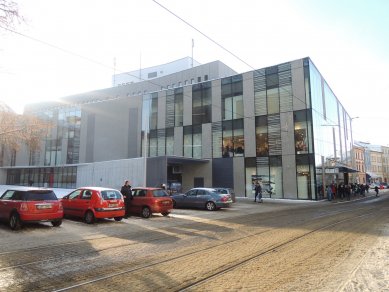
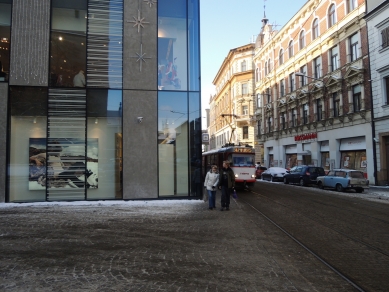
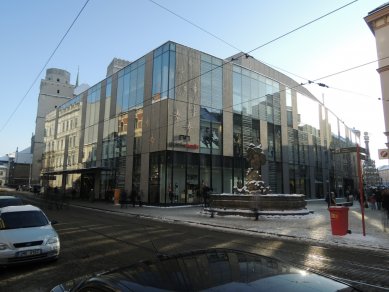
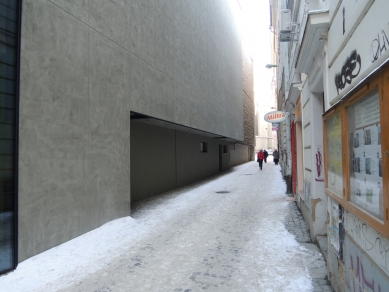
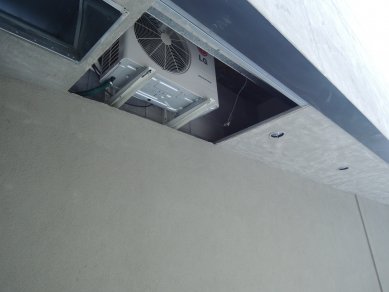
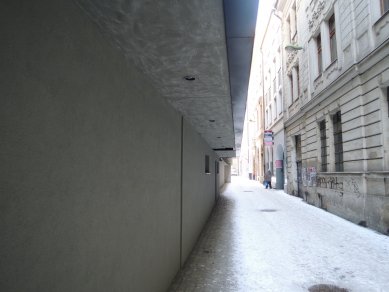
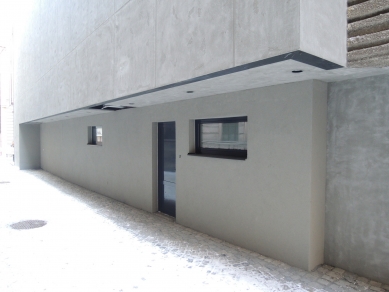
The building of the old Prior by architect Melichar was a demonstration of so-called brutalist architecture and unusually managed the challenging task of contemporary architecture at its time – namely, to deal with the historical context. Years have also lent it a patina that has further enhanced these qualities. It should be emphasized that the external "grubbiness" and "shabbiness" of the Prior in its last period was much more a result of the absence of proper or even any maintenance rather than a property of architecture that is, in essence, interesting, functional, and aesthetically valid. The current polished facade scarcely accounts for aging, as it strives to be perfect for eternity, but already has many shortcomings in detail – compositional, operational, and technological, which somewhat undermines the effect of luxury. The concession to older architecture in the form of a piece of preserved facade – however carefully hidden on the dark side of the Narrow Alley – demonstrates the immaturity and uncertainty of such a gesture.
The first time was in 2009 when the city council, during its session, altered regulatory plan No. VII, which limited the private rights of the owner of the department store in the area of the arcade as a public space, especially in light of the narrow traffic profile on 8 May street and the need to maintain standards for the area occupied by the heavily loaded tram stop. By abolishing this regulation, the public, or rather the authorities representing the public, lost almost any influence over the protection of the arcade and the adjoining public spaces.
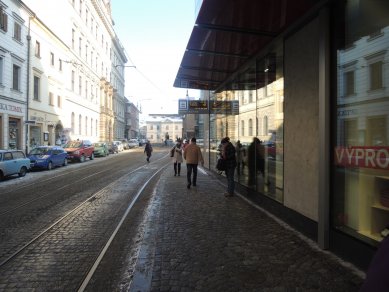
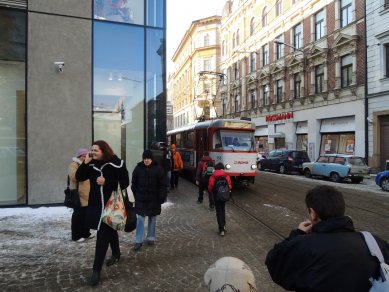
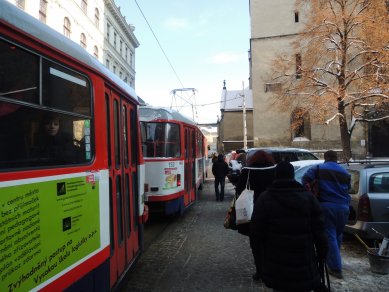
It is astonishing that the building authority or the department of traffic management allowed the occupation of space at the northeast corner right up to the tram tracks. Given the high pedestrian traffic, this has created a very dangerous place. The area of the heavily used tram stop, which also serves as a pedestrian corridor, has dramatically decreased and therefore does not meet the prescribed standards.
The city's proclaimed concern for a quality and wide transportation space in other projects within the city thus loses credibility. The role of the city mayor, Martin Novotný, is difficult to understand, as according to the reasoning of the council meeting and an article in the Olomoucký deník during November 2009, he strongly defended the preservation of the arcade in terms of public interests. During this period, the Council of the City of Olomouc also agreed on the demand to guarantee the preservation of the arcade at the tram stop on 8 May street and recommended that the council approve this modified proposal for a change in the regulatory plan. However, the same reasoning document immediately states that during a private meeting between the mayor and the owner of the department store in December, the mayor changed his mind and recommended to the council to abolish the protection of the arcade.
Only one council member, Prof. František Mezihorák, voted against the abolition, despite the fact that 60% of citizens (1,597) in a survey conducted by the Olomoucký deník requested the preservation of the arcade.
It is surprising that the department of state administration concerning land communications did not respond to the call for a statement regarding the change of the regulatory plan, namely the abolition of the arcade, or even that the transport department, which ensures the operation of public transport, was not invited to respond.
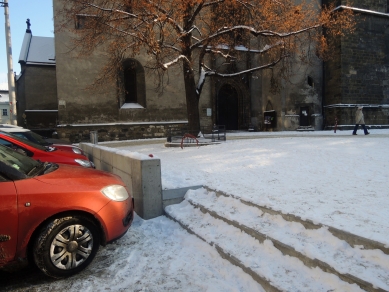
It is equally incomprehensible that the standards for tram stop boarding edge height within barrier-free and comfortable transport have not been adhered to. All the more so as increasing this edge (and thus the whole sidewalk adjacent to the north facade of the building) would also resolve another downside of this location, which is the step at the entrance to the commercial space. If it does not violate the norm, then it certainly contradicts the principles of contemporary urbanism, which is very careful to ensure accessibility at entrances to public spaces. Building steps on a flat surface, where they have never been, and thus creating new barriers, is a mistake that occurs again in the area adjoining the exit of the tram stop, on the new and artificial boundary of Mořické náměstí.
Current urbanistic planning places great importance on the number of entrances at the ground level, which corresponds to medieval parceling, meaning that the widths of facades or entrances are between 6 to 10 meters. The frequency of entrances positively influences the amount of activities in the adjacent streets. During the use of Prior, several independent entrances or open operations spontaneously emerged around the entire perimeter of the department store, even in the Narrow Alley. The reconstruction of Prior violently interrupted this trend and significantly limited the number of entrances. Moreover, the café from Mořické náměstí is accessible with a barrier of several steps, entry from 8 May street requires maneuvering around the merchandise offered by H&M, and the Narrow Alley has been completely degraded from an urbanistic perspective, which has a negative impact on the operations in the neighboring properties. Meanwhile, it concealed an enormous potential of a narrow market street connecting Moř. náměstí and the pedestrian corridor of October 28.
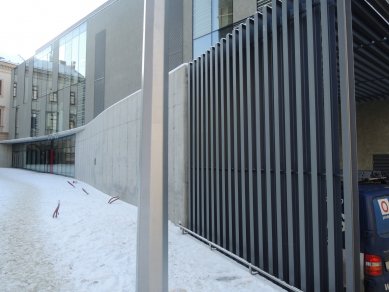
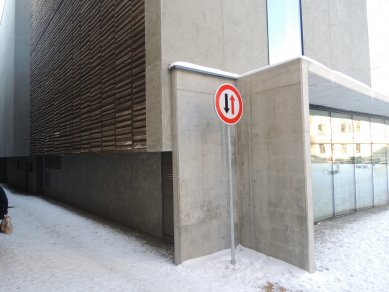
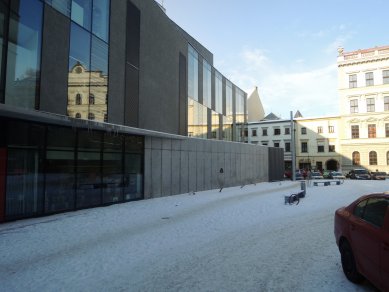
The solution for the supply to Prior also appears problematic. At first glance, it is evident that the supply area has not expanded, and that its extensive concrete boundary has in fact "bitten off" another piece of public space, which is additionally "burdened" by a high historical price. The concrete appendage disrupts the architectural value of Mořické náměstí, reduces its area, and probably complicates the logistics itself, as supply vehicles have to back from 8 May street into the "arm," seriously endangering the already limited pedestrians and tram operations. An alternative to this harsh, historically insensitive, and publicly arrogant solution would have been to preserve the entire original open space without barriers, with the possibility of turning around or one-time passage of supply vehicles on surfaces differentiated only by a different texture of the pavement.
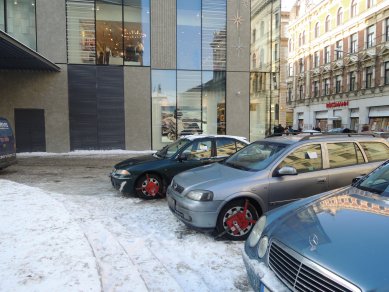
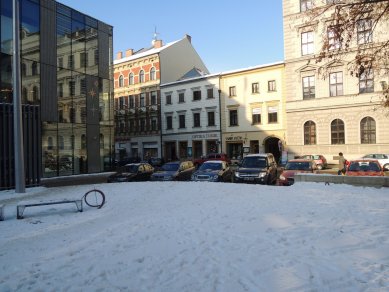
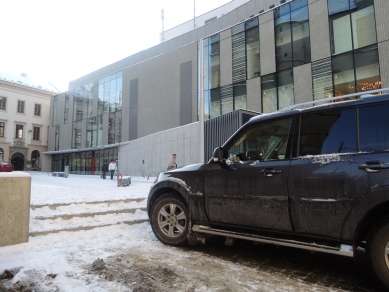
Let us hope that the area from which Mořické náměstí has been deprived by the construction of a concrete wall and steps does not remain forever an unofficial parking lot that drivers have already quickly and happily accepted. For pedestrians, however, there is no space left.
From the perspective of public space, the reconstruction of Prior is yet another example of poorly executed cooperation between the private and public sectors and proof that a quality reconstruction of public space must be preceded not only by thorough discussion about the nature of the space but primarily by a proper architectural competition. The political representation succumbed to the alluring promises of a private investor, promising to include the repair of an important public space in their reconstruction, in exchange for maximizing the sales area of the department store. The result, however, is a dismal, deeply below-average, and degrading appearance of Mořické náměstí, which is unfriendly to any of its potential users. The banal concrete wall of the supply arm will perhaps become some kind of Olomouc "Wailing Wall," on which un-elected citizens can freely lament their laments over the misery of an era that has replaced consumption with greater consumption and mediocrity with banality.
Let us consider the entire story in a neutral manner, if possible, and divide the issue for this purpose into three layers: interior, envelope, and exterior. These layers differ from each other primarily in terms of property relations. The interior as a completely private component, the envelope, or rather, the facade, as a common theme of both the private and public sectors, and finally, the exterior as a sovereign public space.
Interior: Grade 1
Perhaps only in this layer can we speak positively and unequivocally. The outdated interior space (whether in terms of aesthetics, technology, or function) was already inadequate, and its radical reconstruction into a contemporary shopping gallery was the only possible solution. The enormous interest of customers in the first days following the opening of the gallery also clearly refutes the widely spread myth (in this case, more of a virus) that it would be better without Prior, and conversely confirms that this place is ideal for a retail house. It does not disrupt the historic square as in other cities, but is located in its immediate vicinity and connects to the capacity nodes of urban public transport. The apparent conflict, here rather a harmony of spiritual and commercial spaces (the Gothic temple and the temple of consumption), is also desirable from an urban planning perspective. This "cohabitation" has been known since ancient times. The only risk of the general reconstruction of Prior is its economic viability, or the ability of the retailers to "support" the debt amortization from the initiated investment through rental income. However, this risk lies solely on the shoulders of the owner.If similarly commercial spaces of slightly smaller size (in the surrounding streets of October 28, Riegerova, Pavelčákova) were adapted, we would arrive at a pleasant realization that the city center can, in a certain sense, be a "hypermarket" with a clear asset – an authentic public space. The Upper Square and the adjacent shopping streets are, after all, more or less the same size as the hypermarkets Olympia or Globus and their parking lots, and it is mistaken to think that we walk less in them.
Envelope: Grade 3
We hear that the old Prior was concrete and ugly, while the new one is supposed to be glass and beautiful. What lies behind these generalizations? The ratio of concrete to glass surfaces has remained almost the same. Durable, real concrete has been replaced by its imitation – a disposable coating applied to particleboard panels. Just tap them, and everyone will reveal the "laminate" of the current facade element. The plasticity of former facades is similarly cheaply and superficially inscribed into the stripes of sandblasted glass. Can such quotations be considered modern architecture? Do we create it merely by referencing reflective glass surfaces, in which the surrounding historical buildings are supposed to be reflected?The building of the old Prior by architect Melichar was a demonstration of so-called brutalist architecture and unusually managed the challenging task of contemporary architecture at its time – namely, to deal with the historical context. Years have also lent it a patina that has further enhanced these qualities. It should be emphasized that the external "grubbiness" and "shabbiness" of the Prior in its last period was much more a result of the absence of proper or even any maintenance rather than a property of architecture that is, in essence, interesting, functional, and aesthetically valid. The current polished facade scarcely accounts for aging, as it strives to be perfect for eternity, but already has many shortcomings in detail – compositional, operational, and technological, which somewhat undermines the effect of luxury. The concession to older architecture in the form of a piece of preserved facade – however carefully hidden on the dark side of the Narrow Alley – demonstrates the immaturity and uncertainty of such a gesture.
Exterior: Grade 5
Here we are entirely in the realm and law of the public. Several components, or nearly all, have completely failed in protecting the public interest.The first time was in 2009 when the city council, during its session, altered regulatory plan No. VII, which limited the private rights of the owner of the department store in the area of the arcade as a public space, especially in light of the narrow traffic profile on 8 May street and the need to maintain standards for the area occupied by the heavily loaded tram stop. By abolishing this regulation, the public, or rather the authorities representing the public, lost almost any influence over the protection of the arcade and the adjoining public spaces.
It is astonishing that the building authority or the department of traffic management allowed the occupation of space at the northeast corner right up to the tram tracks. Given the high pedestrian traffic, this has created a very dangerous place. The area of the heavily used tram stop, which also serves as a pedestrian corridor, has dramatically decreased and therefore does not meet the prescribed standards.
The city's proclaimed concern for a quality and wide transportation space in other projects within the city thus loses credibility. The role of the city mayor, Martin Novotný, is difficult to understand, as according to the reasoning of the council meeting and an article in the Olomoucký deník during November 2009, he strongly defended the preservation of the arcade in terms of public interests. During this period, the Council of the City of Olomouc also agreed on the demand to guarantee the preservation of the arcade at the tram stop on 8 May street and recommended that the council approve this modified proposal for a change in the regulatory plan. However, the same reasoning document immediately states that during a private meeting between the mayor and the owner of the department store in December, the mayor changed his mind and recommended to the council to abolish the protection of the arcade.
Only one council member, Prof. František Mezihorák, voted against the abolition, despite the fact that 60% of citizens (1,597) in a survey conducted by the Olomoucký deník requested the preservation of the arcade.
It is surprising that the department of state administration concerning land communications did not respond to the call for a statement regarding the change of the regulatory plan, namely the abolition of the arcade, or even that the transport department, which ensures the operation of public transport, was not invited to respond.
It is equally incomprehensible that the standards for tram stop boarding edge height within barrier-free and comfortable transport have not been adhered to. All the more so as increasing this edge (and thus the whole sidewalk adjacent to the north facade of the building) would also resolve another downside of this location, which is the step at the entrance to the commercial space. If it does not violate the norm, then it certainly contradicts the principles of contemporary urbanism, which is very careful to ensure accessibility at entrances to public spaces. Building steps on a flat surface, where they have never been, and thus creating new barriers, is a mistake that occurs again in the area adjoining the exit of the tram stop, on the new and artificial boundary of Mořické náměstí.
Current urbanistic planning places great importance on the number of entrances at the ground level, which corresponds to medieval parceling, meaning that the widths of facades or entrances are between 6 to 10 meters. The frequency of entrances positively influences the amount of activities in the adjacent streets. During the use of Prior, several independent entrances or open operations spontaneously emerged around the entire perimeter of the department store, even in the Narrow Alley. The reconstruction of Prior violently interrupted this trend and significantly limited the number of entrances. Moreover, the café from Mořické náměstí is accessible with a barrier of several steps, entry from 8 May street requires maneuvering around the merchandise offered by H&M, and the Narrow Alley has been completely degraded from an urbanistic perspective, which has a negative impact on the operations in the neighboring properties. Meanwhile, it concealed an enormous potential of a narrow market street connecting Moř. náměstí and the pedestrian corridor of October 28.
The solution for the supply to Prior also appears problematic. At first glance, it is evident that the supply area has not expanded, and that its extensive concrete boundary has in fact "bitten off" another piece of public space, which is additionally "burdened" by a high historical price. The concrete appendage disrupts the architectural value of Mořické náměstí, reduces its area, and probably complicates the logistics itself, as supply vehicles have to back from 8 May street into the "arm," seriously endangering the already limited pedestrians and tram operations. An alternative to this harsh, historically insensitive, and publicly arrogant solution would have been to preserve the entire original open space without barriers, with the possibility of turning around or one-time passage of supply vehicles on surfaces differentiated only by a different texture of the pavement.
Let us hope that the area from which Mořické náměstí has been deprived by the construction of a concrete wall and steps does not remain forever an unofficial parking lot that drivers have already quickly and happily accepted. For pedestrians, however, there is no space left.
From the perspective of public space, the reconstruction of Prior is yet another example of poorly executed cooperation between the private and public sectors and proof that a quality reconstruction of public space must be preceded not only by thorough discussion about the nature of the space but primarily by a proper architectural competition. The political representation succumbed to the alluring promises of a private investor, promising to include the repair of an important public space in their reconstruction, in exchange for maximizing the sales area of the department store. The result, however, is a dismal, deeply below-average, and degrading appearance of Mořické náměstí, which is unfriendly to any of its potential users. The banal concrete wall of the supply arm will perhaps become some kind of Olomouc "Wailing Wall," on which un-elected citizens can freely lament their laments over the misery of an era that has replaced consumption with greater consumption and mediocrity with banality.
The English translation is powered by AI tool. Switch to Czech to view the original text source.

3 comments
add comment
Subject
Author
Date
prior
IvoT
19.12.12 03:05
ne úplný souhlas
lasifa
20.12.12 10:40
souhlas
betonář
20.12.12 10:35
show all comments