
To restore Kantor's villa, Jablonec nad Nisou wants to apply for grants from EU and regional funds
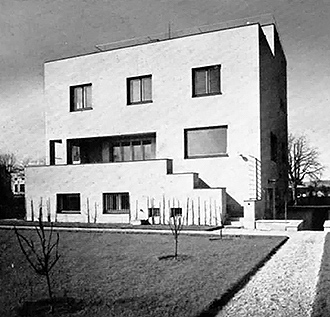 |
The villa near the Jablonec dam was built by physician Alfréd Kantor; it is one of the most valuable objects of this style in the region. The four-story house resembles the famous Müller Villa in Prague. It was constructed in 1934 according to the design of Heinrich Kulka, a student and close collaborator of the modern architecture classic Adolf Loos. The family had to leave the villa after the war and moved to Germany. Although the house underwent an insensitive conversion into apartments in the 1960s, some original elements have been preserved. The municipality purchased the valuable house in 2017 for 8.121 million crowns.
The reconstruction of the villa is estimated to cost over 65 million crowns. From European funds, the city can obtain nearly 21 million crowns through the Integrated Territorial Investments program for the Liberec – Jablonec agglomeration (ITI), and from the regional investment support program, the city has a chance to receive another up to 25 million. The municipality would like to start the reconstruction of the villa this year, aiming for completion in the spring of 2028, when the building should then serve the public from mid-year.
In 2023, the city hall announced an architectural competition for the solution of the villa, which was to address not only the building itself but also the exhibitions and the garden, with 28 studios and ateliers applying. The Prague atelier Objektor architekti won, which then developed the project documentation. "We will try to save everything that has remained here and was designed by architect Kulka. Unfortunately, not much has survived, as the interventions in the 1960s were quite drastic," said architect Jakub Červenka to ČTK earlier.
A visitor center with exhibitions will be created in the villa. The original, partially preserved built-in furniture and other preserved components will be professionally restored. At the same time, an educational center will be established in the newly adapted spaces, focusing on both expert and popular lectures for schools as well as the professional and general public. The municipality plans for year-round operation, for which it will build technical and technological facilities. The monument will thus be protected from the negative influences of inappropriate or nonexistent usage.
The English translation is powered by AI tool. Switch to Czech to view the original text source.
0 comments
add comment
Related articles
0
29.09.2025 | In the restoration of Kantor's villa, Jablonec n. N. is collaborating with the family of the former owner
0
07.09.2025 | Jablonec nad Nisou is preparing the reconstruction of Kantor's villa
0
23.05.2024 | Jablonec exceptionally opened Kantor's villa, architects presented the renovation proposal
0
22.04.2024 | The project for the restoration of the Kantor's villa in Jablonec nad Nisou will be prepared by the studio Objektor
0
24.04.2023 | Jablonec wants EU money for the reconstruction of Kantor's villa
0
23.03.2017 | Jablonec will buy the functionalist Kantor Villa
0
21.04.2016 | Jablonec is negotiating the purchase of the functionalist Kantor's villa