
Variations in White
The former farm buildings have received a new face.

Publisher
Tisková zpráva
03.12.2007 00:05
Tisková zpráva
03.12.2007 00:05
 |
“For a long time, I worked for universities, conservatories, and opera houses – old, 'clumsy' institutions where it is often difficult to change the way things are done and to stimulate new decisions. After all those years, I felt I could become my own boss and go freelance,” says Mogens Dahl as he explains his motivation for creating the institute.
With many ideas about what the new space should look like, he came up with concepts even before the reconstruction and refurbishment began. However, some ideas were born only during discussions with visitors and colleagues during the year and a half of actual construction work.
Copenhagen's Waterfronts
Like many other cities in Europe, Copenhagen is currently rediscovering its waterfronts. Islands Brygge, formerly a neighborhood of sailors and shipbuilders in the eastern part of the city center, has become a showcase for new Danish architecture. Social transformation has also sparked architectural development.
Snorresgade is one of the few places in Islands Brygge that has retained its original, slightly chaotic character. The temporary buildings that have remained to this day give the district a unique atmosphere.
Snorresgade 22
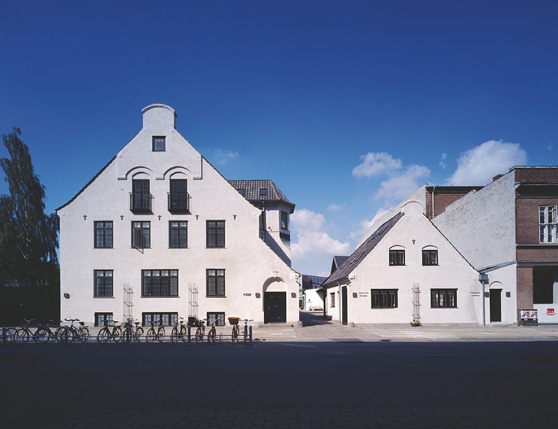
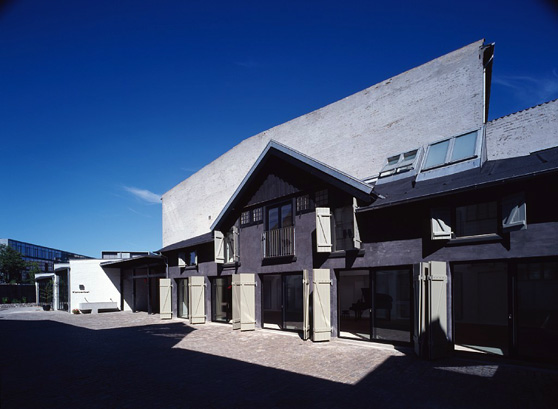
Amidst this colorful jumble stands a building that stands out with its very well-maintained exterior. The main building, erected in the early 20th century, originally belonged to a printing company. On the opposite side of the courtyard, additional extensions were built at the same time – a caretaker's house, a carriage shed, and stables. Later, these spaces were used as an automobile workshop for many decades. Today, the Dahl Institute stands here.
The first floor of the building was originally divided by numerous partition walls into small rooms cluttered with spare parts. Even before the redesign was conceived, the building had to be completely cleared out. Parts designated for preservation were uncovered only very slowly.
 |
 |
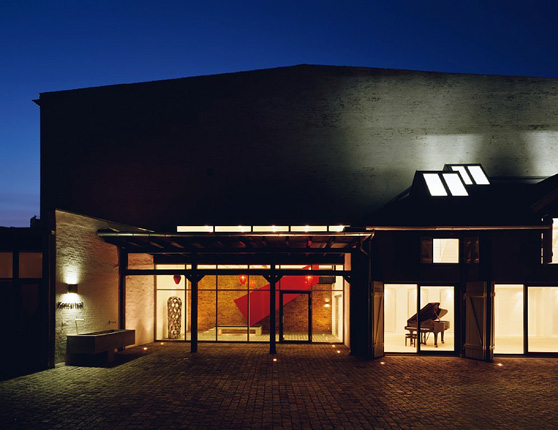 |
In the multifunctional interior, rehearsals and concerts take place
The facades of both institute buildings face the street and are covered with cracked white plaster. Today, they are dominated by two simple bands of black lettering. The neighboring building has become a symbol of the city's reconstruction: two former grain warehouses right on the waterfront were transformed by Dutch architects from the MVRDV studio into very stylish residential spaces.
The former caretaker’s house facing the street now serves a dual purpose. The ground floor houses the administrative office of the institute, and the first floor can be used as a guest apartment, meeting room, or lounge for musicians. At first glance, it might seem that the renovation of the old stables changed the appearance of this place very little. However, the transformation was quite pronounced.
The Copenhagen institute offers classes in choral singing, piano playing, and conducting as well as jazz, choral, and chamber music concerts. The interior is used in many ways, and the large hall is often rearranged. Therefore, it must be variable; there are no fixed seats. Still, the concert hall feels very intimate.
Foyer and concert hall with a gallery
 |
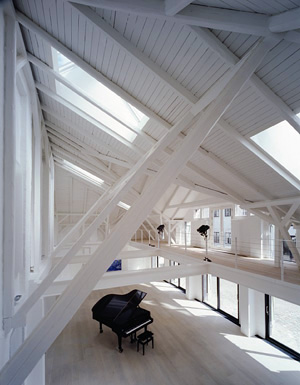
On the right side of the foyer is a 130 m² concert hall with a gallery. The gallery serves as a "second floor" during choir performances and as a balcony for viewers in the case of concerts. “We always wanted to make maximum use of the height of the space. We preserved two very heavy steel beams, which are a reminder of the workshop. Today they serve as supports for this elongated 'bridge',” says Frank Maali, the architect responsible for the conversion.
Everything is white
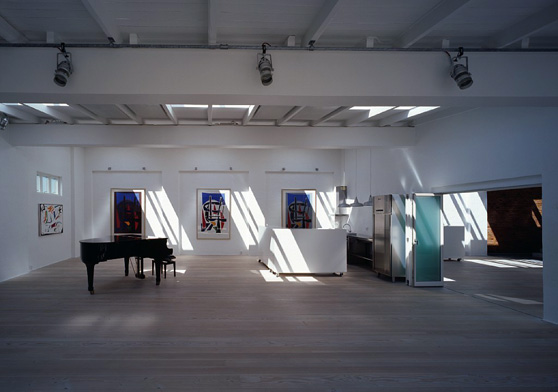
Except for the foyer and its disproportionately large staircase with a large steel railing, the institute's spaces are almost entirely white. The brick walls have been plastered, though the structure of the masonry remains visible. The wooden roof beams and the heavy steel trusses of the gallery have been painted white. Even the new three-centimeter-thick wooden planks of the floor have been given a translucent white finish. Only the subtle steel frames of the windows and glass doors, through which one enters the hall from the courtyard, have been painted black, contrasting with the monochrome interior.
Neither the client nor the architects planned any acoustic measures in advance. Adjustments were proposed only after a series of precise tests by specialist Jane Voetmann. He placed perforated acoustic panels on the rear wall of the large hall. This was necessary because the surfaces of hard materials, steel, wood, and glass resonate, and this adjustment reduces the reverberation time in the room to optimal levels.
 |
Soft daylight creates a pleasant environment
Even before the start of the actual project, architects Frank Maali and Gemma Lalanda knew how to achieve the intended effects with daylight. In the dark areas with few vertical windows, they added light from above, which also does not glare. Four new skylight towers were installed on the roof to illuminate the interior from both sides. Direct rays from the southern sun are diffused by a large window with alabaster (milk) glass. Indirect light coming from the north reflects off the surrounding fire walls and enters the building through smaller clear glass windows. Especially at noon, when the sun is highest, the large hall is flooded with soft yet strong light. The sharp rhythm of the pilasters, wooden beams, and acoustic panels on the back wall of the room is accentuated, highlighted, or conversely dampened by the incoming light and partial shadows following the position of the windows.
Originally, very muted light entered the room through several windows from the street. Now, almost a dozen new roof windows have been installed. On the northern side, large pivoting windows were used, and on the southern side, smaller windows with dark semicircular frames that were specially developed for historic building preservation. Except for the construction pegs in the open position, they fully match the historical pattern.
Specifications
Architect: Maali & Lalanda A/S, Copenhagen
Location: Snorresgade 22, Copenhagen (Denmark)
Client: Mogens Dahl, Copenhagen
Year of completion: 2005
> www.velux.cz
> Page of VELUX company in the catalog
Year of completion: 2005
> www.velux.cz
> Page of VELUX company in the catalog
The English translation is powered by AI tool. Switch to Czech to view the original text source.