
Low-energy houses: an investment in comfort

Publisher
Tisková zpráva
07.05.2008 23:55
Tisková zpráva
07.05.2008 23:55
In the last 15 years, the price of gas and electricity for households has increased by an average of almost 10% per year. The costs of heating apartments and family homes have more than doubled compared to the end of the last century, and will certainly continue to rise. Owners of a typical family house will spend the same amount on heating over the next 40 years as they would pay to purchase their house today.
If the year-on-year price increase stabilizes at a very optimistic three percent (which is less than half of the current trend), the costs of heating houses will increase very dramatically over the coming years. For example, if a typical family house currently costs 30 thousand crowns to heat annually, with a 3% price increase over 20 years it will be more than 50 thousand, and after 40 years it could reach almost 100 thousand crowns a year. Costs that seem acceptable from today’s perspective will soon escalate to unsustainable amounts. This will be especially true for seniors and older generations, whose incomes typically do not match such price increases. Heating the described house over 40 years will amount to a total of 2.25 million crowns. However, very few investors consider the construction of their house over such a long horizon. Therefore, most of the current new builds are likely to face costly renovations and further improvements to insulating capabilities over the next 20 years.
A major problem with current insulation efforts is the deterioration of the indoor environmental quality of homes. This is a serious issue with insulated renovated houses, as well as with insulated and sealed new builds. The desire to save energy often leads to poor ventilation of houses and a deterioration in humidity and other hygiene parameters of the interior. The use of YTONG blocks reduces the thermal losses of the house while also significantly improving the quality of the indoor environment and living comfort. Ytong enhances indoor air quality because it naturally regulates humidity and thus prevents the formation and growth of mold and other microorganisms. The thermal comfort of the house is not only increased by aerated concrete in winter but also during hot summer days, when its thermal accumulation prevents undesirable overheating of the interior. Thus, a similar low-energy house also benefits the health of its residents, which may even be a greater advantage than low heating costs.
> Xella company's page in the catalog
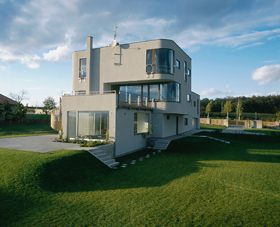 |
| Architecture and quality of execution must be balanced. A modern villa made of Ytong aerated concrete offers its users true luxury. Not only in its form, but also in thermal comfort and the quality of the indoor climate. |
Available low-energy houses
Modern building materials and technologies allow for a reduction of heat losses by half or even to just one-seventh compared to a conventional house. While a typical house built today has a consumption of around 110 kWh per square meter of usable area per year, energy-efficient houses consume only 50 – 70 kWh/m² and low-energy houses only 15 – 50 kWh/m² (if you divide the total annual energy consumption for heating by the usable area of your house, you can easily categorize your house or perhaps the project of your future house). The so-called low-energy and energy-efficient houses have thus become a hit in contemporary construction. Thanks to many years of experience from Western and Northern Europe and the rapid development of building materials, the prices of such houses do not necessarily differ dramatically from conventional constructions. However, it is essential to thoroughly consider the entire house concept and thoughtfully choose the building materials. Otherwise, energy savings can be offset by increasing the construction budget by several dozen percent. In terms of thermal protection, Ytong aerated concrete blocks are among the most suitable building materials for low-energy houses. When they are used in the conceptual design of a family house, significant energy savings can be achieved (see table below). Moreover, with lower acquisition costs than other often very complicated thermal insulation systems. Other building materials require expensive and complicated facade insulation. Ytong, however, achieves above-standard parameters even without additional insulation and with low wall thicknesses. Aerated concrete houses have the same heat consumption as other contemporary masonry with an expensive insulation system.Higher comfort at lower costs
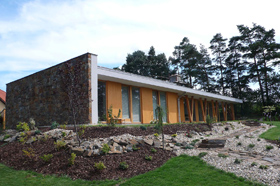 |
| Modern family house in the countryside made of Ytong aerated concrete. Above-standard comfort at reasonable costs. |
Energy Consumption of Family Houses for Heating
 |
| * projected annual heating costs assuming a year-on-year energy price increase of 5% ** total heating costs for a family house over the specified period |
> Xella company's page in the catalog
The English translation is powered by AI tool. Switch to Czech to view the original text source.