
BIMTech EAR: When designers don't have to deal with stamps, but can focus on design

Publisher
Tisková zpráva
08.09.2026 20:00
Tisková zpráva
08.09.2026 20:00
At the beginning of the story of the company BIM Technology s.r.o., bimtech.cz, stood a simple question: How to save time for designers that they spend on bureaucracy instead of designing buildings? The answer was found in 2015 by three university friends – an architect, a civil engineer, and a software developer. Today, their tools are used by tens of thousands of professionals in the Czech Republic and abroad. The new BIMTech electronic stamp (BIMTech EAR) also enables designers to manage the electronic authorization of project documentation faster and with minimal risk of errors.
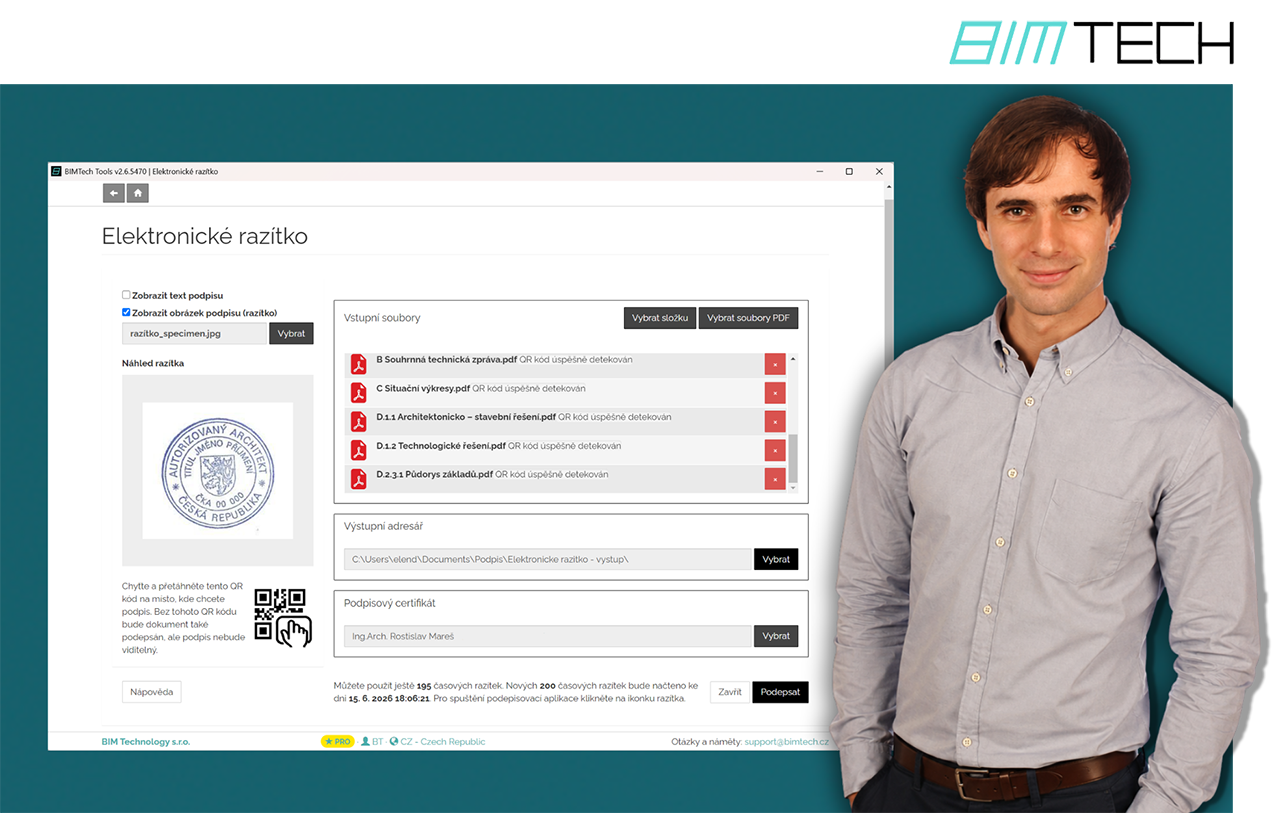 |
We talked to architect Rostislav Mareš about the new BIMTech EAR, which bids farewell to all the confusion surrounding digital signatures.
The new building law brought several changes for designers and architects. One of the most notable is the obligation of electronic authorization of project documentation. This was precisely the reason for the creation of BIMTech EAR - a tool designed to simplify the entire process as much as possible and save designers time and bureaucracy headaches. We talked with architect Rostislav Mareš, a member of the Czech Standards Agency and co-creator of the data standard for buildings (DSS) for the BIM law, about how the idea was born, the obstacles designers frequently encounter today, and why quality support is crucial when implementing new technologies.
Since July 2024, the new building law will be in effect. What has changed for designers and architects?
What has changed is that people who have spent their whole lives doing what they do best – imagining homes, fine-tuning construction details, and shaping human dreams – suddenly had to become a bit of IT specialists overnight. Suddenly, it is no longer enough to "just" design a great building. The Builder's Portal entered the game, bringing with it a new reality: a heap of technical abbreviations, correct formats, electronic signatures, authorization certificates, and monitoring the validity of time stamps. For a person who spends days in CAD or BIM software thinking about statics and architecture, this is simply a completely foreign world. The biggest complications arise when you spend months working on a project, perfecting it down to the last detail, only to have the office send it back to you. Not because the building had poor statics or layout, but simply because you made a small mistake when signing a PDF document or forgot to attach a time stamp, or many things could go wrong. The result is lost time and unnecessary extra paperwork due to formalities that have nothing to do with construction itself.
In what areas do designers most frequently make mistakes with the new digital bureaucracy?
At first, it was practically in everything. Someone used the wrong certificate, another did not have the correct PDF format, or the time stamp was missing. I remember a case of a designer who signed documentation for three quarters of a year using a personal certificate instead of an authorization one. Several construction proceedings passed normally without anyone noticing. Only when the system began to check the documentation rigorously did the problem surface. This shows how complex the beginning of digitization in construction was.
Was the new legislation more of an opportunity for a new product or an effort to help designers cope with the changes?
Rather based on what we saw around us. We monitor legislative changes, and several months before the launch of the new system, we began to realize how much work and complications this would bring to designers. We imagined our colleagues standing in lines for identity verification, buying time stamps, setting up software, and studying manuals. And we thought this should be done more simply.
When did you realize that the electronic authorization stamp would be a problem?
At the moment we discovered how many steps a person must take to sign documentation correctly. Designers are great at designing buildings. Forcing them to study the technical details of electronic signatures is not the ideal way. So we decided to hide most of these steps in the background and automate as much as possible.
How would you describe BIMTech EAR to someone hearing about electronic authorization stamps for the first time?


What do you see as the biggest benefit?
In that the designer can fully focus on their work without having to deal with administrative matters. For larger projects that contain thirty to fifty drawings, manual authorization can take an hour or more. Our tool can handle it in just one minute while significantly reducing the risk of errors. Moreover, on our website, you will find a simple calculator, allowing anyone to easily calculate how much time and money using BIMTech EAR will actually save them.
Who is the typical user?
Today, BIMTech EAR is used by independent designers, smaller studios, and large design offices. Even some manufacturing companies use us. Electronic authorization is relevant for practically anyone preparing documentation for construction proceedings.
You often mention user support. Is it as important to you as the software itself?
Absolutely. It has been shown that providing a high-quality tool is not enough. Designers need to be sure that when they encounter an issue, there is someone to turn to. We often deal with situations where a notice comes from the building office that the documentation is not correct. The user sends us the materials, we check them, verify them, and look for where the issue truly lies. In several cases, it turned out that the documentation was processed correctly and the error was elsewhere – perhaps in the assessment or in document handling on the office's side. We also helped resolve a situation where the building office declared the documentation invalid. After a thorough review, we discovered that the problem was not with the documentation created by our tool but with an older version of the files uploaded to the system that had been signed with different software. It took several hours to find out where the mix-up occurred.
It is precisely in such situations that the advantage of a Czech solution becomes evident. We are not an anonymous foreign service. Behind BIMTECH are people who know the Czech construction environment, understand legislation, and are able to assist users even when the problem does not lie directly in the software itself.
How large is the team behind BIMTECH today?
Our shared journey began in 2015 when we – three colleagues from university: an architect, a civil engineer, and a software developer – decided to establish BIMTECH. Today we are eight. From the very beginning, we wanted to build a company and our tools to be efficient and sustainably long-term, so we never wanted to grow at all costs.
In this sustainable building process, it greatly helps that we return a large part of what we earn back into our own research and development of new technologies. Our tools have long been helping not only in the domestic market. We regularly supply them to designers in the Netherlands, Germany, Austria, Italy, Spain, Slovenia, and Romania.
BIMTech EAR is part of a broader platform, BIMTech Tools. What do you offer today?
When we founded the company, we wanted to make designers' daily work easier. Gradually, we developed tools for working with cadastral maps and other GEO services, building materials, BIM objects, construction details, and functionality for calculating construction physics. The basic tools are available to users for free; more complex tools are part of BIMTech PRO, which also includes BIMTech EAR for electronic document authorization. Users thus gain not only a tool for the electronic stamp but access to additional tools that assist them in various phases of design.
How many users does BIMTECH have today?
Today, more than 44,000 users from among designers, architects, civil engineers, and students, primarily from the Czech Republic and Slovakia, utilize our tools.
Of course, we are pleased with the number itself, but the greatest value for us comes from the people behind it. Thanks to their feedback and experiences, we know what works, how to help them save time, and how to adapt to legislative changes while moving BIMTECH forward.
With what vision do you move BIMTECH forward, and how do you intend to make designers' lives easier in the future?
We are still encountering things that unnecessarily take time from designers. Be it bureaucracy, working with documentation, or new obligations brought by legislation. Therefore, we continuously strive to enhance our tools and respond to what people truly need in practice.
Equally important to us are students. They will be the ones designing buildings and advancing the entire field in a few years. Therefore, if a domestic or foreign school contacts us with an interest in collaboration, we will gladly offer them access to the PRO version under favorable conditions. They can thus try working with modern BIM technologies even while studying.
And if someone is unsure whether BIMTech EAR will suit them, they can try it out without fear. We offer the first month for 1 CZK, and if they find that they will not utilize it, they can terminate the service at any time. We believe that software should win over users by helping them, not by binding them to a contract.
What gives you the greatest motivation to continue?
Probably the fact that most of the people for whom we create our tools are designers and architects just like us. They are former classmates, colleagues, or people we regularly meet at conferences and professional events. When a tool saves them an hour of work or helps solve a problem that has troubled them for several days, we immediately see that our work has meaning. Feedback is equally important. When something does not work, our users tell us bluntly. Thanks to that, we can continue moving forward and developing tools that truly help designers.
We thank architect Rostislav Mareš for his open answers and the time he dedicated to us.
Author: Mgr. Kateřina Saidl
Photography: BIM Technology, bimtech.cz
The English translation is powered by AI tool. Switch to Czech to view the original text source.
0 comments
add comment