Defense and Search for Contemporary Architecture Theory
Publisher
Jakub Filip Novák
25.04.2007 00:50


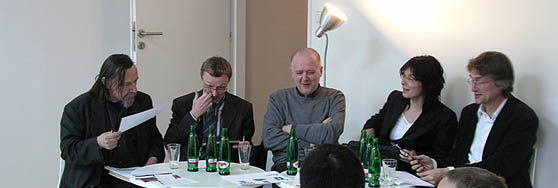
On April 5th, the Czech Center hosted another thematic evening of Versus Architect. The cycle dramaturgically prepared by the studio A1Architects continued with the theme Theory versus Architect.

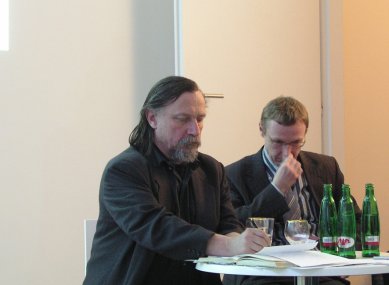
Jindřich Vybíral
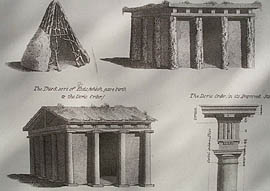
opened with a series of contributions explaining that he is not the one who produces theory, but rather belongs to the "most disgusting category," which only teaches theory. Through a series of brief comments, he modeled the essence of architectural theory from many perspectives and did not hide his nature as a historian, making a basically chronological walkthrough of examples of architectural theory from the last two centuries. He generally defined theory as entertainment for everyone, as an art that can truly be done by all. Each theory, according to him, finds its supporters, some more, some less, and the theory of architecture itself has strong competitors in many other fields. He claimed that it still holds true that theory is gray, but the tree of life is green, which Jindřich Vybíral corroborated with countless erroneous architectural theories. In constructing the origin of architecture from dust, he reminded a significant part of architectural theories that thrived regardless of the empirical facts of archaeological research. Using the example of Gottfried Semper and his universal cultural theory, in which he dealt with the development of artistic forms from their inception and sought simple and economical shapes tied to the most basic human needs, he showed that although modern archaeology has refuted nearly all his arguments, the abstract system of his theory nevertheless remained unscathed. Generations of interpreters still find new meanings in his work. Semper would be astonished.
According to J.V., the task of theory was mainly to legitimize practice. From the study perspective of a sunny functionalist city and photographs of anonymous housing estates, he documented the commonly held notion of the relationship between theory and practice—mistrust and skepticism. Nevertheless, he reminded that the projected confrontation does not illustrate the failure of theory, but rather its replacement by ideology. The real designation of the projected situation is, therefore, the state to which architecture has come without theory.
Jindřich Vybíral also expressed opposition to overestimating theory in architectural practice. He reminded that it is known that in the history of architecture, the most insightful and thoughtful theories did not have the greatest resonance, but simply those that had the most pictures. And in the history of the field, the strongest impulses for architecture were provided by universally educated experimenters, often entirely without architectural education.
And why then did the theory of architecture even arise? According to Jindřich Vybíral, it was about the valorization of the field, the appreciation of architecture. A discipline that historically did not belong among the fine arts needed to establish itself as a mental, not manual, or mere commercial activity. This historical reference is important even in today’s situation. In conclusion, Jindřich Vybíral referred to Jean-François Lyotard’s analysis of the postmodern situation. According to it, the leading intellectual tendency of the postmodern world is no longer critical of the current state, but rather adaptation. Contemporary science no longer serves to discover truth but to seek practical results. Accordingly, education also looks like this. The concept of teaching as the transfer of knowledge has been reduced to mere competency training. Therefore, today there is a need to strengthen the role of useless disciplines, such as the theory of architecture. Theory should educate architects capable of dialogue, because without dialogue, it has no meaning.

The joint contribution from Marian Zervan and Monika Mitášová was about a peculiar phenomenon noticed by historians, namely that in the twentieth century (not just in architecture), there are no complex theories of architecture. There are few books bearing the title theory of architecture, but there are many anthologies of architecture. They asked themselves how it is that we cannot say what theory of architecture or theory of art is. On one hand, it dissolves into philosophy, on the other into typology; it has no boundaries. There is a great imbalance—despite the lack of theory, thousands of theorists publish books with selections of texts on architecture. In Vitruvius, we still find a text of very heterogeneous nature encompassing all genres—history, materials science, work processes, etc. As a model of treatises on architecture, this remained the case until the 18th century. In the 19th century, it began to break down into separate genres. The great theory of architecture ceased to have significance in the 20th century, even though two or three theories (books) are recalled as having played a significant role (such as For a New Architecture, etc.). However, Marian Zervan asked what significant role they actually had? He discovered that partly they were sort of explanations and partly manifestos, but their influence is generally disputed. It seems that no one simply believes in or needs the type of general theories anymore. For one problem, there are always many positions. In today’s anthologies, we find answers to questions that are no longer presented as revealed truths as in medieval treatises, but as dialogical and polemical questions reflecting a multitude of perspectives. One of the roles of anthologies is, therefore, to bring the discussion itself into the center of architects' attention and to name the topics.
Based on this introduction, Monika Mitášová and Marian Zervan performed analyses of the most significant anthologies of texts on architecture, whose depth and informativeness far exceeded the limits of the evening, thus it was more of a very quick overview as a prelude to publishing this extensive work. According to information provided to the organizers of the cycle, the text will likely be published in one of the issues of the journal Stavba.
Marian Zervan finally noted that from anthologies, we learn that theories are some written texts, but what those texts deal with and what their general nature is, is basically difficult to ascertain. Anthologies introduce us to a world of diverse genres and natures in a world of many kinds and procedures that is difficult to summarize into something like the theory of architecture.
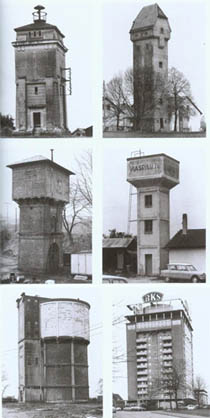
Another guest, Marek Pokorný, primarily posed a series of questions to the present theorists. He recalled the area of interpreting contemporary architecture, as a reference framework for interpreting art in general. According to him, theory is a system of concepts that do not contradict each other and serves either to illuminate an area for someone who is lost in it or to convince someone who is familiar with it that everything is different. Alternatively, theory is an attempt to find the clearest language that can be embodied in practice. Theory and history are so mutually intertwined that they cannot be separated, which he stated had been demonstrated by previous contributions. He summed up the previous comments with the feeling that theory essentially does not exist and rhetorically questioned the need for any theory, however partial, at all. He suggested that with certain perspectives, even the performances of architecture (buildings) can be a theory that is then verified by the practice of their use. He asked about the impacts of theory on interpretation and the actual strength of theories in relation to the conditions under which architecture emerges. If “development theory” and “investor philosophy” dictate mass production, what is their relationship to the theory of architecture popular in academic circles? Nevertheless, according to him, theory is not merely a written affair but also has a material form, which Marek Pokorný projected in several brief examples.


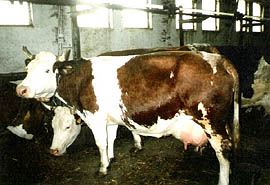
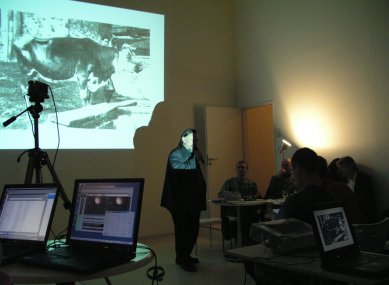
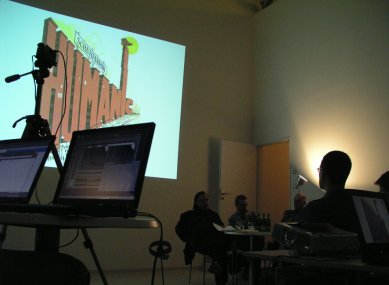
An impatiently waiting Petr Rezek began by projecting a black-and-white photograph of grazing cows, introducing himself by saying that he would not talk long. He pointed to one aspect that, as he believes, has not yet been mentioned during the evening. He reportedly learned from his colleague Rostislav Švácha that all Renaissance and Baroque treatises on architecture were written so that architects could communicate with their clients. To master the terminology and be able to negotiate. Petr Rezek represented the opinion that the positions and texts formulated by architects are essentially requested by their clients and the audience. According to him, the art scene has long since advanced to such a degree that consumers are no longer able to comprehend what it’s about. He argued that this situation is analogous to the necessity of Renaissance treatises. The focus of his contribution became a notice on a "theory" that stays grounded, which can be mapped as the groundwork for understanding clients and builders.
He also lamented the fruitlessness of theory in education. If in response to the question "why is this line straight?" one receives the answer, "there are garages there," he then rhetorically asks what treatises on architecture, what anthologies, the given listener has read? On what theory will the given architect base his future activities? According to Petr Rezek, it is not about theory; it is about much more elementary things, which he illustrated by projecting a gradually abstracting cow into an avant-garde image, arguing solely that "there is still a udder," as an example of how to treat one’s client in the theoretical area.

In the end, the audience seemed quite taken aback by the highly abstract presentations, and there was not a single question, so the shortest evening in the history of the Versus Architect meetings concluded early enough that after a classic toast, a significant portion of those present moved on to a nearby café to address issues of which the author of this text has no information.

The next evening will take place on Thursday, May 3, 2007, and will be on the topic Textbook House versus Architect, with guests Alena Šrámková and Ivan Ruller. The essence of the meeting should be whether and how it is possible to reflect on one's own creation and learn from it.
The English translation is powered by AI tool. Switch to Czech to view the original text source.
2 comments
add comment
Subject
Author
Date
příspěvek do diskuse
tomáš butta
25.04.07 02:08
hola cenzuro
KirovReporting
25.04.07 07:10
show all comments