<Vysoká škola báňská> built an experimental passive house
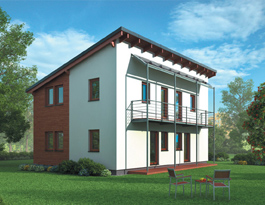 |
"The research and investment center was built as an experimental house so that we could assess and examine how such a passive wooden structure behaves under real conditions," said the head of the Department of Building Environment and Technical Equipment at the Faculty of Civil Engineering VŠB-TUO, Iveta Skotnicová.
For example, there are temperature sensors in the ground, and thermal-humidity sensors are embedded in the individual structures, with sensors also in the roof, oriented to all cardinal directions. "We also have sensors in the bathroom to simulate a state of increased humidity and monitor how the structure behaves," Skotnicová said.
The president of the Moravian-Silesian Woodworking Cluster, Jiří Pohloudek, said that the new training center has no equivalent in the Czech Republic. Its uniqueness lies, for example, in the fact that it can practically simulate various outdoor conditions, summer in winter or winter in summer, so that students can choose optimal heating systems. "There are five independent heating systems that will be tested under various conditions depending on the building structures, the internal environment, and so on. There is a unique control system from Siemens that monitors the internal environment in terms of CO2, humidity, and other parameters, and these matters can be optimally adjusted," Pohloudek said.
According to the director of the Building Automation Division of Siemens, Milan Kopřiva, the object is exceptional in that everything in it is real and tangible. "This is something that will greatly help students in their studies, because what they learn, they will also see simultaneously," said Kopřiva, adding that the project is an example of how cooperation between schools and companies should look in supporting technical education.
The house has several types of heating systems. "They should be the most modern ones available on our market, whether it's a gas boiler, an electric boiler, or a pellet boiler. We can monitor the efficiencies of those devices, and most importantly, our students will see what those boilers look like and what they do to the environment of the house," Skotnicová said.
Pohloudek stated that the distribution systems are connected in a way that makes them clear and easy to control. Everything can also be monitored on a computer. Wall-mounted radiators, underfloor heating, and distribution systems are being tested.
The establishment of the center cost around ten million crowns. It was funded by European money and resources from private companies.
The English translation is powered by AI tool. Switch to Czech to view the original text source.
0 comments
add comment