
Vincenc Kramář, a lover of cubism, died 50 years ago
 |
His interest in art was evident from childhood. He intended to pursue painting, so in 1896 he enrolled at the Academy of Fine Arts in Prague. However, after a few months, Kramář left the school, likely because he realized certain limitations in his talent despite his relatively successful drawings. This prompted him to immerse himself in the study of art history - in Prague, Munich, and primarily in Vienna. His inheritance from his father allowed him to dedicate some time solely to research and traveling for art.
Paris, in particular, became a place of discovery for Kramář - he frequented local galleries and artists' studios. He quickly got oriented in the current trends of French modernity and was in the right place at the right time. He began purchasing Cubist works by Pablo Picasso, Georges Braque, and André Derain from gallery owners like Daniel-Henry Kahnweiler, who became his friend. This was during a time when these artists faced misunderstanding, and their works were financially accessible.
Kahnweiler wrote of Kramář: "He was the only art historian among the first devotees of Cubism; the others were merchants." Picasso reportedly often asked his gallery owner when "Monsieur Kramar" would visit again and if he would come to see his paintings. The collection, although relatively smaller in scope, attracted attention with its compactness and quality. In addition to Cubists, Kramář focused on drawings and graphics by Paul Cézanne, Paul Gauguin, Auguste Renoir, Henri Matisse, and Juan Gris.
 |
| Pablo Picasso: Self-Portrait (1907) |
Kramář also became known as an enlightened director of the Picture Gallery of the Society of Patriotic Friends of Art, the predecessor of today's National Gallery. During his 20 years at the helm (1919 to 1939), he contributed significantly to a major state purchase of French modern art. His legendary trip to Paris in 1923 is notable, where he invested five million crowns into fresh "finds." He also acquired a collection of Czech Gothic and Baroque art for the gallery.
Not long before his death in 1960, Kramář donated about a third of his - globally unique - collection (which totaled 89 paintings) to the National Gallery, with the remainder going to his heirs. The donation, which included the famous self-portrait by Picasso, became the subject of a restitution dispute after 1989. Kramář's descendants claimed the donation was coerced and tried to retrieve the paintings. However, in the mid-1990s, courts repeatedly ruled that the works would remain in the National Gallery.
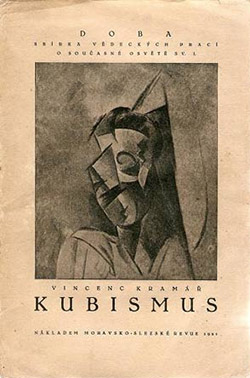
Kramář, born May 8, 1877, in Vysoké nad Jizerou as the youngest of three children of a merchant, was a member of the Communist Party of Czechoslovakia from 1945 until his death. In addition to all his activities, he engaged in publishing. He was the author of the first scientific manual on Cubism, which was published in Brno in 1921. His other treatises were also well-informed - on Rembrandt's Annunciation, on the conservation and restoration of monuments, on the statue of the Suffering Christ, and on the Gothic Madonna of Strakonice.
At the turn of 2000 and 2001, an exhibition titled Vincenc Kramář - from Old Masters to Picasso was held at the Veletržní Palace in Prague. It featured 95 paintings, 150 drawings and graphic sheets, ten sculptures, and a range of accompanying materials - correspondence and photographs.
The English translation is powered by AI tool. Switch to Czech to view the original text source.
0 comments
add comment