
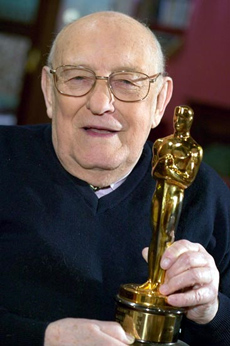
In his 92 years, the film architect Černý, an Oscar winner, has passed away
 |
| image: ceskatelevize.cz |
In addition to Amadeus, this highly sought-after architect shaped many other films; in the 1970s, he worked on more than ten films or television series each year. Černý's name can be found in the credits of The King of Šumava (1959) or Forman's Loves of a Blonde (1965). He also contributed to the sets of the series about the Homolkov family, the successful detective series Sinful People of Prague (including subsequent feature films), or Heavenly Riders about Czechoslovak RAF pilots.
Karel Černý was busiest in the 1970s when, alongside regime and tendentious films such as Red Glow Over Kladno (1974) or When Prague Rose (1975), he also worked on comedies that are still popular today by Marie Poledňáková, How to Pull a Whale’s Tooth (1977) and How to Get Daddy into Reform School (1978). As an artist, he also participated in television series such as 30 Cases of Major Zeman (1974), We All Have to Go to School (1984), or the Czech-German co-production series about Lucia, the street terror (1984).
In the late 1980s, Černý slowly began to leave the demanding work in film; nevertheless, he still designed the sets and decorations for the series The Territory of White Kings (1989) or the comedy The Violet Thief (1992). Later, he worked on several television projects, and his filmography lists the Czech-Greek film Autumn Return (2001) as his last work. In the early 1990s, he was supposed to use his experiences to contribute to the production design of the musical Rebels, set in 1968, but he declined.
"Although I didn't want to, I had to refuse... Director Filip Renč wanted decorations like we made in the sixties, but we had three weeks for the clip of the song We’ll Get a Vase for Our Apartment, whereas today the pace is much faster...," he said twelve years ago when receiving a medal from the Minister of Culture for his 80th birthday. Instead, Černý, who received a Czech Lion award in 2013 for his extraordinary contribution to Czech cinematography, occasionally advised younger colleagues and also taught at the film school in Písek.
He did, however, lament that film architects today have much less work than he did in his time, making it difficult for them to gain experience. Černý, who was born on April 7, 1922, in Plzeň, started from the ground up in the film industry. He began as an extra during summer vacations in Bechyně, where the film Fiery Summer with Lída Baarová was being shot in 1939. He earned extra money as a statistician during his architecture studies and began doing other auxiliary jobs in film during the war.
In the late 1940s and early 1950s, Černý, about whom one episode of the GEN series was made, started his career as a film architect. The first film he worked on was called One from the Relay (1949), which told the story of Emil Zátopek. From Černý's Peter (1963) onwards, he was involved in all of Miloš Forman's Czech films, and their collaboration ultimately earned him an Oscar. He received numerous awards for his work but valued only a fraction of them. "There are about fifteen or twenty films for which I am not the slightest bit ashamed," Černý said in an interview.
The English translation is powered by AI tool. Switch to Czech to view the original text source.
0 comments
add comment