
Ústí architects criticize the study of the rehabilitation of the mine in Chabařovice
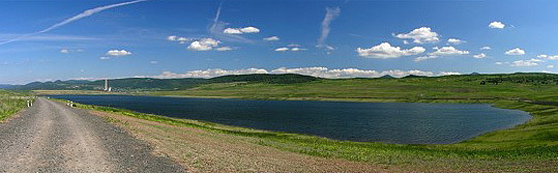 |
The study from 45 years ago anticipated that a cultural landscape, including the municipalities that had disappeared due to mining, would arise in the area of the mine. This is also what architects Jaromír Veselý and Michal Gabriel desire. However, the current regulations of the Mining Office do not allow construction in the reclaimed area. According to the author of the spatial study, Vladimír Charvát, this is a nearly schizophrenic situation. "The area is undergoing remediation, which means that one could actually build there. However, the area is still an extraction site," he explained.
Veselý and Gabriel admit that the current reclamation is better than nothing, but they criticize many of the measures taken. According to Veselý, using large stones as protection for the banks against erosion and waves is inappropriate. Small pebbles can also be found on the future beaches. "This is the worst possible selected method," he said at a public meeting in Ústí nad Labem dedicated to Lake Milada. "Our ancestors planted oaks on the banks when constructing large ponds, which lasted there for several hundred years," added Veselý.
According to the director of the Fuel Combine, Petr Lence, the reinforcement of the banks needed to be reconsidered after heavy rains in 2010. At that time, part of the bank collapsed, interrupting the cycling path as well.
Veselý finds it unsuitable that the access road runs right by the water. "Even in the campsite planned near Roudníky, everyone will have to cross the road from their towels to the water," he stated. He is also dissatisfied with the way the project designers solved the drainage of the reclaimed area and the channeling of water into the lake. According to him, the drainage looks like sewers. "This method was taught 60 years ago, applied 30 years ago, but today the Ministry of the Environment has grant programs to improve things so that they work and are visually pleasing," Veselý said. Funding is being used to convert the originally flat concreted channels into channels resembling the original streams.
However, Lence stated that the chosen solution is temporary. "In the area, the water system has been systematically altered for over 100 years, and groundwater has been pumped out for a long time," he said. Coal was discovered in the area in the 18th century, and since 1977, 61 million tons of coal have been extracted from the Chabařovice brown coal opencast mine.
Both architects criticized mainly that a permanent settlement, which existed there before mining began, will not return to the reclaimed countryside. Four municipalities disappeared there in the 1970s. "In 1967, the authors of the study wrote that the extracted space would return to cultural landscape after mining ceased. You haven't done a fundamental thing - you didn't restore it to the cultural landscape, and you didn't even have that assignment. We have a unique opportunity to create the landscape in our image, but instead, we've built a waterworks, and we don't know what to do with it," said Gabriel, who learned about the plans to build the lake only as chairman of the commission for the development of the city of Ústí nad Labem in 2001.
From 2015, the lake and its surroundings should belong to the towns of Ústí nad Labem, Chabařovice, Trmice, and the municipality of Řehlovice, in whose cadastral area they lie. Their representatives, united in the Association of Municipalities of Lake Milada, are considering how to utilize the potential of the lake. The study also offers a variant for a hotel with a conference center or the use of a nearby steelworks after its operation ends as a center for modern art. City representatives agree that further plans need to be discussed at the political level.
The English translation is powered by AI tool. Switch to Czech to view the original text source.

0 comments
add comment