
The state issued the Roman Catholic parish of the Prague rotunda of St. Longinus
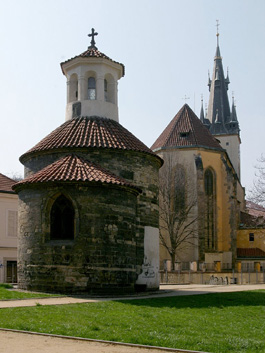 |
The agreement concerns the land with the rotunda building on Na Rybníčku Street near St. Stephen's Church. The building is one of three surviving rotundas in Prague, along with the rotunda of the Holy Cross on Karolíny Světlé Street and the rotunda of St. Martin at Vyšehrad.
Among the significant cultural monuments, the church is also requesting the Sázava Monastery, the Church of St. John of Nepomuk at Zelená Hora near Žďár nad Sázavou, the Porta Coeli Monastery in Předklášteří, and the castles at Týniště, Žďár nad Sázavou, and Kroměříž.
For some requests, the six-month statutory deadline for concluding a return agreement has already expired. The National Heritage Institute argues that the requests are often incomplete and require additional documentation that needs to be located. The church at Zelená Hora is likely close to being returned, while the request for the Bouzov Castle was rejected by the German Order. Requests for the return of property also concern movable monuments, most of which are decided by the National Gallery in Prague.
Last December, then-Minister of Culture Jiří Balvín stated that the most watched works, specifically the Vyšší Brod Altarpiece and Rubens' paintings, will be returned; however, no agreement has been signed yet. "The National Gallery already has firm positions on several requests from the legal, art historical, and liturgical perspectives. However, it does not bear the political stance, and that is not clear," gallery spokesperson Eva Kolerusová previously told ČTK. "Therefore, we decided to wait for final agreements until this matter is clarified at the level of state and church representatives, among other reasons, because the NG currently has an acting director," she added.
The government party ČSSD has tried in recent months to narrow the scope of restitutions as defined by law; they promised this effort to their voters. Recently, however, the pressure to reduce the amount of financial compensation included in the restitutions has eased - likely also because the churches do not want to hear about any reduction in the extent of the restitutions. The proposed taxation of the compensations was strictly rejected by the Christian Democrats, who threatened to leave the government otherwise.
Churches that have reached an agreement with the state are to receive real estate worth approximately 75 billion crowns under the law. Over the course of 30 years, the state will also pay them 59 billion crowns for property that cannot be returned because it is no longer owned by the state.
The rotunda of St. Longinus was built in the early 12th century and is the smallest and second oldest of the three surviving Romanesque rotundas in Prague. It served as the parish church of the settlement Rybníček, surrounded by a cemetery. To this day, there are streets Na Rybníčku and V Tůních, whose names attest to the area's rich water springs.
In the early 13th century, the rotunda passed into the possession of the Teutonic Knights, who sold it to the wife of Přemysl Otakar I. The original Romanesque chapel was expanded in the 17th century on the western side with a longitudinal Baroque nave. In 1783, it was abolished as a chapel and became a storage for church tools. During the construction of Na Rybníčku Street, the rotunda was to be demolished, but the National Museum Society, led by František Palacký, advocated for its preservation.
The English translation is powered by AI tool. Switch to Czech to view the original text source.

0 comments
add comment